
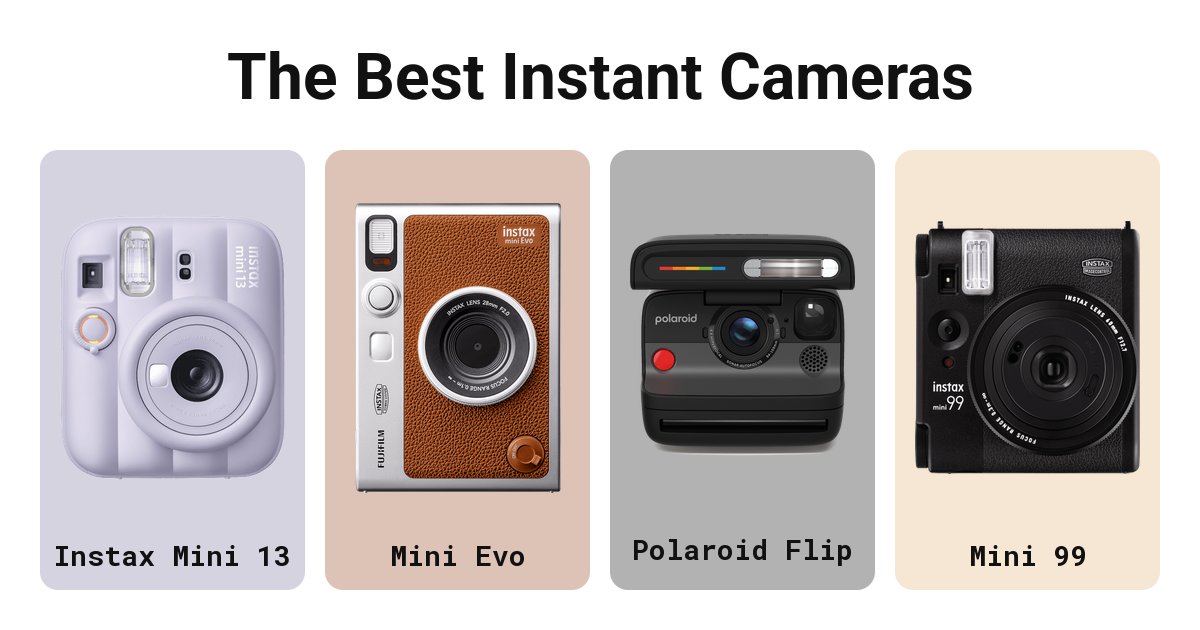
The Instax Mini 13 is the best instant camera for most people: $79.95, one button, a self-timer, and film at about $0.91 a shot. Six other picks below.
The cameras below run from $79.95 to $210 and use five different film sizes. Film is a running cost on top of the camera, so each pick says what a shot costs as well as what the camera does.
Best overall: Instax Mini 13
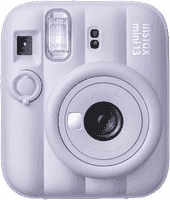
Instax Mini 13Best overall
Street price: $79.95 (list $93.95)
Amazon rating: 4.5 out of 5 (19 ratings)
Pros
- twist-the-lens operation is easy for kids and first-timers
- new 2 s and 10 s self-timer plus the wedge stand make group shots practical
- close-up mode framing matches the selfie mirror closely
Cons
- flash fires on every shot and cannot be switched off
- no tripod socket and no double-exposure mode
- nothing new for anyone who already owns a Mini 11 or Mini 12
The Mini 13 is the camera to buy if you want instant photos without learning anything. Twist the lens to turn it on, look through the viewfinder, press the one button. Exposure is automatic. Two AA batteries last about 100 shots, and you can buy AAs anywhere.
What it adds over the Mini 12 is a self-timer. Twist the ring around the shutter button once for 2 seconds, or twist and hold for 10. The wrist strap folds into a wedge that tilts the camera up, so a group shot on a table actually works. The close-up mode corrects for parallax, which means a selfie lands where the mirror shows it.
You give up control. The flash fires on every shot and cannot be turned off. There is no tripod socket, no double exposure and no way to brighten or darken a picture. If you want those, the Mini 99 below has all of them.
It was $79.95 on Amazon on October 5, 2026, and it uses the cheapest film on this list at about $0.91 a shot. The Amazon rating is 4.5 from only 19 ratings, too few to mean much, so lean on the reviews instead. PCMag’s Jim Fisher gave it 4 out of 5 and called it the quintessential entry-level instant camera.
If the Mini 13 is out of stock, the Mini 12 is the same camera without the timer. It was $82.94 that day, $2.99 more, and holds 4.6 from 1,554 ratings. We compare the two in Instax Mini 12 vs Mini 13, and the older models in Mini 11 vs Mini 12 and Mini SE vs Mini 12.
Best hybrid: Instax Mini Evo
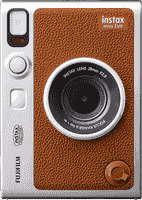
Instax Mini EvoBest hybrid
Street price: $199.00 (list $234.95)
Amazon rating: 4.6 out of 5 (2,008 ratings)
Pros
- 100 lens/film effect combinations make it feel like a real creative tool
- can review and choose which shots to print, so no wasted film
- retro dial-and-lever design feels premium
Cons
- photos look noticeably more digital/lower-resolution than analog Instax prints
- printing is slow if you shoot a lot
- no optical viewfinder
The Mini Evo takes a digital photo first. You look at it on the 3.0-inch screen, and only the shots you like go onto Instax Mini film. On a pure film camera every missed frame costs you about $0.91. On the Evo, a missed frame costs nothing.
It also gives you more to play with than any analog Mini. There are 10 lens effects and 10 film effects, which makes 100 combinations, plus exposure compensation of plus or minus 2 stops. It focuses automatically from 10 cm, and the flash can be switched off. The internal memory holds about 45 shots and a microSD card holds more. A print takes about 16 seconds, and one charge covers about 100 shots.
The trade is the look. Reviewers and buyers agree the prints come out flatter and more digital than an analog Instax print, because the picture comes from a small sensor rather than from light hitting the film. There is no optical viewfinder, and it charges over micro-USB rather than USB-C.
At $199 it costs $119.05 more than the Mini 13. Buyers rate it 4.6 out of 5 across 2,008 ratings, the largest count of any camera on this page, and TechRadar calls it its favorite hybrid instant camera.
We picked it over the analog Mini 99 in Instax Mini 99 vs Mini Evo, since the two were $9.95 apart and the Evo saves that much in about 11 shots of film. Against the LiPlay+, which has a rear selfie camera, see Mini Evo vs LiPlay.
Best Polaroid: Polaroid Flip
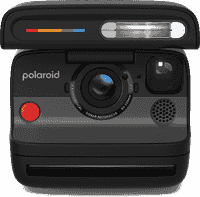
Polaroid FlipBest Polaroid
Street price: $210.00 (list $199.99)
Amazon rating: 4.7 out of 5 (8 ratings)
Pros
- sonar autofocus produces sharp shots without effort
- the flip-up lid protects the lens and switches the camera off
- exposure compensation, self-timer and double exposure work without a phone
Cons
- film cost, about $2.37 a shot
- no lens filters or external flash support
- cannot focus close enough for a frame-filling selfie
The Flip is the Polaroid to buy if you want the big, square-ish print with the white frame. Its i-Type print is 107 x 88 mm, the largest on this list, and it also takes Polaroid 600 film.
Polaroid film costs about $2.37 a shot, so the camera that wastes the fewest frames is the one worth paying for. That is where the Flip earns its price. It focuses with sonar across four distance zones, where the Polaroid Now uses two. A light in the viewfinder warns you before a shot comes out too bright or too dark. The flash is the most powerful Polaroid has made and adjusts its output to the distance, out to 4.5 m. On the body you get exposure compensation of plus or minus 1, a self-timer and double exposure. The app adds full manual control and a bulb mode. The flip-up lid covers the lens and doubles as the power switch, and the battery lasts about 120 shots and charges over USB-C.
The downsides are size and close-ups. It weighs 648 g, and it cannot focus closer than 0.4 m, so a frame-filling selfie is out. The flash switches itself on every time you open the lid, which can overexpose a bright scene.
It was $210 on Amazon on October 5, 2026, above Polaroid’s $199.99 list price. PCMag made it its Editors’ Choice for i-Type cameras and called it the best instant camera Polaroid has made to date. In Polaroid Flip vs Polaroid Now, the $80 gap to the Now worked out at about 34 shots of film, and the Flip won.
Best for creative control: Instax Mini 99
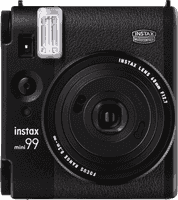
Instax Mini 99Best for creative control
Street price: $189.05 (list $199.95)
Amazon rating: 4.6 out of 5 (182 ratings)
Pros
- six color-effect filters and brightness dial give real creative control
- solid, premium-feeling build
- double exposure and bulb mode are rare on an analog Instax
Cons
- expensive next to the Mini 12/41
- color effects can be gimmicky for casual shooters
The Mini 99 is the Instax for someone who wants to steer the picture and still get a real analog print. It has five shooting modes: Normal, Indoor, Sports, Double Exposure and Bulb, with bulb exposures up to 10 seconds. A dial sets brightness across five levels. Six color-effect filters tint the print with light inside the camera, and the flash can be set to auto, fill-in, red-eye reduction or off. Focus has three zones, from macro at 0.3 m out to landscape.
There is also a tripod socket and a self-timer, and a rechargeable NP-70S battery replaces AAs, rated at about 100 shots. Two shutter buttons, one for upright and one for sideways shots, make it easier to hold either way. At 305 g it is lighter than the Mini 13.
It was $189.05 on October 5, 2026, which is $109.10 more than the Mini 13 for the same Instax Mini film at $0.91 a shot. Buyers rate it 4.6 out of 5 across 182 ratings. Digital Camera World said it offers the most advanced controls yet on an Instax camera. The color effects can feel fussy if you just want to point and shoot.
If you are torn between this and the Mini Evo, our Mini 99 vs Mini Evo page leans to the Evo for most people, and to the Mini 99 if a true film print matters more than choosing what prints. Against the cheaper, fully automatic Mini 41, see Mini 41 vs Mini 99.
Best pocket camera: Polaroid Go Generation 3
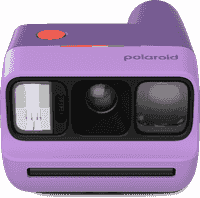
Polaroid Go Generation 3Best pocket camera
Street price: $82.00 (list $89.99)
Amazon rating: 3.8 out of 5 (224 ratings)
Pros
- genuinely pocket-sized
- Go film is much cheaper per shot than i-Type
- selfie mirror and stronger flash make selfies work
Cons
- prints blow out in bright sunlight
- flash turns itself back on for every shot
- no tripod thread despite having a self-timer
The Go Generation 3 is the instant camera that fits in a jacket pocket. It weighs 252 g and measures 106.5 x 83.8 x 64.6 mm, the smallest instant camera you can buy. It takes its own Go film, which is not interchangeable with i-Type or 600.
Go film is the reason to look at it if you like the Polaroid look. A double pack of 16 shots was $21.79 in September 2026, about $1.36 a shot against $2.37 for full-size i-Type. The print is smaller at 66.6 x 53.9 mm, with a 47 x 46 mm picture. It has a selfie mirror, a self-timer and double exposure, a new 63.75 mm lens that improves selfies over the Generation 2, and a USB-C battery rated at about 120 shots. Digital Camera World found it gave the most consistent results of any Go.
It has real flaws. It overexposes easily in strong sun; TechRadar warned that bright scenes can be overexposed “to near-oblivion.” The flash goes back on before every frame even after you switch it off. Focus is fixed, there is no tripod socket, and there is no exposure control. Buyers rate it 3.8 out of 5 across 224 ratings, lower than the Generation 2’s 4.2, so treat that as a caution.
It was $82 on October 5, 2026. Pick it for size. If size does not matter, our Polaroid Go vs Instax Mini 12 comparison chose the Instax for its cheaper film, and Polaroid Go vs Polaroid Now chose the Now for its full-size print.
Best for big prints: Instax Wide 400
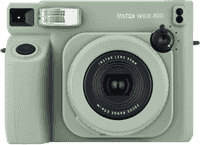
Pros
- large wide-format prints are great for group shots and events
- self-timer and angle-adjustment accessory are useful additions over the Wide 300
Cons
- very large and heavy to carry around
- no selfie mirror despite the size
The Wide 400 is for group photos, weddings and anything where a Mini print feels too small. Instax Wide prints are 86 x 108 mm with a 62 x 99 mm picture, twice the area of a Mini print.
It is set up for those shots. The self-timer and tripod socket let you join the group, and an angle-adjustment accessory in the box tilts the camera on a table. A close-up lens accessory brings focus down to 0.4 to 0.5 m. Otherwise it is point-and-shoot: automatic exposure, a flash that fires on its own, and four AA batteries for about 100 shots.
The cost is bulk. It weighs 616 g and measures 162 x 98 x 123 mm, and there is no selfie mirror. Normal focus starts at 0.9 m. Digital Camera World called it a clear improvement on the Wide 300 but still as big as ever. Buyers rate it 4.0 out of 5 across 331 ratings.
It was $149.95 on October 5, 2026, the same as Fujifilm’s list price. Wide film costs about $1.40 a shot when bought as a five-pack of 100 shots for $139.95. That is less per shot than Instax Square and well under Polaroid i-Type.
Instax Wide 300 vs Wide 400 explains what the self-timer and accessory add over the older model. Instax Wide Evo vs Wide 400 chose the Wide 400 over the $365.89 hybrid, since the gap buys about 154 shots of film.
Best square format: Instax Square SQ1
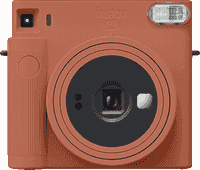
Instax Square SQ1Best square format
Street price: $199.95 (list $119.95)
Amazon rating: 4.6 out of 5 (677 ratings)
Pros
- square format prints feel more premium than Mini prints
- simple point-and-shoot operation
- compact for a Square-format camera
Cons
- no self-timer, unlike the discontinued SQ6
- square film costs $1.57 a shot, more than Mini or Wide
- street price was well above Fujifilm's $119.95 list price in October 2026
The SQ1 makes square pictures, 62 x 62 mm on an 86 x 72 mm print. That sits between Mini and Wide in size, and many people simply prefer the shape. It works like the Mini 13: twist the lens to turn it on, twist again for selfie mode, and the exposure is automatic. There is a selfie mirror, and a pair of CR2 lithium batteries lasts about 300 shots.
It is plain in the ways the other Instax picks are not. There is no self-timer, which the discontinued SQ6 had, no manual control, and the flash always fires. Square film is the most expensive Instax film at about $1.57 a shot ($31.40 for a twin pack of 20), more than Wide.
Check the price before you buy. It was $199.95 on Amazon on October 5, 2026, $80 above Fujifilm’s $119.95 list price. At that price it costs about the same as the Mini Evo. If it drops back toward list, it is the easiest way into square instant photos.
Buyers rate it 4.6 out of 5 across 677 ratings. DPReview found it fun for photographers and non-photographers alike. The SQ40 uses the same lens and film in a plainer black body; it was $200 that day, weighs 453 g against 390 g, and holds 4.4 out of 5 across 401 ratings. Our Instax Square SQ1 vs SQ40 comparison picked the SQ1.
Instax or Polaroid?
Pick Instax if you care most about cost and consistency. Pick Polaroid if you want the bigger print and the classic white frame, and accept paying more per shot.
The gap in film cost is large: $0.91 a shot for Instax Mini against $2.37 for Polaroid i-Type, with Polaroid Go at $1.36 in between. The table below has the full set.
The print is where Polaroid wins. An i-Type print is 107 x 88 mm with a 79 x 77 mm picture. An Instax Mini print is 86 x 54 mm with a 62 x 46 mm picture. Instax Wide closes the size gap at $1.40 a shot.
Polaroid film is also fussier. Color i-Type shifts toward cyan in the cold and toward red in the heat, and at $2.37 a frame a bad exposure hurts. That is why the Flip’s warning light and distance-aware flash matter. Our Instax vs Polaroid page covers this in full, and Polaroid i-Type vs 600 film explains the two film types the Flip accepts.
Film size and cost per shot compared
| Film | Print size | Picture size | Cost per shot | 100 shots | Picks that use it |
|---|---|---|---|---|---|
| Instax Mini | 86 x 54 mm | 62 x 46 mm | $0.91 | $91 | Mini 13, Mini Evo, Mini 99 |
| Polaroid Go | 66.6 x 53.9 mm | 47 x 46 mm | $1.36 | $136 | Go Generation 3 |
| Instax Wide | 86 x 108 mm | 62 x 99 mm | $1.40 | $140 | Wide 400 |
| Instax Square | 86 x 72 mm | 62 x 62 mm | $1.57 | $157 | Square SQ1 |
| Polaroid i-Type | 107 x 88 mm | 79 x 77 mm | $2.37 | $237 | Flip |
Prices are regular Amazon prices checked October 5, 2026, except Polaroid Go film, checked September 10, 2026. The 100-shot column is each film’s per-shot cost times 100.
Instax Mini is the cheapest film by a wide margin, and three of the seven picks use it. Wide film costs less per shot than Square because it sells in a five-pack of 100 shots. For a side-by-side of the three Instax formats, see Instax Mini vs Square vs Wide.
Film camera or hybrid?
A film camera like the Mini 13 or the Flip exposes the film directly through the lens. Every press of the button makes a print, good or bad, and the print is the only copy. A hybrid like the Mini Evo takes a digital photo, lets you review it, and prints only what you choose. You also keep a digital copy.
The hybrid saves film and adds effects, at the cost of a flatter print. If the look of the print is the point, buy a film camera.
There is a third route. A Mini 13 and an Instax Mini Link 3 phone printer cost $179.90 together on October 5, 2026, $19.10 less than the Mini Evo. That gives you a true film camera and a way to print your phone photos on the same film. We weigh this up in Instax printer vs camera.
What about Kodak?
Kodak’s instant cameras, such as the Smile and the Printomatic, print on Zink paper, which needs no ink or film. Prints are sticky-backed and cost about $0.49 each at September 2026 paper prices, cheaper than any film on this page.
We left them off this list because of print quality. The reviews in our Kodak records describe Zink prints as washed out, pink-tinted or closer to a photocopy than a photo, and quality drops further indoors. For a sticker camera for a child, that may not matter. For something that looks like an instant photo, it does.
See Kodak vs Polaroid and Instax vs Zink for the details, and our best instant print camera guide for the Kodak models worth buying.
How we chose
We have not tested most of these cameras in person yet. The picks come from each product’s published specs, prices and Amazon ratings checked on October 5, 2026, and from named professional reviews, including PCMag, PetaPixel, TechRadar, Digital Camera World and DPReview. Our method is on the How We Test page.
Several big lists put the Mini Evo first, among them The Verge and Tom’s Guide. We put the Mini 13 first because it costs $119.05 less, makes a true film print, and our own Mini 12 vs Mini 13 comparison already recommends it. The Evo is still here as the hybrid pick. We chose the SQ1 over the SQ40 for square, matching our comparison of the two.
Two cameras that appear on other lists are left out. The Instax Mini Evo Cinema was $389 with 3.7 out of 5 from 23 ratings, and reviewers called its picture quality, battery life and speed poor for the money. The Polaroid Go Generation 2 has been replaced by the Generation 3. The Mini 12 is not a separate pick because the Mini 13 does everything it does, plus the timer, for less.
For more focused lists, see the best Polaroid camera, the best Instax camera and the best cheap instant camera.
At a glance
| Model | Pick | Street price | Film | Cost per shot | Print size | Amazon rating |
|---|---|---|---|---|---|---|
| Instax Mini 13 | Best overall | $79.95 | Instax Mini | $0.91 | 86 x 54 mm | 4.5 (19 ratings) |
| Instax Mini Evo | Best hybrid | $199.00 | Instax Mini | $0.91 | 86 x 54 mm | 4.6 (2,008 ratings) |
| Polaroid Flip | Best Polaroid | $210.00 | Polaroid i-Type (also takes Polaroid 600) | $2.37 | 107 x 88 mm | 4.7 (8 ratings) |
| Instax Mini 99 | Best for creative control | $189.05 | Instax Mini | $0.91 | 86 x 54 mm | 4.6 (182 ratings) |
| Polaroid Go Generation 3 | Best pocket camera | $82.00 | Polaroid Go | $1.36 | 66.6 x 53.9 mm | 3.8 (224 ratings) |
| Instax Wide 400 | Best for big prints | $149.95 | Instax Wide | $1.40 | 86 x 108 mm | 4.0 (331 ratings) |
| Instax Square SQ1 | Best square format | $199.95 | Instax Square | $1.57 | 86 x 72 mm | 4.6 (677 ratings) |
Prices and ratings checked October 5, 2026.
Frequently asked questions
Which brand is best for instant cameras?
Fujifilm's Instax for most people. Instax Mini film costs about $0.91 a shot against $2.37 for Polaroid i-Type, and the cameras set their own exposure reliably. Choose Polaroid if you want the larger 107 x 88 mm print and the classic white frame.
Is Instax better than Polaroid?
Instax is cheaper to run and more consistent. Polaroid gives you a bigger print: 107 x 88 mm on i-Type film against 86 x 54 mm on Instax Mini. Our Instax vs Polaroid comparison goes through the trade-offs in detail.
Is Instax or Kodak better?
Instax, for print quality. Kodak's Zink cameras cost less per print, about $0.49, but the reviews in our records describe the prints as washed out or photocopy-like next to real instant film.
Why is Instax so much cheaper than Polaroid?
Per shot, Instax Mini film was $0.91 and Polaroid i-Type $2.37 at regular Amazon prices on October 5, 2026. A Polaroid i-Type pack holds 8 shots for $18.99, and an Instax Mini twin pack holds 20 for $18.17.
What is a good quality instant camera?
For film quality with control, the Instax Mini 99 or the Polaroid Flip. For simple, consistent results, the Instax Mini 13.
Related reading
- Instax vs Polaroid: Which Instant Camera Should You Buy? (2026)
- Instax Mini vs Square vs Wide: Which Film Size Should You Choose? (2026)
- Instax Mini 12 vs Mini 13: Which Should You Buy? (2026)
- Polaroid Flip vs Polaroid Now and Now+: Which Should You Buy? (2026)
- Best Polaroid Camera 2026: Every Current Model Ranked