
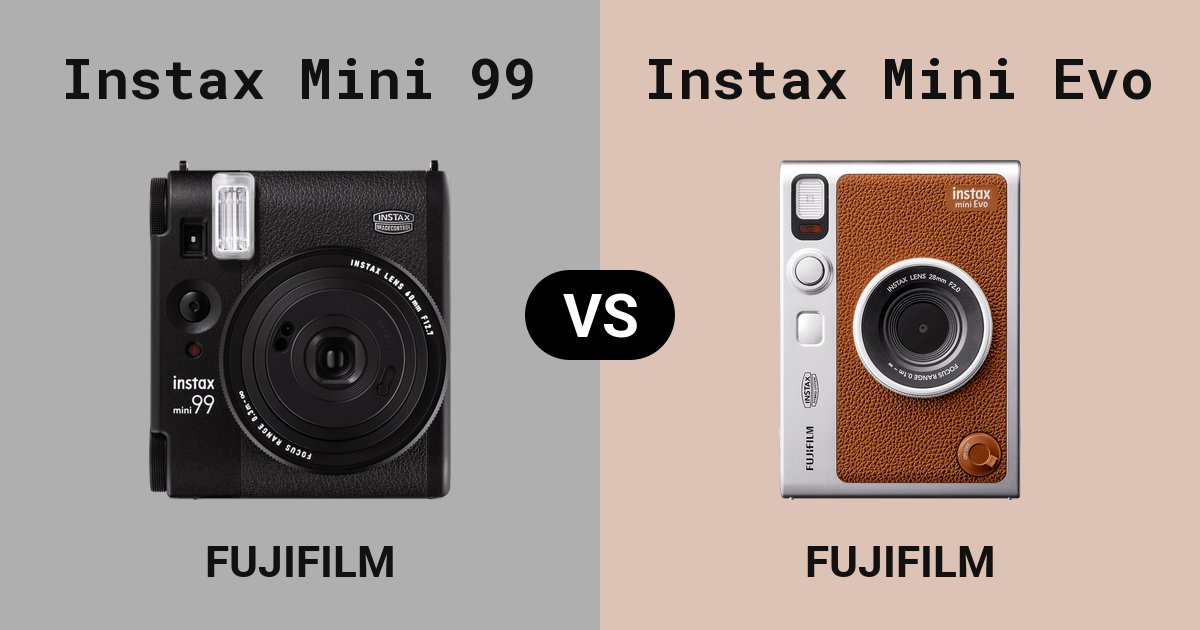
The Mini 99 shoots straight to film and the Mini Evo shoots digitally first, then prints only the frames you pick. The Evo is the one to buy, because at $0.88 a shot the film it saves pays back the $56.82 it costs more.
Fujifilm sells the Instax Mini 99 and the Instax Mini Evo at the top of the Mini range. The Mini 99 arrived in 2024, the Mini Evo in 2021. They print on the same film and work in completely different ways.
What is actually different
The Mini 99 is analog. Light goes through the 60 mm f/12.7 lens and lands on the film, so every press of the shutter costs a frame whether the picture is any good or not. Focus is set in three zones: macro from 0.3 to 0.6 m, standard from 0.6 to 3.0 m, landscape from 3.0 m to infinity. The shutter runs from 1.8 seconds to 1/400, with a bulb mode that holds for up to 10 seconds. A brightness dial moves exposure across five levels, L+, L, N, D and D-. The shooting modes are Normal, Indoor, Sports, Double Exposure and Bulb, and there is a tripod socket. The only screen is a small LCD showing the shooting mode and the film counter.
The Mini Evo is a hybrid, which means it is a digital camera that prints. It takes the picture with a sensor and shows it on a 3.0-inch colour LCD of about 460,000 dots. Nothing comes out of the camera until you decide it should. Pictures sit in internal memory, about 45 of them, or on a microSD card, and you print the ones you want at 318 dpi. A print takes 16 seconds, and a charge covers about 100 of them. The Evo connects over Bluetooth to the instax mini Evo app. Its autofocus works from 10 cm, its shutter runs from 1/4 to 1/8000 second, and exposure compensation goes from -2.0 to +2.0 EV.
On the Mini 99 you pay for every frame you shoot. On the Evo you pay only for the frames you choose to print.
Both cameras have effects, added at opposite ends of the process. The Evo has a ring around the lens for 10 lens effects and a dial on top for 10 film effects, which gives 100 combinations, applied to the digital file before it prints. The Mini 99’s effects are optical: six colour filters applied inside the camera as the film is exposed. PCMag’s Jim Fisher describes the Mini 99 as analog with internal lights that add optical filter effects to instant snaps.
The Mini 99 has double exposure, a bulb mode and a tripod socket. The Evo has none of those, and no optical viewfinder either. TechRadar calls the Evo its favourite hybrid instant camera, while noting that the digital-first approach and the missing optical viewfinder might put off fans of true analogue photography. Digital Camera World’s line was that if you want one instant print camera that does it all, and you are satisfied with the digital-looking photographs, the Evo has much to recommend it. On the Mini 99, the same site said it offers the most advanced controls yet on an Instax camera.
The bodies are close in size. The Mini 99 weighs 305 g and comes in Black and Silver. The Evo weighs 285 g and comes in Black and Brown. Both run about 100 shots per charge, the Mini 99 on an NP-70S pack and the Evo on a built-in cell charged over Micro-B USB.
Price and film cost
At the last price check, on September 9, 2026, the Mini 99 was $177.18 and the Mini Evo was $234. The list prices are $199.95 and $234.95. The gap is $56.82.
Both take Instax Mini film, 86 x 54 mm with a 62 x 46 mm image, at about $0.88 a shot. A twin pack of 20 shots was $17.50 on the same date. That makes the price gap worth about 65 frames of film. If you would throw away one shot in three on the Mini 99, the Evo has paid back the difference before you reach 200 pictures. Shoot carefully and the Mini 99 stays the cheaper camera for longer.
Which one to buy
Buy the Mini Evo if you want to see the picture before you spend film on it. Film goes further because you print only the shots you pick. It holds about 45 pictures internally and more on a card, and the two dials give 100 effect combinations. Amazon buyers rate it 4.6 out of 5 across 2,600 ratings. Accept that the prints look more digital than an analog Instax, and that there is no optical viewfinder.
Buy the Mini 99 if you want a real analog print and controls to go with it. Its brightness dial, colour filters, double exposure, 10-second bulb mode and tripod socket are all missing from the Evo, which costs $56.82 more. Buyers rate it 4.6 out of 5 across 178 ratings.
Where to buy
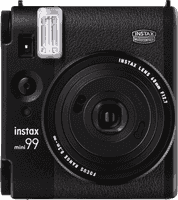 Instax Mini 99$177.18 (list $199.95)Check price on Amazon
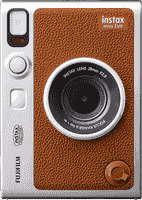 Instax Mini Evo$234.00 (list $234.95)Check price on Amazon
Specs side by side
Same on both: Current · Instax Mini film · 86 x 54 mm print · 62 x 46 mm image · $0.88 a shot · selfie mirror · self timer · Shots per battery / prints per charge: 100.
| Spec | Instax Mini 99 | Instax Mini Evo |
|---|---|---|
| Type | Analog instant camera | Hybrid instant camera |
| Launched | 2024 | 2021 |
| Lens | retractable, 60 mm f/12.7, 2 components 2 elements | 28 mm equivalent, 10 cm and beyond |
| Focus | macro 0.3-0.6 m, standard 0.6-3.0 m, landscape 3.0 m to infinity | autofocus, 10 cm and beyond |
| Exposure | programmed electronic, 5 brightness levels (L+, L, N, D, D-) | programmed AE, ISO 100-1600 automatic, -2.0 to +2.0 EV compensation |
| Shutter | 1.8 to 1/400 s, bulb mode up to 10 s | 1/4 to 1/8000 s automatic |
| Flash | automatic, fill-in, red-eye removal or off; effective range 0.3 to 2.7 m | auto / forced / suppressed, range approx. 50 cm to 1.5 m |
| Close-up mode | Yes | No |
| Double exposure | Yes | No |
| Bulb mode | Yes | No |
| Tripod socket | Yes | No |
| Manual modes | Normal, Indoor, Sports, Double Exposure, Bulb | 10 lens effects, 10 film effects, white balance, exposure compensation |
| Power | 1 x NP-70S rechargeable Li-ion | internal Li-ion, USB (Micro-B) charging |
| Print resolution | n/a | 318 dpi |
| Print time | n/a | 16 s |
| Connectivity | n/a | Bluetooth (smartphone app) |
| App | n/a | instax mini Evo app |
| Screen | LCD shooting-mode and film-counter indicator | 3.0-inch TFT color LCD, approx. 460,000 dots |
| Storage | n/a | internal memory (approx. 45 images) plus microSD/microSDHC |
| Dimensions | 103.5 x 117.5 x 60 mm | n/a |
| Weight | 305 g | 285 g |
| Colours | 2 (Black, Silver) | 2 (Black, Brown) |
| Street price | $177.18 (checked September 9, 2026) | $234.00 (checked September 9, 2026) |
| Amazon rating | 4.6 (178 ratings) | 4.6 (2,600 ratings) |
| Buy | Check price on Amazon | Check price on Amazon |
Specs from manufacturer pages; prices and ratings checked September 9, 2026.
What reviewers and buyers say
Instax Mini 99
Published reviews of the Instax Mini 99:
- “The Instax Mini 99 shines in both form and function, with a decent range of creative controls that are accessible and fun to use.” (Tom's Guide, 2024)
- “The Instax Mini 99 is an impressive, 'grown-up' addition to the Instax family whose manual shooting options give more seasoned photographers room for creative experimentation.” (TechRadar, 2024)
- “The Mini 99 takes Fujifilm's instant cameras to new creative heights, offering the most advanced controls yet alongside the most ways to have fun with any Instax camera so far.” (Digital Camera World, 2024)
Amazon buyers rate it 4.6 out of 5 across 178 ratings.
Praised for: six color-effect filters and brightness dial give real creative control, solid, premium-feeling build, double exposure and bulb mode are rare on an analog Instax. Criticised for: expensive next to the Mini 12/41, color effects can be gimmicky for casual shooters.
Instax Mini Evo
Published reviews of the Instax Mini Evo:
- “If you're looking for one instant print camera that does it all, and you're satisfied with the digital-looking photographs from the device itself, the Instax Mini Evo has much to recommend it.” (Digital Camera World, 2022)
- “The Mini Evo is our favorite hybrid instant camera, putting fun first, though its digital-first approach and lack of optical viewfinder might put off fans of true analogue photography.” (TechRadar, 2022)
- “The Instax Mini Evo is a strong contender for the best instant camera for beginners thanks to its blend of digital control and analog instant prints.” (Amateur Photographer, 2022)
- “The Mini Evo is a genuinely fun hybrid camera that lets you shoot digitally, pick your favorite shots, and only print the ones worth keeping.” (Casual Photophile, 2022-11)
Amazon buyers rate it 4.6 out of 5 across 2,600 ratings.
Praised for: 100 lens/film effect combinations make it feel like a real creative tool, can review and choose which shots to print, so no wasted film, retro dial-and-lever design feels premium. Criticised for: photos look noticeably more digital/lower-resolution than analog Instax prints, printing is slow if you shoot a lot, no optical viewfinder.
Frequently asked questions
What is the difference between the Instax Mini 99 and the Instax Mini Evo?
The Mini 99 is analog and the Mini Evo is a hybrid. The Mini 99, from 2024, exposes Instax Mini film directly through a 60 mm f/12.7 lens, so every shutter press costs a frame. The Mini Evo, from 2021, records the picture digitally, shows it on a 3.0-inch screen and prints only the frames you choose, at 318 dpi in about 16 seconds. Both use the same Instax Mini film at about $0.88 a shot.
Is the Instax Mini Evo worth it over the Mini 99?
For most people, yes. At the last check the Mini Evo was $234 and the Mini 99 was $177.18, a gap of $56.82, which is about 65 shots of Instax Mini film at $0.88 each. Because the Evo prints only the pictures you pick, it covers that gap inside 200 shots if you would have binned one frame in three on the Mini 99. Amazon buyers rate the Evo 4.6 out of 5 across 2,600 ratings and the Mini 99 4.6 out of 5 across 178 ratings.
Do the Instax Mini 99 and Mini Evo use the same film?
Yes. Both take Instax Mini film, which prints 86 x 54 mm with a 62 x 46 mm image and costs about $0.88 a shot. A twin pack of 20 shots was $17.50 at the last check, on September 9, 2026.
Which one takes better pictures?
The Mini 99 makes a true analog print, with the light from its 60 mm f/12.7 lens landing on the film, and Digital Camera World said it offers the most advanced controls yet on an Instax camera. The Mini Evo prints a digital file at 318 dpi, and reviewers and buyers both note that its pictures look flatter and more digital than an analog Instax print. The Mini 99 also has double exposure, a bulb mode up to 10 seconds and a tripod socket, none of which the Evo has.
Related comparisons
- Instax Mini 41 vs Mini 99: Which Should You Buy? (2026)
- Instax Mini Evo vs Mini LiPlay: Which Should You Buy? (2026)
- Instax Mini 11 vs Mini 12: Which Should You Buy? (2026)
- Polaroid Flip vs Polaroid Now and Now+: Which Should You Buy? (2026)
- Polaroid Now Gen 2 vs Gen 3: What Changed and Which to Buy (2026)