
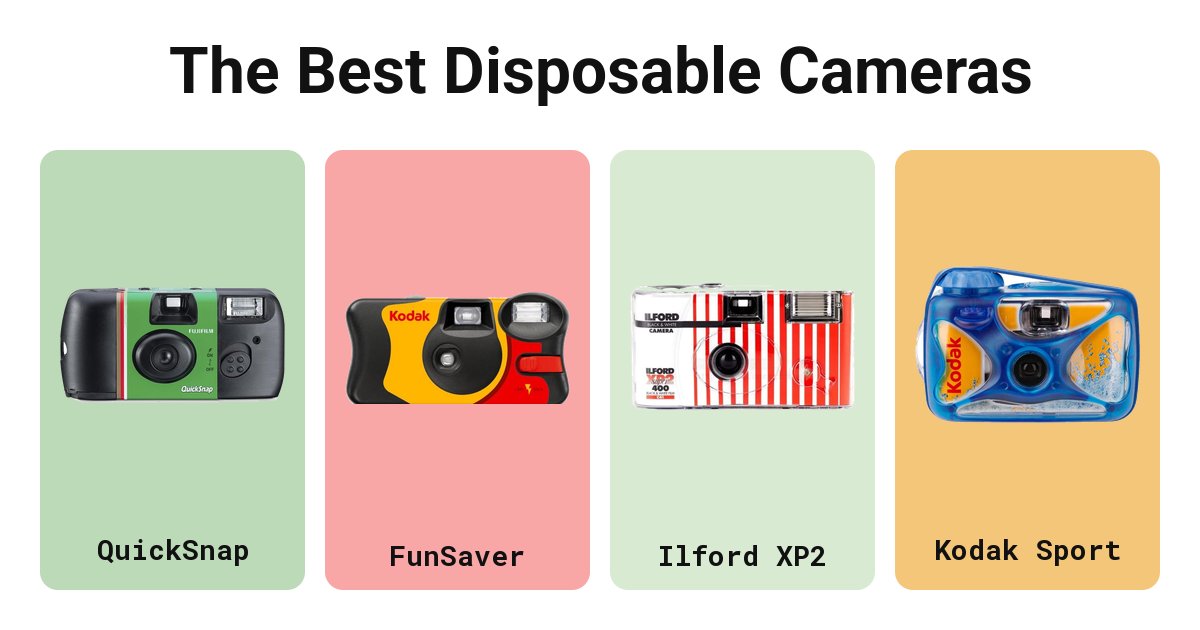
The Fujifilm QuickSnap Flash 400 is the best disposable camera for most people: about $20, a flash that stays on, and about $1.35 a shot once developed. Here is what each pick really costs.
Every camera here costs $19.49 to $29.99 at the October 2026 check, and every one costs about as much again to develop. So where we can, each pick gives two numbers: the camera price, and the cost per shot once a lab has developed and scanned the roll. All six take 27 pictures.
The short answer
| Camera | Film | Flash | Camera price | Per shot, developed |
|---|---|---|---|---|
| Fujifilm QuickSnap Flash 400 | Colour, ISO 400 | Stays on, 1 to 3 m | $19.49 | $1.35 |
| Kodak FunSaver | Colour, ISO 800 | Charge before each shot, 1.2 to 3.5 m | $22.84 | $1.48 |
| Ilford XP2 Super | Black and white (C-41), ISO 400 | Charge before each shot | $26.98 | $1.63 |
| Kodak Tri-X 400 | Black and white, ISO 400 | Stays on, 1.2 to 4.5 m | $29.99 | Needs a black-and-white lab |
| Kodak Sport | Colour, ISO 800 | None | $25.99 | $1.59 |
| Lomography Simple Use | Black and white, ISO 400 (reloadable) | Charge before each shot, about 2 m | $19.90 | Needs a black-and-white lab |
Camera prices are single cameras on Amazon at the October 2026 check (October 14). “Per shot, developed” adds $17 for developing with standard scans at The Darkroom, a mail-in lab, then divides by 27. Return shipping is not included because The Darkroom does not list it. The Tri-X and the black-and-white Lomography need a traditional black-and-white lab, and we did not check that price.
Best overall: Fujifilm QuickSnap Flash 400
Fujifilm QuickSnap Flash 400Best overall
Street price: $19.49
Amazon rating: 4.5 out of 5 (1,062 ratings)
Pros
- the cheapest big-brand disposable with a flash
- small and light, at 90 g
- the flash can be left on, with no button to hold before each shot
Cons
- cooler colour than Kodak's FunSaver
- ISO 400 film needs more light than the ISO 800 rivals
- shorter flash range than the Kodak cameras
If you are not sure which disposable to buy, buy the QuickSnap. It was $19.49 at the October 2026 check, the cheapest big-brand disposable with a flash. With The Darkroom’s $17 developing and scans, that comes to about $1.35 a shot.
It wins on the flash. You switch it on at the front and it stays on, recharging by itself. On the FunSaver and the XP2 you press and hold a button before every flash shot, which is easy to forget. Wirecutter made the QuickSnap one of its two top picks, and The Darkroom’s review called it the easiest disposable to use.
It has a 32 mm f/10 plastic lens, fixed focus from 1 m, and ISO 400 colour film. At 90 g it is also lighter than the FunSaver, at 117 g.
The trade-offs come from the film. ISO 400 needs more light than the ISO 800 in the FunSaver, so shade and dim rooms push you onto the flash, and the flash reaches about 3 m. Shoot It With Film found its colour cooler than the FunSaver’s, leaning green and blue. The single-camera listing holds 4.5 stars from 1,062 ratings, and the long-running 2-pack listing 4.7 from 4,100.
Best in low light: Kodak FunSaver
Pros
- simple enough to hand to anyone at a party
- warm Kodak colour
- the flash makes indoor shots possible
Cons
- the flash has to be charged by hand before every flash shot
- soft, lo-fi pictures from the plastic lens
- developing costs about as much as the camera
The FunSaver is the better colour camera when the light is poor. It uses ISO 800 film, twice the speed of the QuickSnap’s, and its flash is rated to 1.2 to 3.5 m against the QuickSnap’s 3 m. It was $22.84 at the October 2026 check, or about $1.48 a shot developed with scans at The Darkroom.
It is also the most-rated disposable on Amazon US, with 4.6 stars from 6,671 ratings. Wirecutter named it a co-top pick with the QuickSnap. Alison Winterroth tested five disposables and picked the FunSaver for warm colour and low light. Shoot It With Film found it felt better made than the QuickSnap and gave warmer colour.
The flash is slower to use. You hold a button until the ready light comes on before each flash shot. The film stock also varies: Kodak lists only “800 speed film”, and reviewers have found Kodak MAX 800 and Kodak Gold 800 in different batches. Digital Camera World said its pictures fall well short of even a cheap phone.
Best black and white: Ilford XP2 Super
Ilford XP2 Super Single Use CameraBest black and white
Street price: $26.98
Amazon rating: 4.3 out of 5 (957 ratings)
Pros
- black and white that any colour lab can develop
- XP2's wide latitude rescues under- and over-exposed frames
- clear plastic front cover protects the lens and label
Cons
- soft, slightly distorted corners
- the flash has to be charged by hand for every flash shot
- dearer than the colour disposables
Buy the XP2 if you want black and white but do not want to hunt for a special lab. Its film, Ilford XP2 Super 400, is made for the colour C-41 process, so any lab or drugstore that takes colour disposables can develop it. Tell the lab it is XP2. It was $26.98 at the October 2026 check, about $1.63 a shot with The Darkroom’s $17 developing and scans.
Wirecutter picked it as the best black-and-white disposable. Shoot It With Film called it one of its favourite disposables and found it sharper than expected, with XP2’s wide exposure latitude saving frames that were too dark or too bright. The same review noted soft, slightly distorted corners from the 30 mm f/9 plastic lens.
The flash works like the FunSaver’s: you charge it by hand for each shot. The Darkroom rated it weak in low light. On Amazon it holds 4.3 stars from 957 ratings, the most of any black-and-white disposable we checked.
Best traditional black and white: Kodak Tri-X 400
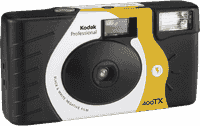
Kodak Tri-X 400 Single Use CameraBest traditional black and white
Street price: $29.99
Amazon rating: 3.8 out of 5 (43 ratings)
Pros
- real Tri-X black-and-white film in a disposable
- the longest flash range of the disposables checked, to 4.5 m
- feels solid for a disposable
Cons
- needs a black-and-white lab, not a drugstore C-41 lab
- developing costs about as much as the camera
- indoor shots without flash come out very underexposed
The Tri-X camera holds Kodak Professional Tri-X 400, a classic black-and-white film with strong grain and contrast. Kodak launched it in December 2021 as its first black-and-white disposable. The Darkroom gave it five stars, and it was Alison Winterroth’s favourite black-and-white disposable.
It also has the best flash here. Kodak’s Power Flash switches on with one touch, recharges by itself, and is rated to 1.2 to 4.5 m, the longest range of any disposable we checked. The lens is 30 mm f/10, and an AA battery comes loaded.
The problem is developing. Tri-X uses the traditional black-and-white process, not C-41, so many drugstores will not take it. The Darkroom says it develops black-and-white disposables, but we did not check its price, so we cannot give a developed cost per shot. Digital Camera World put developing with scans at about the camera’s own price.
Buying it on Amazon is awkward too. The listing we used was $29.99 at the October 2026 check, sold by a third-party seller with a cleaning cloth, and it holds 3.8 stars from only 43 ratings. B&H listed the camera alone at $17 the same day.
The Ilford HP5 Plus Single Use is the alternative, with the same need for a black-and-white lab. It was $29.90 on Amazon with 4.3 stars from 44 ratings.
Best waterproof: Kodak Sport
Pros
- the deepest rating of the waterproof disposables, 15 m
- chunky rubber shell that shrugs off knocks
- big controls that kids can work
Cons
- no flash, so it is for daylight only
- image quality no better than any disposable
- Kodak's own page gives no depth rating
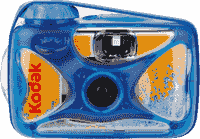
The Kodak Sport is rated to 15 m underwater, the deepest of the two waterproof disposables we checked. It was $25.99 at the October 2026 check, about $1.59 a shot developed with scans at The Darkroom. It holds 4.3 stars from 1,098 ratings.
It has a shock-resistant shell, and with no flash there is no battery to fail in the water. The film is ISO 800 colour, which helps on overcast days. Digital Camera World said you can take it to 15 m underwater, but found the image quality as mediocre as you would expect from a cheap disposable. No flash also means daylight only.
The Fujifilm QuickSnap Waterproof is the alternative. It was $26.89, about $1.63 a shot developed, with 4.3 stars from 2,086 ratings. Fujifilm rates it to 10 m, though its Amazon listing gives two other depths. It also has ISO 800 film and no flash, and underwater your subject needs to be 1 to 3 m away.
Best reloadable: Lomography Simple Use
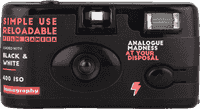
Lomography Simple Use Reloadable Film CameraBest reloadable
Street price: $19.90
Amazon rating: 4.2 out of 5 (134 ratings)
Pros
- cheap way into film that can be reloaded
- small enough to carry anywhere
- colour gels over the flash for tinted shots
Cons
- some rolls come back underexposed or blank
- reloading is fiddly and can break the plastic body
- the flash reaches only about 2 m
The Simple Use is sold as a disposable, but it comes loaded with film and takes any 35 mm roll once that one is done. Pick it if you think one roll will lead to another. The Black & White edition was $19.90 at the October 2026 check with 4.2 stars from 134 ratings.
Editions differ only in the film loaded at the factory: Color Negative 400, Black & White (Lady Grey 400) and three LomoChrome colour-shift films. Lady Grey needs a black-and-white lab, while the Color Negative and LomoChrome editions are C-41 and go to any colour lab.
The flash has yellow, magenta and cyan gels for tinted shots, takes about 15 seconds to recharge and reaches only about 2 m. Digital Camera World tested the Color Negative edition and called it good value, with average sharpness but colour and exposure that hold up well. The complaints are reliability ones: some rolls come back underexposed or blank, and the plastic body can break when you reload it.
Kodak or Fujifilm?
For a colour disposable, the choice is the FunSaver or the QuickSnap. Pick the Kodak for dim rooms and warm colour. Its ISO 800 film and longer flash range give it more room in poor light, and it has far more Amazon ratings. Pick the Fujifilm for ease and price. It cost $3.35 less at the October 2026 check, weighs 27 g less, and its flash stays on.
For a wedding or a party where guests do the shooting, we would hand out QuickSnaps, because nobody has to remember the flash button. Our disposable cameras for weddings guide covers how many to buy and how to get usable pictures.
Cheap disposable cameras and bulk packs
The cheapest big-brand disposable we saw was not on Amazon. Walmart sold a QuickSnap 2-pack for $29.88 at the October 2026 check, $14.94 a camera. Developed at Process One with scans only ($14.98), that is about $1.11 a shot before return shipping, the lowest figure we found.
Bulk packs do not always save money. Some save a few dollars a camera, and some cost more than buying singles:
| Pack on Amazon | Pack price | Per camera | Single camera |
|---|---|---|---|
| Kodak FunSaver, 10 cameras | $179.00 | $17.90 | $22.84 |
| Fujifilm QuickSnap, 10 cameras | $186.00 | $18.60 | $19.49 |
| Kodak Sport, 3-pack | $65.40 | $21.80 | $25.99 |
| Ilford XP2 Super, 2-pack | $61.98 | $30.99 | $26.98 |
| Fujifilm QuickSnap, 20-pack | $540.00 | $27.00 | $19.49 |
All prices are from the October 2026 check (October 14). Several multipacks are third-party bundles, and their prices change often, so work out the price per camera before you buy.
Developing does not get cheaper in bulk. Ten QuickSnaps from the $186 bundle cost another $170 to develop and scan at The Darkroom, $356 in all. Our where to buy disposable cameras guide compares stores and packs.
Disposable or instant?
A disposable looks cheap at $20, but count developing and it costs more per picture than Instax Mini film. Here is the cost per shot with developing, next to instant film:
| What you shoot | Cost per shot |
|---|---|
| QuickSnap from Walmart’s 2-pack, developed and scanned at Process One | $1.11 |
| QuickSnap from Amazon, developed with standard scans at The Darkroom | $1.35 |
| The same, with 4-inch prints from The Darkroom | $1.72 |
| Instax Mini film | $0.91 |
| Polaroid Go film | $1.36 |
| Instax Wide film | $1.40 |
| Instax Square film | $1.57 |
| Polaroid i-Type film | $2.37 |
| Polaroid 600 film | $2.62 |
Instant film prices are regular pack prices, not sales, and do not include the camera. An Instax Mini 13 was $79.95 at the October 2026 check. Against the $1.35 QuickSnap, it saves $0.44 a shot, so it pays for itself after about 182 pictures. Polaroid i-Type and 600 film cost more per shot than any of the developed disposable figures above.
The disposable wins in other ways. There is no camera to buy first, the lab gives you 4x6 prints or scans, and a mail-in lab sends your negatives back. An Instax Mini image is 62 x 46 mm and there is no digital copy. Our disposable camera vs instant camera page covers the whole choice, and best cheap instant camera lists the instant cameras that are cheapest to run.
How to get them developed
Colour disposables, and the XP2, use the C-41 process, which every lab that takes disposables can run. CVS, Walgreens and Walmart still accept them but send the film to an outside lab. CVS says 7 to 10 days and Walmart about 6, and you should not expect your negatives back.
Mail-in labs give you scans and usually return your negatives. At the October 2026 check, The Darkroom charged $17 with standard scans and always returns negatives. Process One charged $5.99 to develop and $8.99 for scans only. Old School Photo Lab charged $25 with round-trip shipping included.
The Kodak Tri-X and the black-and-white Lomography need a lab that runs the traditional black-and-white process. Check before you post them. Our where to develop disposable cameras guide compares drugstores and labs on price, turnaround and negatives.
How we chose
We have not shot these cameras yet. The picks come from each camera’s published specs, prices and Amazon ratings checked on October 14, 2026, and from named reviews, including Wirecutter, Digital Camera World, Shoot It With Film, Alison Winterroth and The Darkroom. Our method is on the How We Test page.
We ranked on how likely each camera is to give a usable roll in the hands of someone who has never used one, then on the full cost once developed. That puts the QuickSnap first for its flash that stays on and its price. We left out reusable 35 mm cameras such as the Kodak M35, which some guides list as disposables but which you have to load with film.
At a glance
| Model | Pick | Street price | Film | Cost per shot (before developing) | Exposures | Amazon rating |
|---|---|---|---|---|---|---|
| Fujifilm QuickSnap Flash 400 | Best overall | $19.49 | 35mm colour, ISO 400 | $0.72 | 27 | 4.5 (1,062 ratings) |
| Kodak FunSaver | Best in low light | $22.84 | 35mm colour, ISO 800 | $0.85 | 27 | 4.6 (6,671 ratings) |
| Ilford XP2 Super Single Use Camera | Best black and white | $26.98 | 35mm black and white (C-41), ISO 400 | $1.00 | 27 | 4.3 (957 ratings) |
| Kodak Tri-X 400 Single Use Camera | Best traditional black and white | $29.99 | 35mm black and white, ISO 400 | $1.11 | 27 | 3.8 (43 ratings) |
| Kodak Sport | Best waterproof | $25.99 | 35mm colour, ISO 800 | $0.96 | 27 | 4.3 (1,098 ratings) |
| Lomography Simple Use Reloadable Film Camera | Best reloadable | $19.90 | 35mm black and white, ISO 400 (reloadable) | $0.74 | 27 | 4.2 (134 ratings) |
Prices and ratings checked October 14, 2026.
Frequently asked questions
What is the cheapest way to develop a disposable camera?
Develop only, with no scans or prints, is cheapest: Process One charged $5.99 at the October 2026 check, and $14.98 with scans. Drugstores charge about $15 a roll for prints, but they send the film out and you should not expect your negatives back. Our where to develop disposable cameras guide compares every option.
What ISO are most disposable cameras?
400 or 800. The Fujifilm QuickSnap Flash 400, the Ilford XP2 Super and the Kodak Tri-X are ISO 400. The Kodak FunSaver and both waterproof cameras, the Kodak Sport and the Fujifilm QuickSnap Waterproof, are ISO 800, which copes better in shade and on dull days.
Is Kodak or Fujifilm the better disposable camera?
It depends on the light. The Kodak FunSaver has faster ISO 800 film, warmer colour and a flash rated to 3.5 m, but you charge the flash by hand for each shot. The Fujifilm QuickSnap Flash 400 is cheaper, lighter and has a flash you can leave on. For most people and most parties, we pick the QuickSnap.
Is it cheaper to buy disposable cameras in bulk?
Sometimes, by a few dollars a camera. At the October 2026 check, a 10-camera FunSaver bundle on Amazon worked out at $17.90 a camera against $22.84 for one. Other packs cost more per camera than a single: a 2-pack of Ilford XP2 was $30.99 a camera against $26.98. Developing does not get cheaper in bulk, and at $15 to $17 a camera it costs about as much as the camera.
Are disposable cameras still a thing?
Yes. Fujifilm, Kodak, Ilford and Lomography all still sell them, and Walmart, Target, CVS, Walgreens and Amazon stock them. CVS, Walgreens and Walmart still take them for developing, though they send the film to an outside lab.
What is the highest quality disposable camera?
No lab measures this, and every disposable has a fixed-focus plastic lens. The film makes the biggest difference. Digital Camera World said the FunSaver's pictures fall well short of even a cheap phone. For black and white, Shoot It With Film found the Ilford XP2 sharper than expected, with soft corners.
Related reading
- Where to Develop Disposable Cameras in 2026: CVS, Walmart and Mail-In Labs
- Where to Buy Disposable Cameras in 2026 (and Which Store Is Cheapest)
- Disposable Cameras for Weddings: Real Costs, Common Problems and the Instant Option (2026)
- Disposable Camera vs Instant Camera (Polaroid, Instax): Cost, Wait and Prints Compared
- Cheap Polaroid Instant Camera? 5 Best Budget Picks 2026