
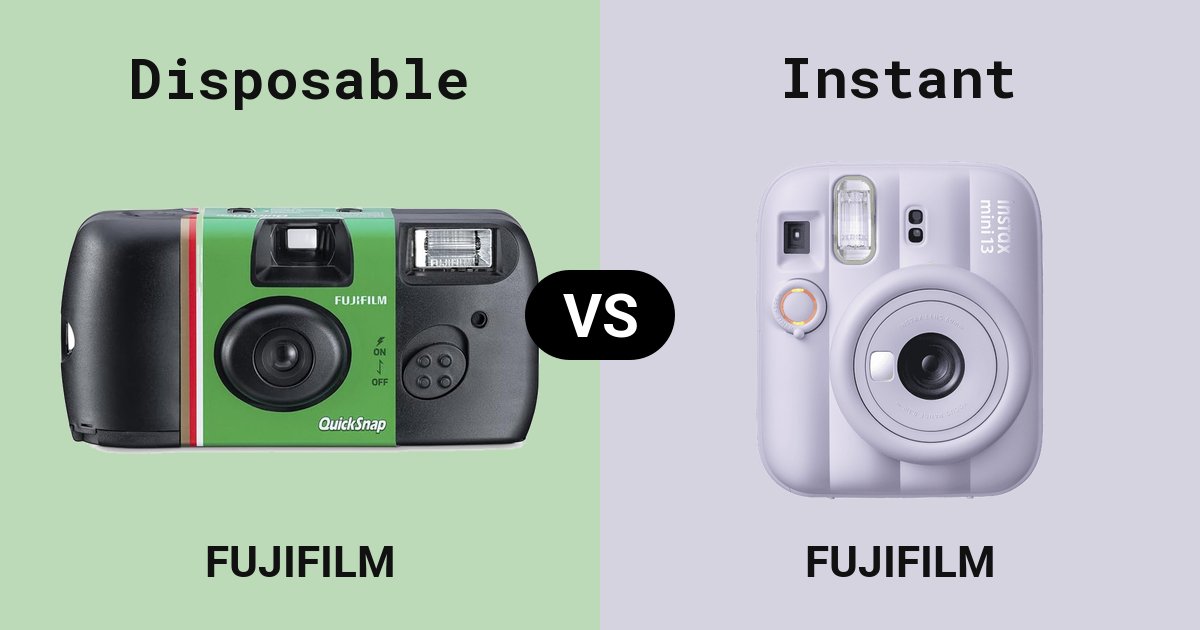
A disposable camera costs about $20 but about $1.35 a shot once developed. Instax Mini film is $0.91 a shot, with a print in your hand in about 90 seconds. Here is which to buy and when.
A disposable camera and an instant camera both give you a photo you can hold. The difference is when and how. A disposable is a roll of 35mm film in a plastic box: you shoot 27 pictures, hand the whole camera to a lab, and get prints or scans days later. An instant camera ejects a print seconds after each shot, the picture develops in front of you, and the camera is yours to keep.
Below, we compare what they cost, how long you wait, what you end up with and when each makes sense. We use the Fujifilm QuickSnap Flash 400 and the Kodak FunSaver for the disposable side, and the Instax Mini 13 and Polaroid Now Generation 3 for the instant side.
The short answer
Buy a disposable for a one-off event or trip, when you want 4x6 prints, scans and negatives, or when you want to hand cameras to several people at once.
Buy an Instax Mini camera if you will shoot more than about 180 pictures, want the print on the spot, or want the cheapest cost per shot.
Buy a Polaroid if you want the larger, near-square print and accept $2.37 a shot.
What is actually different
A disposable holds film that you develop later. Nothing comes out of the camera. When the roll is done, a lab develops the negative, then prints it or scans it, or both. You can order more prints from the negative later.
An instant camera uses film that develops itself. Each press of the shutter makes one print, and that print is your only copy. There is no negative and no file.
Cost per shot, counted honestly
A disposable’s price tag hides most of its cost. You pay for developing on top, and that costs about as much as the camera again. The figures below include developing for the disposable and film only for the instant cameras.
| Disposable (QuickSnap Flash 400) | Instax Mini (Mini 13) | Polaroid i-Type (Now Gen 3) | |
|---|---|---|---|
| Up-front cost | $19.49 a camera | $79.95 camera | $129.99 camera |
| Cost per shot | $1.11 to $1.72 with developing | $0.91 film | $2.37 film |
| Shots per unit | 27 per camera | 10 per pack | 8 per pack |
Prices are from the October 2026 check, on Amazon unless noted. The disposable range runs from a QuickSnap out of Walmart’s 2-pack ($14.94 a camera) developed and scanned at Process One ($14.98), which is $1.11 a shot, to a QuickSnap from Amazon ($19.49) with scans and 4-inch prints from The Darkroom ($27), which is $1.72. With The Darkroom’s standard scans only ($17), it is $1.35. Return shipping from the labs is not included because they do not list it. A Kodak FunSaver ($22.84) with The Darkroom’s scans comes to about $1.48 a shot.
Instant film costs use regular pack prices, never a sale. Instax Wide ($1.40) and Polaroid Go ($1.36) sit level with a developed disposable. Instax Square ($1.57) costs a little more, and Polaroid 600 ($2.62) the most.
So the disposable is cheaper to start, and the Instax Mini is cheaper to keep using. An Instax Mini 13 saves $0.44 a shot against a $1.35 QuickSnap, so the $79.95 camera pays for itself after about 182 shots, or about seven disposables. A Polaroid never catches up, because its film alone costs more per shot than a developed disposable.
Waiting for your pictures
An Instax Mini print develops in about 90 seconds, according to Fujifilm. Polaroid i-Type takes 10 to 15 minutes, according to Polaroid.
A disposable takes days. Walmart says about 6 days and CVS says 7 to 10, and both send the film to an outside lab. The Darkroom, a mail-in lab, takes 2 to 4 days once your camera arrives, plus 2 to 6 days in the post.
The better choice depends on the occasion. An instant print gets passed around the table straight away. A disposable gives you a stack of pictures from a trip a week after you get home.
Print size and picture quality
A lab prints a disposable’s 35mm negative at 4x6 inches. An Instax Mini print is 86 x 54 mm, with a 62 x 46 mm picture inside the white frame. A Polaroid i-Type print is 107 x 88 mm, with a 79 x 77 mm picture. Both instant pictures are much smaller than a 4x6.
Neither kind is sharp by camera standards. The QuickSnap has a 32 mm f/10 plastic lens and the FunSaver a 30 mm f/10 single plastic element, both focused from 1 m. Digital Camera World said the FunSaver’s pictures fall well short of even a cheap phone. The Mini 13 has a 60 mm f/12.7 lens that focuses from 0.3 m, closer than any disposable.
With a disposable, the lab’s scanner also sets how much detail you get. The Darkroom’s standard scans are 1024 x 1536 pixels, and its enhanced scans, $2 more, are 2048 x 3072.
Indoors and at night
Both kinds depend on the flash in dim rooms, and neither flash reaches far:
| Camera | Flash range |
|---|---|
| Fujifilm QuickSnap Flash 400 | 1 to 3 m |
| Kodak FunSaver | 1.2 to 3.5 m |
| Kodak Tri-X 400 Single Use | 1.2 to 4.5 m |
| Instax Mini 13 | 0.3 to 2.2 m |
| Instax Wide 400 | 0.9 to 3 m |
We have no published flash range for the Polaroid Now Generation 3. Beyond these distances, both kinds of picture come out dark. Disposables have one advantage: ISO 800 film in the FunSaver copes better with shade and dull days than ISO 400. On the FunSaver you also have to charge the flash by hand before each shot, while the QuickSnap’s flash stays on.
Digital copies and negatives
Here the disposable wins clearly. Most labs scan the roll, and at The Darkroom scans are part of the $17 price. Process One charged $8.99 for scans only. You can post the scans, print more copies or order larger prints.
Mail-in labs such as The Darkroom and Process One return your negatives. CVS, Walgreens and Walmart send the film out, and you should not expect your negatives back from them. Our where to develop disposable cameras guide compares every option.
An instant print has no negative and no file. If you want a digital copy, you scan or photograph the print. A hybrid camera such as the Instax Mini Evo takes a digital photo first and prints the ones you choose, which our Instax printer vs camera page explains.
Waste and reuse
A disposable camera is used once. The lab opens it to take the film out, so you buy a new plastic body for every 27 pictures. Most have a battery inside for the flash; the waterproof Kodak Sport has no flash and no battery. Mpix, a mail-in lab, says it recycles disposable cameras after processing. We have not checked what other labs do.
An instant camera is reused for years, but each pack of film is a plastic cartridge: 10 shots for Instax Mini, 8 for Polaroid. Polaroid 600 packs also carry their own battery, which powers the camera.
If you like the disposable look but not the waste, the Lomography Simple Use comes loaded with film and takes any 35mm roll afterwards.
Which one to buy
Choose a disposable if:
- it is a one-off: a holiday, a party, a wedding table
- you want 4x6 prints, scans and negatives
- you want to hand cameras to several people at once
- you are happy to wait a week to see the pictures
Choose an Instax Mini camera if:
- you will shoot more than about 180 pictures
- you want the print in the room, to hand round or stick in a guest book
- you want the lowest cost per shot, $0.91
Choose a Polaroid if you want the larger 79 x 77 mm picture and the Polaroid look, and accept $2.37 a shot.
For the disposables, start with our best disposable cameras. For instant cameras, see best instant camera and Instax vs Polaroid. Planning a wedding? Disposable cameras for weddings works out what ten disposables cost against an instant guest book.
Where to buy
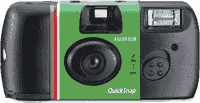 Fujifilm QuickSnap Flash 400$19.49Check price on Amazon
 Kodak FunSaver$22.84Check price on Amazon
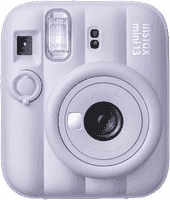 Instax Mini 13$79.95 (list $93.95)Check price on Amazon
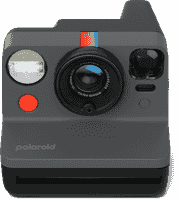 Polaroid Now Generation 3$129.99 (list $119.99)Check price on Amazon
Specs side by side
Same on all four: Current.
| Spec | Fujifilm QuickSnap Flash 400 | Kodak FunSaver | Instax Mini 13 | Polaroid Now Generation 3 |
|---|---|---|---|---|
| Type | Disposable film camera | Disposable film camera | Analog instant camera | Analog instant camera |
| Launched | n/a | n/a | 2026 | 2025 |
| Film or media | 35mm colour, ISO 400 | 35mm colour, ISO 800 | Instax Mini | Polaroid i-Type (also takes Polaroid 600) |
| Print size | n/a | n/a | 86 x 54 mm | 107 x 88 mm |
| Image size | n/a | n/a | 62 x 46 mm | 79 x 77 mm |
| Film cost per shot | $0.72 before developing | $0.85 before developing | $0.91 | $2.37 |
| Exposures | 27 | 27 | n/a | n/a |
| Developing | C-41 colour process, which any lab that takes disposables can run. | C-41 colour process, which any lab that takes disposables can run. | n/a | n/a |
| Lens | 32 mm f/10, plastic | 30 mm f/10, single plastic element | 60 mm f/12.7, 2 components 2 elements | Coated optical-grade polycarbonate and acrylic two-lens system; focal lengths not published for Generation 3 |
| Focus | fixed; 1 m to infinity | fixed; 1 m to infinity | fixed; 0.3 m and beyond; Close-up Mode 0.3 to 0.5 m with parallax correction | autofocus that picks between 2 fixed focus zones: 0.40 to 1.3 m and 1.0 m to infinity |
| Exposure | fixed aperture and shutter speed | fixed aperture and shutter speed | automatic, Lv 5.0 to 14.5 (ISO 800) | automatic; Polaroid lists six usable apertures from f/64 to f/11. Polaroid support documents a three-position exposure compensation (brighten, neutral, darken) reached by holding the flash button on the Now line, though PCMag's reviewer treated the Gen 3 as having no on-body exposure control |
| Shutter | fixed, 1/100 s | fixed, about 1/100 s | programmed electronic shutter, 1/2 to 1/250 s, slow synchro for low light | custom shutter system driven by a precision step motor; Amazon's spec sheet lists a 10 s maximum exposure. Polaroid does not publish the full speed range |
| Flash | switched on at the front, with a continuous-flash setting; 1 to 3 m | manual, charged by a button before each flash shot; 1.2 to 3.5 m | constant firing flash with automatic light adjustment; recycle time 7 s or less; effective range 0.3 to 2.2 m | built-in flash, fires automatically, can be switched off with the flash button |
| Selfie mirror | n/a | n/a | Yes | No |
| Close-up mode | n/a | n/a | Yes | No |
| Self timer | n/a | n/a | Yes | Yes |
| Double exposure | n/a | No | No | Yes |
| Bulb mode | n/a | n/a | No | No |
| Tripod socket | n/a | n/a | No | Yes |
| Power | built-in battery for the flash | pre-loaded battery for the flash | 2 x AA alkaline (LR6) | built-in lithium-ion battery, USB-C rechargeable |
| Shots per battery / prints per charge | n/a | n/a | 100 | 120 |
| App | n/a | n/a | instax UP! | Polaroid app for Scan & Share only; the Now Gen 3 has no Bluetooth and no app camera control |
| Dimensions | 115 x 54 x 34 mm | 120 x 59 x 35 mm | 105.5 x 124.7 x 67.6 mm | 150.2 x 112.2 x 94 mm |
| Weight | 90 g | 117 g | 327 g | 448 g |
| Colours | n/a | n/a | 5 (Dreamy Purple, Frost Blue, Candy Pink, plus 2 more) | 7 (Black, Pebble White, Arctic Blue, plus 4 more) |
| Street price | $19.49 (checked October 14, 2026) | $22.84 (checked October 14, 2026) | $79.95 (checked October 5, 2026) | $129.99 (checked October 5, 2026) |
| Amazon rating | 4.5 (1,062 ratings) | 4.6 (6,671 ratings) | 4.5 (19 ratings) | 4.3 (540 ratings) |
| Buy | Check price on Amazon | Check price on Amazon | Check price on Amazon | Check price on Amazon |
Specs from manufacturer pages; prices and ratings checked October 14, 2026.
What reviewers and buyers say
Fujifilm QuickSnap Flash 400
Published reviews of the Fujifilm QuickSnap Flash 400:
- “The QuickSnap costs about the same as the FunSaver, gives cooler, green- and blue-leaning colour and recharges its flash automatically, and the reviewer recommends disposables like it for fun or as a first step into film.” (Shoot It With Film, 2020-07)
Amazon buyers rate it 4.5 out of 5 across 1,062 ratings.
Praised for: the cheapest big-brand disposable with a flash, small and light, at 90 g, the flash can be left on, with no button to hold before each shot. Criticised for: cooler colour than Kodak's FunSaver, ISO 400 film needs more light than the ISO 800 rivals, shorter flash range than the Kodak cameras.
Kodak FunSaver
Published reviews of the Kodak FunSaver:
- “The FunSaver is a typically basic plastic disposable with a funky design and a roll of Kodak MAX 800 that works pretty well, but picture quality falls well short of even a cheap phone.” (Digital Camera World, 2024-01)
- “Against the Fujifilm QuickSnap, the FunSaver felt better made and more comfortable to hold and gave warmer colour, and the reviewer recommends either for fun or as a first step into film.” (Shoot It With Film, 2020-07)
- “The FunSaver delivers imperfect, hit-or-miss fun, and for a regular lo-fi film habit the reviewer thinks a cheap reusable or second-hand camera makes more sense.” (Australian Photography)
- “Its value today is recreational and experimental rather than as a travel camera, and its limitations are what make it fun.” (Dusty Grain, 2021-01)
Amazon buyers rate it 4.6 out of 5 across 6,671 ratings.
Praised for: simple enough to hand to anyone at a party, warm Kodak colour, the flash makes indoor shots possible. Criticised for: the flash has to be charged by hand before every flash shot, soft, lo-fi pictures from the plastic lens, developing costs about as much as the camera.
Instax Mini 13
Published reviews of the Instax Mini 13:
- “This is a simple continuation of the insanely popular Fujifilm Instax Mini line of cameras and is adorable for the same reasons that the previous models were.” (Chris Niccolls, PetaPixel, 2026-03)
- “The Fujifilm Instax Mini 13 is the quintessential entry-level instant camera, making it easy to snap wallet-size instant pictures thanks to its one-button operation, selfie mirror, and convenient AA battery power.” (Jim Fisher, PCMag, 2026-03)
- “The Instax Mini 13 has a vibrant design, is easy to use, and doesn't cost much. If you need an instant camera in 2026, this is a great choice.” (Harish Jonnalagadda, Android Central, 2026-05)
Amazon buyers rate it 4.5 out of 5 across 19 ratings.
Praised for: twist-the-lens operation is easy for kids and first-timers, new 2 s and 10 s self-timer plus the wedge stand make group shots practical, close-up mode framing matches the selfie mirror closely. Criticised for: flash fires on every shot and cannot be switched off, no tripod socket and no double-exposure mode, nothing new for anyone who already owns a Mini 11 or Mini 12.
Polaroid Now Generation 3
Published reviews of the Polaroid Now Generation 3:
- “Reviewing the Gen 3 body (as the Now+), Finnen concludes that if you are an avid photographer you will reap far bigger rewards from a vintage Polaroid such as the Impulse AF, and that the third generation does not change that.” (Dan Finnen, 2025-04)
- “Fisher, who notes the Now Gen 3 is physically identical to the Now+ he tested apart from Bluetooth, calls it a stylish instant camera that wins nostalgia points for its classic square I-Type film format but whose basic autofocus misses too often to justify the cost per use.” (PCMag (Jim Fisher), 2025-06)
- “Reviewing the Gen 3 body in Now+ form, he says he has really enjoyed using it and finds it a lot of fun, while flagging the sealed internal battery and the ongoing film cost as the things to think about before buying.” (PhotographyBanzai, 2025-10)
Amazon buyers rate it 4.3 out of 5 across 540 ratings.
Praised for: simple point-and-shoot operation, the classic Polaroid look and full-size prints, solid build and good colour choices, no Bluetooth means no phone in the way. Criticised for: film cost, eight shots a pack, exposure and sharpness can disappoint indoors and in mixed light, expensive for what buyers call a novelty, viewfinder framing takes practice, the print shows more than you expect.
Frequently asked questions
Is it worth buying a disposable camera?
For a one-off trip or event, yes. There is no camera to buy first, you get 4x6 prints or scans, and a mail-in lab returns your negatives. For regular shooting, an Instax Mini camera is cheaper: at the October 2026 check its film cost $0.91 a shot against about $1.35 for a QuickSnap developed with scans, so a $79.95 Instax Mini 13 pays for itself after about 182 shots.
What are the disadvantages of an instant camera?
You pay for the camera up front, $79.95 for an Instax Mini 13 at the October 2026 check. Each shot gives one small print and nothing else: no negative and no digital copy unless you scan it. Polaroid film is dear, at $2.37 a shot for i-Type. And the flash range is short, 0.3 to 2.2 m on the Mini 13.
Why is Instax so much cheaper than Polaroid?
It is the film. At regular prices, Instax Mini film cost $0.91 a shot and Polaroid i-Type $2.37. A Polaroid print is larger, though: a 79 x 77 mm image against 62 x 46 mm on Instax Mini. Our Instax vs Polaroid comparison covers the rest.
Is a disposable camera one time use only?
The camera is. The lab opens it to take the film out, and you buy a new camera for the next roll. Reloadable cameras that look like disposables exist, such as the Lomography Simple Use, which takes any 35mm roll after the first.
How long will a disposable camera last?
The film has an expiry date printed on the box. Walgreens Photo says film can still be processed after that date and usually lasts several years past it, depending on how it is stored. Older film can shift in colour, so shoot it sooner rather than later.
Related comparisons
- Best Disposable Cameras 2026: 6 Picks and What They Really Cost
- Where to Develop Disposable Cameras in 2026: CVS, Walmart and Mail-In Labs
- Disposable Cameras for Weddings: Real Costs, Common Problems and the Instant Option (2026)
- Best Instant Camera 2026: 7 Picks for Every Budget
- Cheap Instant Film in 2026: Cost Per Shot for Every Format, and Where to Save