
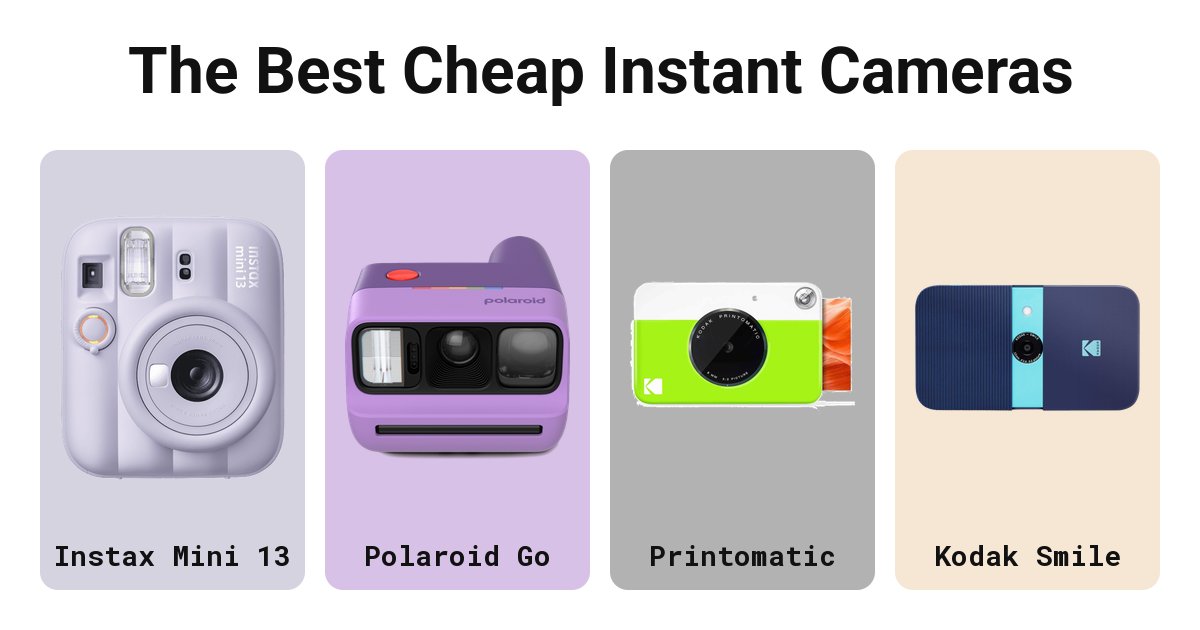
The best budget instant camera is the one with cheap film. Camera plus 100 shots starts at $119.99, and the $89.95 Instax Mini 13 is the best value on real film.
Every pick here is an affordable instant camera with a list price under $150. We ranked these budget picks on what you pay over the first 100 pictures, because on every Instax and Polaroid camera here, 100 shots of film costs more than the camera does. Three of the five picks are Kodak cameras that print on paper instead of film: they are cheaper to run, and the prints show it.
Cheapest to buy vs cheapest to own
| Camera | Camera price | Per shot | Camera + 100 shots |
|---|---|---|---|
| Kodak Printomatic | $69.99 | $0.50 | $119.99 |
| Kodak Smile | $99.99 | $0.50 | $149.99 |
| Instax Mini 13 | $89.95 | $0.95 | $184.95 |
| Kodak Mini Shot 2 Retro | $149.99 | $0.45 | $194.99 |
| Polaroid Go Generation 3 | $89.99 | $1.40 | $229.99 |
| For scale: Polaroid Now Generation 3 | $129.99 | $2.40 | $369.99 |
Camera prices are list prices, checked in November 2026; street prices are often lower. “Camera + 100 shots” is the camera price plus the per-shot figure times 100. Totals use the list price, or the typical price where a camera usually sells for more than 20% below list; none of these does. Film and paper come in packs of 8 to 60, so your real spend rounds up to whole packs. Per-shot figures use regular pack prices, never a sale, rounded up to the next 5 cents: Instax Mini, i-Type and Polaroid Go checked in November 2026, Zink and 4PASS in September 2026.
The order changes once you count film. The Printomatic costs $19.96 less to buy than the Instax Mini 13. After 100 shots it is $64.96 less. The Now Generation 3 shows why full-size Polaroid is not a budget format: 100 shots of its film cost about $240, more than any camera on this list.
Best budget instant camera: Instax Mini 13
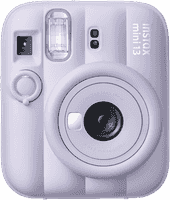
Instax Mini 13Best budget instant camera
List price $89.95
Pros
- twist-the-lens operation is easy for kids and first-timers
- new 2 s and 10 s self-timer plus the wedge stand make group shots practical
- close-up mode framing matches the selfie mirror closely
Cons
- flash fires on every shot and cannot be switched off
- no tripod socket and no double-exposure mode
- nothing new for anyone who already owns a Mini 11 or Mini 12
The Mini 13 is the cheapest way to shoot real instant film without giving up anything that matters. It lists at $89.95, and Instax Mini film runs about $0.95 a shot, so the camera plus 100 shots comes to $184.95. For that you get automatic exposure, a selfie mirror, a close-up mode for 0.3 to 0.5 m with parallax correction, and a 2 second and 10 second self-timer. The wrist strap doubles as a wedge stand that tilts the camera up for timer shots.
There is nothing to set. Twist the lens to turn it on and press the button. It runs on two AA batteries, good for about 100 shots, which you can buy anywhere. PCMag’s Jim Fisher scored it 4 and called it the quintessential entry-level instant camera. The limits: the flash fires on every shot and cannot be turned off, there is no tripod socket, and there is no exposure control.
It has too few owner ratings so far to read much into. The Instax Mini 12 is the same camera without the self-timer. It lists at $79.95, $10 less, and owners often rate it about 4.5 out of 5. That makes it $174.95 with 100 shots. Buy the Mini 12 if you will never use the timer, or if the Mini 13 is out of stock in the color you want. Our Instax Mini 12 vs Mini 13 comparison picks the Mini 13 for the timer.
Cheapest Polaroid to run: Polaroid Go Generation 3
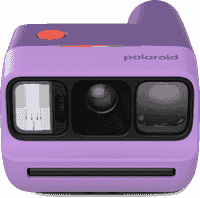
Polaroid Go Generation 3Cheapest Polaroid to run
List price $89.99
Owners rate it about 3.5 out of 5 (hundreds of ratings)
Pros
- genuinely pocket-sized
- Go film is much cheaper per shot than i-Type
- selfie mirror and stronger flash make selfies work
Cons
- prints blow out in bright sunlight
- flash turns itself back on for every shot
- no tripod thread despite having a self-timer
If it has to say Polaroid on the front, the Go is the affordable way in. It lists at $89.99. Go film costs about $1.40 a shot, the only Polaroid film under $2, so the camera plus 100 shots comes to $229.99. A full-size Now Generation 3 with 100 shots of i-Type would come to $369.99, $140 more.
The saving comes from a smaller picture. A Go print is 66.6 x 53.9 mm with a 47 x 46 mm image, which is smaller than the 62 x 46 mm image on an Instax Mini print, and Mini film is still about 45 cents a shot cheaper. That is why our Polaroid Go vs Instax Mini 12 comparison picks the Instax. Buy the Go for the Polaroid look, the size and the brand, not to save money against Instax.
It weighs 252 g and has a selfie mirror, a self-timer and double exposure, and it charges over USB-C. Exposure is automatic, with no way to adjust it, and TechRadar’s Jon Stapley warned that bright sun overexposes it easily. The flash switches itself back on before every frame. Owners typically rate it about 3.5 out of 5. The discontinued Go Generation 2 rates higher, at about 4, and lists at $79.99. Polaroid Go vs Polaroid Now covers what you give up against the full-size camera.
Lowest total cost: Kodak Printomatic
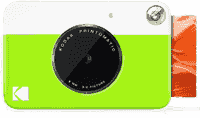
Kodak PrintomaticLowest total cost
List price $69.99
Owners rate it about 3.5 out of 5 (thousands of ratings)
Pros
- easy for kids and beginners to point-and-shoot
- prints double as fun adhesive stickers
- cheap way to get both a print and a digital copy
Cons
- Zink prints look washed-out or pink-tinted compared to real film
- no preview, so bad shots print anyway
- image quality drops a lot indoors or in low light
The Printomatic is the cheapest camera here to own: $69.99 list for the camera and about $0.50 a print, or $119.99 with 100 prints. It is a digital camera with a printer inside. It prints on Zink paper, which has the color built into the sheet and needs only heat, so there is no ink or film. Each 76 x 51 mm print has a sticky back, and with a microSD card (not included) it also keeps a digital copy.
The low running cost comes with two catches. There is no screen, so every shot prints a few seconds after you take it, good or bad. The prints are also the weakest on this list. Owners and reviewers describe them as washed out or pink-tinted next to real film, and quality drops sharply indoors. Tom’s Guide called both the digital and printed results merely average, and ByteTier scored it 5.7 out of 10.
It manages about 25 prints a charge, and only 5 sheets of paper come in the box, so plan on a 50-sheet pack, often found for about $25, straight away. Owners typically rate it about 3.5 out of 5 across thousands of ratings. A slider switches between color and black and white, and there is nothing else to learn, which makes it a reasonable first camera for a young child.
If the look of the print matters to you, the Mini 13 costs about $65 more over 100 shots. See Kodak vs Polaroid and Instax vs Zink for how the prints compare.
Best for choosing what prints: Kodak Smile
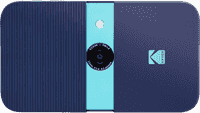
Kodak SmileBest for choosing what prints
List price $99.99
Owners rate it about 4 out of 5 (thousands of ratings)
Pros
- the screen lets you choose which shots to print instead of wasting paper
- slide-open body is genuinely pocketable and cannot fire by accident
- prints are ready in well under a minute and have sticky backs
Cons
- print and image quality are only fair, and dull or indoor light defeats it
- the flash is weak beyond about two metres
- you have to press OK after the shutter or the photo is not saved
The Smile fixes the Printomatic’s biggest flaw. It has a color screen on the back and a separate print button, so you spend about $0.50 only on the shots you want. It was $99.99 at Kodak’s own store on November 11, 2026, when Amazon had no new stock on its main listing. With 100 prints that comes to $149.99, $30 more than the Printomatic.
The slide-open body is the power switch and covers the lens, and at 122 x 79 x 23 mm it is thin enough for a pocket. Prints come out in about 35 seconds, a charge lasts about 40 prints, and the flash can be set to on, off or auto. It has a self-timer, and a photo booth mode puts two shots on one sheet.
The camera side is basic. The sensor is 5 MP, with Kodak’s 10 MP figure reached by interpolation. Internal memory holds only two to five photos, so a microSD card is close to essential. You press the shutter and then OK to keep a shot, which catches out anyone you hand it to. It charges over micro-USB, the flash is weak beyond about two meters, and print quality is only fair in dull light. Tech Advisor found it hard to recommend, citing low print quality and limited features. Tom’s Guide recommended it as a pocketable instant camera for under $100.
Owners typically rate it 4 out of 5 across thousands of ratings. The praise centers on the screen stopping children from burning through paper. Instax vs Zink shows how its prints compare with film.
Best camera and phone printer: Kodak Mini Shot 2 Retro

Kodak Mini Shot 2 RetroBest camera and phone printer
List price $149.99
Owners rate it about 4 out of 5 (thousands of ratings)
Pros
- colors print true to life and vibrant
- compact and genuinely pocketable
- straightforward controls anyone can pick up
Cons
- battery life is weaker than rival hybrid cameras and has no charge indicator
- no double-exposure mode
- small 2x3 print size limits detail
The Mini Shot 2 Retro does two jobs. It is a camera with a 1.77-inch screen, so you choose what to print, and over Bluetooth it also prints photos from your phone through the Kodak Photo Printer app. It lists at $149.99 and is often found for about $130. Its 4PASS prints cost about $0.45 each, the lowest of the five picks, for $194.99 with 100 prints at list price.
4PASS is a dye-sublimation process. Paper and ribbon come together in one cartridge, so there is nothing to load wrong, and the print gets a laminate layer. Prints measure 53 x 86 mm, close to the 86 x 54 mm of an Instax Mini print. Tom’s Guide said it reproduces color faithfully and had the best low-light performance of any instant camera it tested. It has a selfie mirror and a self-timer.
The weak point is the battery. It lasts about 20 prints, and there is no battery-level indicator, so it can run flat without warning. Each print takes about 60 seconds, and there is no double exposure.
Owners typically rate it 4 out of 5 across thousands of ratings. Kodak’s Mini Shot 4 Era prints larger 4PASS photos for about $0.30 each and was $118.99 at Kodak’s store on October 5, 2026, but it has too few owner ratings to judge it by. For more on how Kodak’s two print types differ, see Kodak vs Polaroid.
Why the Instax Mini SE is not a pick
The Mini SE is the cheapest Instax camera, with a $64 list price, and it takes the same film as the Mini 13, at about $0.95 a shot. On Amazon it is sold as Renewed only. On November 11, 2026, new stock was at Walmart for $64, with a 10-pack of Mini film in the box.
It also gives up more than the Mini 13. Instead of automatic exposure it has a brightness dial and a fixed 1/60 s shutter, so a shot at the wrong setting overexposes in bright light. There is no selfie mirror, no close-up mode and no self-timer. In Instax Mini SE vs Mini 12 we picked the Mini 12 over it, and the same reasons put the Mini 13 above it here.
Cheapest instant film, ranked
Running cost is mostly about which film or paper a camera takes. Here is every format our budget picks use, plus the others for comparison, at regular pack prices, with each per-shot cost rounded up to the next 5 cents.
| Film or paper | Pack | Per shot | Checked |
|---|---|---|---|
| Kodak 4PASS 2x3 | 60 sheets | $0.45 | September 2026 |
| Kodak Zink 2x3 | 50 sheets | $0.50 | September 2026 |
| Instax Mini | 20 shots | $0.95 | November 2026 |
| Polaroid Go | 16 shots | $1.40 | November 2026 |
| Instax Wide | 100 shots | $1.40 | October 2026 |
| Instax Square | 20 shots | $1.55 | November 2026 |
| Polaroid i-Type | 8 shots | $2.40 | November 2026 |
| Polaroid 600 | 8 shots, $20.99 at Polaroid’s store | $2.65 | October 2026 |
The two Kodak papers are not film. Zink and 4PASS print a digital photo, and the cameras that use them keep a digital file. Instax and Polaroid expose a chemical print through a lens, and there is no digital copy. Kodak’s larger 4x4 4PASS paper is cheaper still, at about $0.30 a print. On this list, Instax Mini is the cheapest real film by a wide margin, at well under half the price of i-Type.
Is a “Polaroid” under $50 worth it?
Not if you want a real instant print. The cheapest printing camera in our database is the Kodak Memo Shot Era, $39.99 at Kodak’s store on October 5, 2026. It is closer to a label maker than an instant camera. It prints small 69 x 46 mm black-and-white pictures on thermal paper, 30 to a roll, from a 2 MP sensor, and a photo taken on the camera cannot be saved or sent to your phone. We found no per-roll price for the paper, so we cannot give a cost per shot. The Instax Pal was often found for about $40, but it is a small digital camera that needs a separate Instax printer to print anything.
There are also kids’ print cameras well under $50. We have not covered them, so we cannot say how they compare. The cheapest color-printing cameras we cover start at $64 new, for the Instax Mini SE at Walmart, and the Kodak Printomatic’s $69.99 list price.
How we chose
We have not tested most of these cameras in person yet. The picks come from each camera’s published specs, prices and owner ratings checked in November 2026 (cameras mentioned only in passing were last checked in October), and from named professional reviews, including PCMag, TechRadar, Digital Camera World and Tom’s Guide. Our method is on the How We Test page.
We ranked on the cost of the camera plus 100 shots, then on how good those shots are likely to be. That puts the Mini 13 first. It is not the cheapest to own, and the Mini 12 lists at $10 less, but the Mini 13 is the cheapest camera on real film with a self-timer, a selfie mirror and a close-up mode. We included Kodak’s paper-printing cameras because they win on running cost, and we say plainly where their prints fall short. The Polaroid Flip is our pick for the best Polaroid, but at over $200 plus about $2.40 a shot it is not cheap, so it sits in our best Polaroid camera guide. Cost per shot always uses the regular film or paper price, never a sale.
At a glance
| Model | Pick | Price | Film | Cost per shot | Print size | Owner rating |
|---|---|---|---|---|---|---|
| Instax Mini 13 | Best budget instant camera | List price $89.95 | Instax Mini | about $0.95 | 86 x 54 mm | n/a |
| Polaroid Go Generation 3 | Cheapest Polaroid to run | List price $89.99 | Polaroid Go | about $1.40 | 66.6 x 53.9 mm | About 3.5 out of 5 |
| Kodak Printomatic | Lowest total cost | List price $69.99 | Kodak Zink 2x3 | about $0.50 | 76 x 51 mm | About 3.5 out of 5 |
| Kodak Smile | Best for choosing what prints | List price $99.99 | Zink 2x3 | about $0.50 | 76 x 51 mm | About 4 out of 5 |
| Kodak Mini Shot 2 Retro | Best camera and phone printer | List price $149.99 | Kodak 4PASS 2.1x3.4 | about $0.45 | 53 x 86 mm | About 4 out of 5 |
Prices and ratings checked in November 2026.
Frequently asked questions
What is the cheapest instant camera available?
Of the current cameras in our database that print in color, the cheapest is the Instax Mini SE, which was $64 new at Walmart with a 10-pack of film on November 11, 2026. On Amazon it is sold as Renewed only. The next cheapest new is the Kodak Printomatic, with a $69.99 list price. The Kodak Memo Shot Era was $39.99 at Kodak's store on October 5, 2026, but it prints small black-and-white thermal pictures.
What is the cheapest Instax camera?
The Instax Mini SE, with a $64 list price. On November 11, 2026, new stock was $64 at Walmart with a 10-pack of film, and Amazon sold it as Renewed only. The Instax Mini 13 lists at $89.95 and adds automatic exposure, a selfie mirror, a close-up mode and a self-timer.
What is the best budget Polaroid camera?
The Polaroid Go Generation 3, with an $89.99 list price and film at about $1.40 a shot. The cheapest current full-size Polaroid is the Now Generation 3, which lists at $129.99, is often found for about $120, and takes i-Type film at about $2.40 a shot. Discontinued Now Generation 2 stock was often found for about $110.
Why is Instax so much cheaper than Polaroid?
Mostly the film. At regular prices in October 2026, Instax Mini film cost about $0.95 a shot and Polaroid i-Type about $2.40. Over 100 shots that is about $95 against $240.
Is there a cheaper version of a Polaroid camera?
The Polaroid Go uses smaller Go film at about $1.40 a shot, against about $2.40 for the full-size i-Type film. For a similar instant print for less, an Instax Mini camera shoots film at about $0.95 a shot.