
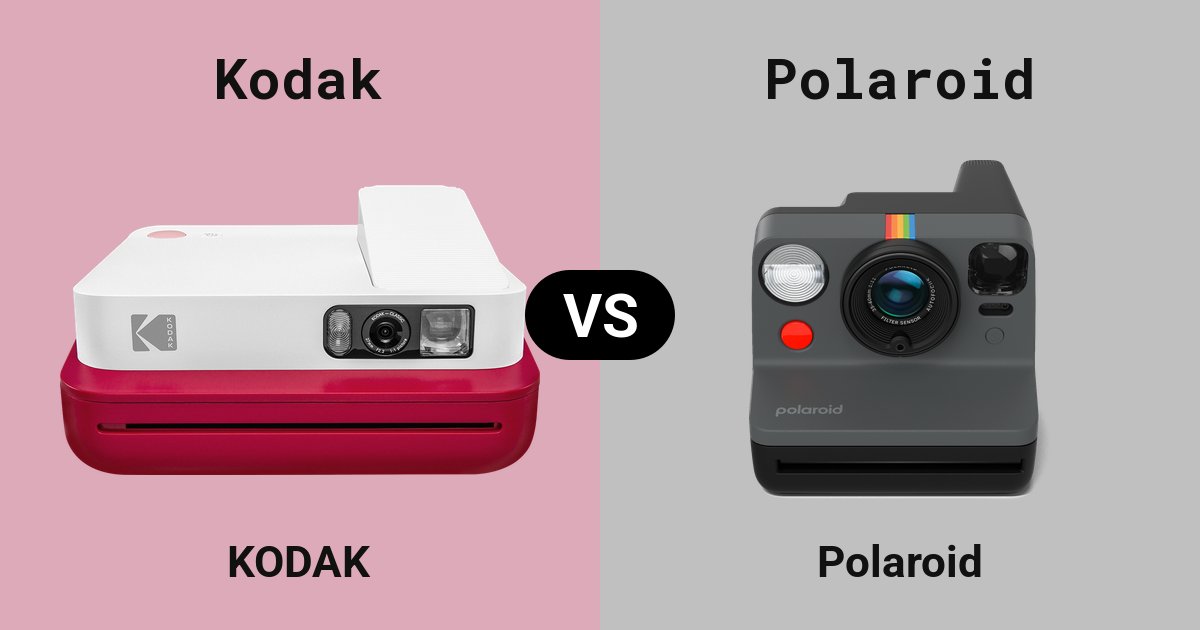
Polaroid cameras shoot real instant film at $1.36 to $2.37 a shot, while Kodak's instant cameras take a digital photo and print it on Zink or 4PASS paper for 30 cents to $1. Buy Polaroid for the big chemical print, and Kodak for cheap, fast sticker-sized prints.
Polaroid and Kodak both sell cameras that hand you a print, but they work in completely different ways. A current Polaroid camera exposes a sheet of chemical instant film through a lens. A Kodak instant camera takes a digital photo and prints it on Zink or 4PASS paper. The Polaroid print costs $1.36 to $2.37 a shot, and a full-size i-Type print is bigger than most Kodak prints. The Kodak print arrives in about a minute and costs 30 cents to $1.
The short answer
Buy Polaroid if you want the print itself: the square image in the white frame, made by chemistry rather than a printer. Expect to pay at least $82.00 for the camera and about $2.37 a shot for full-size i-Type film.
Buy Kodak if you want cheap, fast prints for a child, a party or a scrapbook. Kodak’s Zink prints have sticky backs, and several models keep a digital copy or let you choose which shots to print. The cheapest Kodak camera that prints in colour, the Printomatic, was $69.99.
Prices and ratings on this page come from our product records, checked on 2026-10-05.
How each one makes a picture
Polaroid’s five current cameras (the Go Generation 3, Now Generation 3, Now+ Generation 3, Flip and I-2) are analog. The lens exposes the film directly, a pod of reagent inside the film is broken and spread across the sheet, and the picture appears over several minutes. Keith Wee’s review of the Go Generation 3 describes the image slowly appearing over a 15-minute wait. There is no sensor, no screen and no digital file. Every press of the shutter uses a frame of film.
Kodak’s instant cameras are digital. A sensor takes the picture, and a printer built into the body puts it on paper. There are two print technologies in the range:
- Zink (the Smile, Smile+, Smile Classic, Printomatic, Printomatic+, Step and Step Touch). Zink paper has the colour built into it as layers of colourless dye crystals, and heat from the print head turns each layer to yellow, magenta or cyan. There is no ink or cartridge, and the sheet goes through once. Zink started as a project inside Polaroid Corporation in the 1990s before it was spun out as its own company in 2005.
- 4PASS (the Mini Shot 2, 3 and 4 cameras). These use dye-sublimation cartridges that hold both paper and ribbon, and finish the print with a laminate layer.
The Kodak Memo Shot Era is a third case: a 2-megapixel camera shaped like a film canister that prints in black and white on rolls of thermal paper.
Kodak does not make these cameras itself. Our records list C+A Global as the licensee behind the Smile, Smile+, Smile Classic, Printomatic+, Step and Step Touch, and Prinics as the licensee behind the Mini Shot 3 Retro, the Mini Shot Era cameras and the Memo Shot Era.
How the prints look
This is where Polaroid wins. Reviewers describe Kodak’s Zink prints as washed out next to real instant film, and most of the Kodak Zink records carry that complaint. Digital Camera World wrote of the Smile+ that its prints have a “washed-out, photocopy-like quality”. Printomatic buyers report pink or red-tinted prints, and image quality drops sharply indoors and in dim light. The Smile+ and Smile sensors are 5 MP, although Kodak advertises 10 MP.
The 4PASS cameras do better on colour. Tom’s Guide said the Mini Shot 2 Retro reproduces colour faithfully and had the best low-light performance of any instant camera it tested. Tom’s Guide was less kind to the newer Era models. It found the Mini Shot 3 Era’s images noisy, with print quality below the cheaper Mini Shot 2 Retro, and called the Mini Shot 4 Era’s print quality underwhelming. Buyers add that its prints are not as sharp as Instax or Polaroid.
The Zink camera with the best reputation for print quality is the Smile Classic. WIRED called its output the best Zink it had tested, with decent tonal range and contrast.
Polaroid prints have their own faults. Polaroid’s colour i-Type film shifts cyan in the cold and red in the heat. TechRadar warned that the Go Generation 3 overexposes easily in bright sun, and PCMag’s Jim Fisher said the Now Generation 3’s autofocus misses too often to justify the cost per use. A missed Polaroid frame is lost money. Several Kodak cameras let you avoid that: the Smile, Step Touch and Mini Shot cameras have screens, so you can look at a shot before you print it.
Cost per shot
| Paper or film | Pack | Cost per shot | 100 shots |
|---|---|---|---|
| Kodak 4PASS 4x4 | 120 sheets, $35.99 | about $0.30 | about $30 |
| Kodak 4PASS 2x3 or 3x3 | 60 sheets, $24.99 | about $0.42 | about $42 |
| Kodak Zink 2x3 | 50 sheets, $24.37 | about $0.49 | about $49 |
| Kodak Zink 3.5x4.25 | 40 sheets, $39.99 | about $1.00 | about $100 |
| Polaroid Go | 16 shots, $21.79 | about $1.36 | about $136 |
| Polaroid i-Type | 8 shots, $18.99 | about $2.37 | about $237 |
All prices are Amazon prices, checked on 2026-10-05.
Add the camera and the gap widens. A Kodak Printomatic at $69.99 plus 100 Zink prints comes to about $119. A Polaroid Go Generation 3 at $82.00 plus 100 shots of Go film comes to about $218. A Polaroid Now Generation 3 at $129.99 plus 100 shots of i-Type comes to about $367.
The Memo Shot Era is left out of the table. We found no price for a single refill roll, so we cannot work out its cost per shot. Each roll prints 30 images.
Print size
| Format | Print size |
|---|---|
| Kodak Zink 2x3 | 76 x 51 mm |
| Kodak 4PASS 2.1x3.4 | 86 x 53 mm |
| Kodak 4PASS 3x3 | 76 x 76 mm |
| Kodak Zink 3.5x4.25 | 89 x 108 mm |
| Kodak 4PASS 4x4 | 102 x 102 mm |
| Polaroid Go | 66.6 x 53.9 mm (47 x 46 mm image) |
| Polaroid i-Type | 107 x 88 mm (79 x 77 mm image) |
Most Kodak cameras print on 2x3-inch or 2.1x3.4-inch paper, a sheet under half the area of a Polaroid i-Type print. Two Kodak cameras close the gap. The Smile Classic prints 89 x 108 mm with a white border, at about $1.00 a sheet. The Mini Shot 4 Era prints 102 x 102 mm, a slightly larger sheet than i-Type, at about $0.30. It is also big: 822 g, against 252 g for the Polaroid Go Generation 3. Our records do not give an image size for the Kodak prints, so the Kodak rows above are sheet sizes only.
Durability
The Kodak 4PASS prints are laminated, and reviewers describe them as resisting water, fingerprints and fading. Zink says its paper is water-resistant and tear- and smudge-resistant, and Kodak’s 2x3 Zink paper is sticky-backed. Reviewers of the Kodak Smile did see colours drift, with whites turning pink.
We found no comparable water or smudge rating for Polaroid film in the sources we read, so we cannot set the two side by side on this point.
Camera prices
The cheapest Kodak instant camera was the Memo Shot Era at $39.99, a sale price on Kodak’s own store. The cheapest colour one was the Printomatic at $69.99. Most of the range sits between $79.99 and $134.99.
Polaroid starts higher. The Go Generation 3 was $82.00, the Now Generation 3 $129.99, the Now+ Generation 3 $149.99 and the Flip $210.00, above its $199.99 list price. The I-2 lists at $599.99, but no retailer price was on record at the last check.
The cameras you can buy
Kodak
| Model | Type | Film or media | Street price | Amazon rating |
|---|---|---|---|---|
| Kodak Memo Shot Era | Digital instant camera | Kodak thermal paper roll, black and white | $39.99 | 4.2 (774 ratings) |
| Kodak Printomatic | Digital instant camera | Kodak Zink 2x3 | $69.99 | 3.9 (26,595 ratings) |
| Kodak Printomatic+ | Digital instant camera | Zink 2x3 | $79.99 | 3.8 (107 ratings) |
| Kodak Smile | Digital instant camera | Zink 2x3 | $99.99 | 4.4 (2,078 ratings) |
| Kodak Smile+ | Digital instant camera | Kodak Zink 2x3 | $99.99 | 4.1 (280 ratings) |
| Kodak Mini Shot 2 Retro | Hybrid instant camera | Kodak 4PASS 2.1x3.4 | $114.99 | 4.3 (4,962 ratings) |
| Kodak Mini Shot 4 Era | Hybrid instant camera | Kodak 4PASS 4x4 | $118.99 | 2.4 (6 ratings) |
| Kodak Mini Shot 3 Era | Hybrid instant camera | Kodak 4PASS 3x3 | $119.99 | 3.3 (369 ratings) |
| Kodak Smile Classic | Digital instant camera | Kodak Zink 3.5x4.25 | $119.99 | 3.8 (225 ratings) |
| Kodak Step Touch | Digital instant camera | Zink 2x3 | $129.99 | 3.3 (1,267 ratings) |
| Kodak Mini Shot 3 Retro | Hybrid instant camera | Kodak 4PASS 3x3 | $134.99 | 4 (6,360 ratings) |
| Kodak Mini Shot 2 Era | Hybrid instant camera | Kodak 4PASS 2.1x3.4 | n/a | n/a |
| Kodak Step Instant Print Digital Camera | Digital instant camera | Zink 2x3 | n/a | 4.1 (1,544 ratings) |
Prices and ratings checked October 5, 2026.
The Kodak range is large and confusing, with three Smile cameras, two Printomatics and Era and Retro versions of the Mini Shot on sale side by side. Two were unavailable at the last check: the Step camera and the Mini Shot 2 Era.
The Smile has the best Amazon rating of the Zink cameras, 4.4 from 2,078 ratings. It has a screen and a separate print button, so you only spend paper on shots you like. The Printomatic has by far the most ratings, 3.9 from 26,595, and prints every shot with no preview. The Mini Shot 2 Retro, at 4.3 from 4,962, is the best-rated hybrid and the one Tom’s Guide praised for colour. Note that the Mini Shot 3 and 4 Era cameras keep no digital file, and the Mini Shot 3 Retro deletes its photos when you switch it off.
Polaroid
| Model | Type | Film or media | Street price | Amazon rating |
|---|---|---|---|---|
| Polaroid Go Generation 3 | Analog instant camera | Polaroid Go | $82.00 | 3.8 (224 ratings) |
| Polaroid Now Generation 3 | Analog instant camera | Polaroid i-Type (also takes Polaroid 600) | $129.99 | 4.3 (540 ratings) |
| Polaroid Now+ Generation 3 | Analog instant camera | Polaroid i-Type (also takes Polaroid 600) | $149.99 | 4.2 (251 ratings) |
| Polaroid Flip | Analog instant camera | Polaroid i-Type (also takes Polaroid 600) | $210.00 | 4.7 (8 ratings) |
| Polaroid I-2 | Analog instant camera | Polaroid i-Type (also takes Polaroid 600 and SX-70) | $599.99 | 3.8 (22 ratings) |
Prices and ratings checked October 5, 2026.
The Go Generation 3 is the cheapest Polaroid and the smallest instant camera on sale, with a print about 60 percent of the width and height of an i-Type print. The Now Generation 3 is the plain full-size camera. The Flip is the one reviewers point to: PCMag made it their Editors’ Choice for I-Type cameras, crediting its sonar autofocus. Our Polaroid Flip vs Polaroid Now and Polaroid Go vs Polaroid Now pages cover those choices in detail.
Who should buy Kodak
Buy Kodak for a child. The Printomatic, Smile and Step are cheap, light and simple, and a print costs about 49 cents. Our records list children among the best uses for all three.
Buy Kodak for scrapbooks and journals. The sticky-backed Zink prints work as stickers, and the 4PASS prints survive handling.
Buy Kodak if you also want to print from your phone. The Smile+, Smile Classic, Step Touch and the Mini Shot cameras all print phone photos over Bluetooth, and reviewers of the Smile Classic and Mini Shot 3 Retro say phone photos print better than the cameras’ own shots.
Who should buy Polaroid
Buy Polaroid if the look of the print is the point. A 107 x 88 mm chemical print with a white frame is something no Kodak camera makes.
Buy Polaroid if you will shoot slowly. At about $2.37 a frame for i-Type, eight shots a pack and a wait of several minutes for each print, it suits a few considered pictures more than a stream of party snaps. If you want real instant film at a lower running cost, our Instax vs Polaroid comparison covers Fujifilm’s cheaper film.
Sources
- Product records in
src/data/productsfor every current Kodak and Polaroid camera, with prices and Amazon ratings checked 2026-10-05: camera prices, paper and film prices, cost per shot, print sizes, specifications, licensees, and the reviewer and buyer verdicts quoted above. docs/research/price-check-2026-10-polaroid-kodak.md: the 2026-10-05 price check, including the i-Type and Kodak paper prices.- https://www.zink.com/ and https://zink.com/technology : no ink cartridges, toner or ribbons, printing in a single pass, colour embedded in the paper, and paper described as water-resistant and tear- and smudge-resistant.
- https://en.wikipedia.org/wiki/Zink_(technology) : colourless dye crystals in yellow, magenta and cyan layers activated by heat pulses, and Zink’s start as a Polaroid project spun out in 2005.
- https://en.wikipedia.org/wiki/Instant_film : the developer reagent spread across integral instant film.
- https://keithwee.com/2026/06/15/polaroid-go-gen-3-review-smaller-sharper-still-wonderfully-imperfect/ : the 15-minute development wait on the Go Generation 3.
Frequently asked questions
Is Kodak or Polaroid cheaper?
Kodak, on both the camera and the prints. The Kodak Printomatic was $69.99 on 2026-10-05 and its Zink paper works out at about $0.49 a print. The cheapest current Polaroid, the Go Generation 3, was $82.00, and Go film costs about $1.36 a shot. Full-size Polaroid i-Type film costs about $2.37 a shot, at $18.99 for an 8-shot pack.
Do Kodak instant cameras use real film?
No. The Kodak Smile, Printomatic, Step and Mini Shot cameras take a digital picture with a sensor and then print it. The Zink models print on paper with the colour already embedded in it, activated by heat. The Mini Shot cameras print with 4PASS dye-sublimation cartridges that add a laminate layer. Polaroid cameras expose chemical instant film through a lens, with no sensor and no digital file.
Kodak Printomatic or Polaroid: which should I buy?
Buy the Printomatic if the camera is for a child or a party and you want prints that cost about 49 cents each. It was $69.99 and also saves a digital copy to a microSD card. Buy a Polaroid if you want the large chemical print: the Now Generation 3 was $129.99 and its i-Type prints measure 107 x 88 mm, against 76 x 51 mm for a Printomatic print. Reviewers describe Zink prints as washed out next to Polaroid and Instax film.
Is Kodak better than Instax?
Kodak is cheaper to run and Instax gives the better print. Kodak Zink paper costs about $0.49 a print and 4PASS paper about $0.30 to $0.42, against about $0.91 a shot for Instax Mini film at the last check. Our records for the Kodak Smile, Smile+ and Step all list print quality below Instax as a drawback, and Tech Advisor said Zink cameras like the Step cannot match Instax rivals.
Do Kodak instant prints last?
The two Kodak paper types make different claims. The 4PASS prints from the Mini Shot cameras are laminated, and reviewers describe them as resisting water, fingerprints and fading. Zink says its paper is water-resistant and tear- and smudge-resistant. Reviewers of the Kodak Smile noticed colours drifting, with whites turning pink.
Related comparisons
- Instax vs Polaroid: Which Instant Camera Should You Buy? (2026)
- HP Sprocket vs Kodak Step: Which Should You Buy? (2026)
- Kodak Mini 2 Retro vs Polaroid Hi-Print: Which Should You Buy? (2026)
- Polaroid Go vs Polaroid Now: Which Should You Buy? (2026)
- Polaroid i-Type vs 600 Film: What Is the Difference? (2026)