
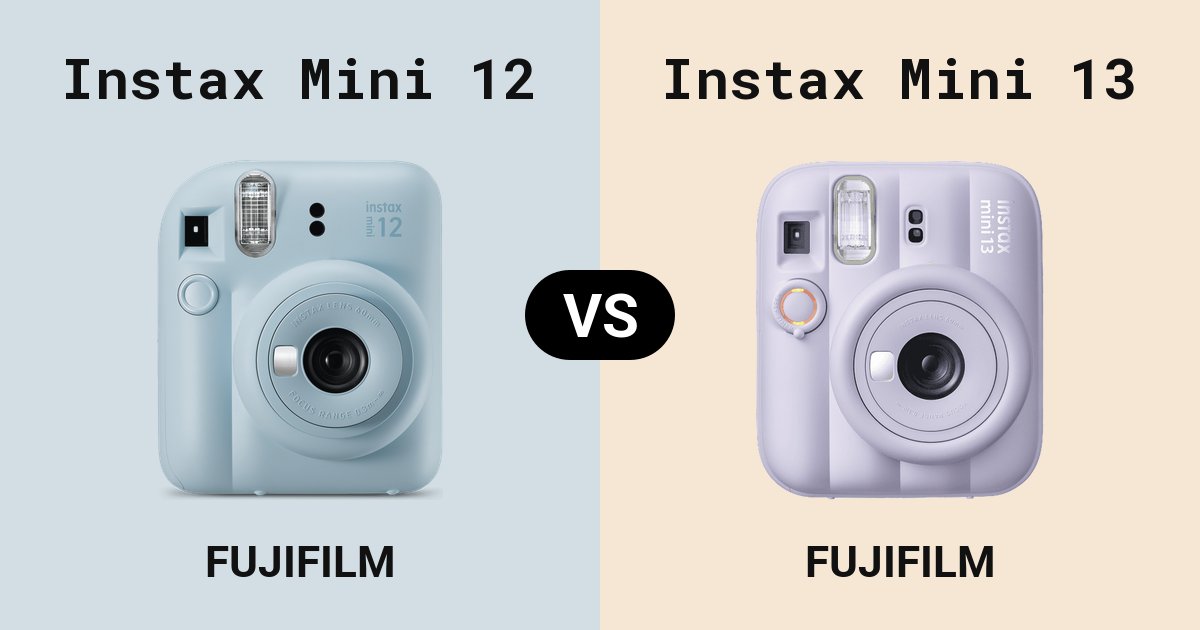
The Mini 13 is the Mini 12 plus a 2 and 10 second self-timer, with the same lens, film and always-on flash. Which is better for you, what each costs, and where the cheaper Mini SE fits.
Fujifilm launched the Instax Mini 12 in 2023 and the Mini 13 in 2026 as its successor. The Mini 12 was still on sale at the November 2026 price check, so for now you can pick either. What matters is whether the newer camera changes anything you would notice.
What is actually different
Very little inside. Both cameras use the same 60 mm f/12.7 lens, two components in two elements. Both set exposure themselves between Lv 5.0 and 14.5 at ISO 800, and both run a 1/2 to 1/250 second shutter with a slow synchro mode for low light. Each has a selfie mirror and a close-up mode that works from 0.3 to 0.5 m with parallax correction, so close shots land where you framed them. Two AA batteries run either camera for about 100 shots. Our page on Instax batteries covers what each model takes. Both work with the instax UP! app. Neither has double exposure, bulb mode, a tripod socket or any manual control, and on both the flash fires on every frame.
The new part is the self-timer. The Mini 13 has a 2 second and a 10 second timer, set with the ring around the shutter button: twist it once for 2 seconds, twist and hold for 10. The wrist strap doubles as a wedge-shaped stand that tilts the camera upward for timer shots. The Mini 12 has no self-timer at all, so group shots with the photographer in them mean handing the camera to someone else.
Fujifilm quotes the Mini 13’s flash in more detail: a recycle time of 7 seconds or less and an effective range of 0.3 to 2.2 m, with automatic light adjustment. We do not have the same figures for the Mini 12, so we cannot say whether the flash itself changed.
The Mini 13 is slightly heavier at 327 g, 21 g more than the Mini 12’s 306 g, and it comes in new colours. The Mini 12 comes in Pastel Blue, Blossom Pink, Mint Green, Lilac Purple and Clay White. The Mini 13 comes in Dreamy Purple, Frost Blue, Candy Pink, Lagoon Green and Clay White.
Chris Niccolls at PetaPixel called it a simple continuation of the Instax Mini line, adorable for the same reasons the previous models were. Jim Fisher at PCMag scored it 4 out of 5 and called it the quintessential entry-level instant camera. Harish Jonnalagadda at Android Central said it is easy to use, does not cost much and is a great choice if you need an instant camera in 2026. On the Mini 12, Digital Camera World said it is still the best bang-for-buck instant camera you can buy, and Dan Finnen called it the best Instax camera for jumping into instant film, despite a battery door that fits terribly.
Price and film cost
Fujifilm’s own US store lists the Mini 13 at $89.95. The Mini 12 lists at $79.95 and is often found for about $85, so the newer camera usually costs about $5 more. Street prices move, so check both before you buy.
Film costs the same on either camera. Both take Instax Mini film, which prints 86 x 54 mm with a 62 x 46 mm image. A twin pack of 20 shots is often found for about $19, which works out at about $0.95 a shot. Five twin packs, 100 shots, come to about $95, more than either camera, so film is the bill that keeps coming whichever one you buy. For the editions and pack sizes, see our guide to Instax Mini film.
Which one to buy
Buy the Mini 13 if you take group shots or selfies from a table. It takes the same picture as the Mini 12 and adds a self-timer and a stand, for about $5 more. Buy the Mini 12 if you never need the timer, since everything else is the same.
The Mini 12 still has a far longer track record with owners, who often rate it about 4.5 out of 5. The Mini 13 has too few owner ratings so far to read much into. The Mini 12 is also the one to pick if you want one of its colours.
If you already own a Mini 12, keep it. The Mini 13 will not take a better picture, and the only thing you would gain is the timer. And if the always-on flash is what bothers you, neither camera fixes it.
Mini 12, 13 or SE?
The cheaper third option is the Instax Mini SE. On November 11, 2026 Walmart sold it new for $64.00 with a 10-shot pack of film, while Amazon listed only Renewed units. It costs less because it does less: a fixed 1/60 second shutter and a brightness dial instead of automatic exposure, focus from 0.6 m instead of 0.3 m, and no selfie mirror, close-up mode or self-timer. In return, four AA batteries give it about 200 shots. Our Instax Mini SE vs Mini 13 comparison goes through it in detail.
If you are also weighing the Mini 11, it is the Mini 12’s discontinued predecessor, with the same lens and film. Instax Mini 11 vs Mini 12 covers what changed between them. To protect either camera, see our guide to Instax Mini camera cases.
Where to buy
 Instax Mini 12List price $79.95Check price on Amazon
 Instax Mini 13List price $89.95Check price on Amazon
Specs side by side
Same on both: Analog instant camera · Current · Instax Mini film · 86 x 54 mm print · 62 x 46 mm image · about $0.95 a shot · Lens: 60 mm f/12.7, 2 components 2 elements · Exposure: automatic, Lv 5.0 to 14.5 (ISO 800) · selfie mirror · close-up mode · no double exposure · no bulb mode · no tripod socket · Shots per battery / prints per charge: 100 · App: instax UP!.
| Spec | Instax Mini 12 | Instax Mini 13 |
|---|---|---|
| Launched | 2023 | 2026 |
| Focus | fixed; 0.3 m to infinity; close-up (selfie) mode 0.3 to 0.5 m with parallax correction | fixed; 0.3 m and beyond; Close-up Mode 0.3 to 0.5 m with parallax correction |
| Shutter | 1/2 to 1/250 s, slow synchro for low light | programmed electronic shutter, 1/2 to 1/250 s, slow synchro for low light |
| Flash | auto, always fires | constant firing flash with automatic light adjustment; recycle time 7 s or less; effective range 0.3 to 2.2 m |
| Self timer | No | Yes |
| Power | 2 x AA alkaline | 2 x AA alkaline (LR6) or NiMH (HR6) |
| Dimensions | 104 x 66 x 122 mm | 105.5 x 124.7 x 67.6 mm |
| Weight | 306 g | 327 g |
| Colours | 5 (Pastel Blue, Blossom Pink, Mint Green, plus 2 more) | 5 (Dreamy Purple, Frost Blue, Candy Pink, plus 2 more) |
| Price | List price $79.95 | List price $89.95 |
| Owner rating | About 4.5 out of 5 | n/a |
| Buy | Check price on Amazon | Check price on Amazon |
Specs from manufacturer pages; prices and ratings checked in November 2026.
What reviewers and owners say
Instax Mini 12
Published reviews of the Instax Mini 12:
- “The Mini 12's upgrades over the Mini 11 are worth the extra money if you mostly photograph people, though bright daylight can still cause over-exposure.” (Cameralabs, 2023)
- “The Mini 12 is easier to shoot with than the Mini 8 and delivers the joy and fun that's at the heart of Instax cameras without missing the older camera's extra modes.” (Amateur Photographer, 2023)
- “The Instax Mini 12 is still the best bang-for-buck instant camera you can buy.” (Digital Camera World, 2023)
- “The Mini 12 is an iterative update that keeps what works about the Mini 11 but makes it even better, and is the best Instax camera for jumping into instant film, despite a battery door that fits terribly.” (Dan Finnen, 2024-01)
Owners rate it about 4.5 out of 5 across thousands of ratings.
Praised for: easy enough for kids and first-timers, reliable auto-exposure in daylight, fun color options. Criticised for: flash always fires and cannot be turned off, feels plastic and toy-like, battery door fits poorly.
Instax Mini 13
Published reviews of the Instax Mini 13:
- “This is a simple continuation of the insanely popular Fujifilm Instax Mini line of cameras and is adorable for the same reasons that the previous models were.” (Chris Niccolls, PetaPixel, 2026-03)
- “The Fujifilm Instax Mini 13 is the quintessential entry-level instant camera, making it easy to snap wallet-size instant pictures thanks to its one-button operation, selfie mirror, and convenient AA battery power.” (Jim Fisher, PCMag, 2026-03)
- “The Instax Mini 13 has a vibrant design, is easy to use, and doesn't cost much. If you need an instant camera in 2026, this is a great choice.” (Harish Jonnalagadda, Android Central, 2026-05)
Praised for: twist-the-lens operation is easy for kids and first-timers, new 2 s and 10 s self-timer plus the wedge stand make group shots practical, close-up mode framing matches the selfie mirror closely. Criticised for: flash fires on every shot and cannot be switched off, no tripod socket and no double-exposure mode, nothing new for anyone who already owns a Mini 11 or Mini 12.
Frequently asked questions
What is the difference between the Instax Mini 12 and Mini 13?
The self-timer, the colours and a little weight. Both use a 60 mm f/12.7 lens, automatic exposure from Lv 5.0 to 14.5, a 1/2 to 1/250 second shutter with slow synchro, a close-up mode from 0.3 to 0.5 m with parallax correction, two AA batteries and about 100 shots per set. The Mini 13, launched in 2026, adds a 2 second and 10 second self-timer and weighs 327 g against 306 g for the Mini 12.
Should I upgrade from the Mini 12 to the Mini 13?
No. The lens, exposure, shutter and film are the same, so your pictures will not change. The self-timer is the only new feature. Owner and reviewer feedback on the Mini 13 lists 'nothing new for anyone who already owns a Mini 11 or Mini 12' as a recurring complaint. Spend the money on film instead.
Can you turn off the flash on the Instax Mini 13?
No. The flash fires on every shot on both the Mini 12 and the Mini 13. The Mini 13 adjusts the flash output automatically and Fujifilm quotes an effective range of 0.3 to 2.2 m, but there is no way to switch it off.
Do the Mini 12 and Mini 13 use the same film?
Yes. Both take Instax Mini film, which prints 86 x 54 mm with a 62 x 46 mm image. A twin pack of 20 shots is often found for about $19, about $0.95 a shot.