
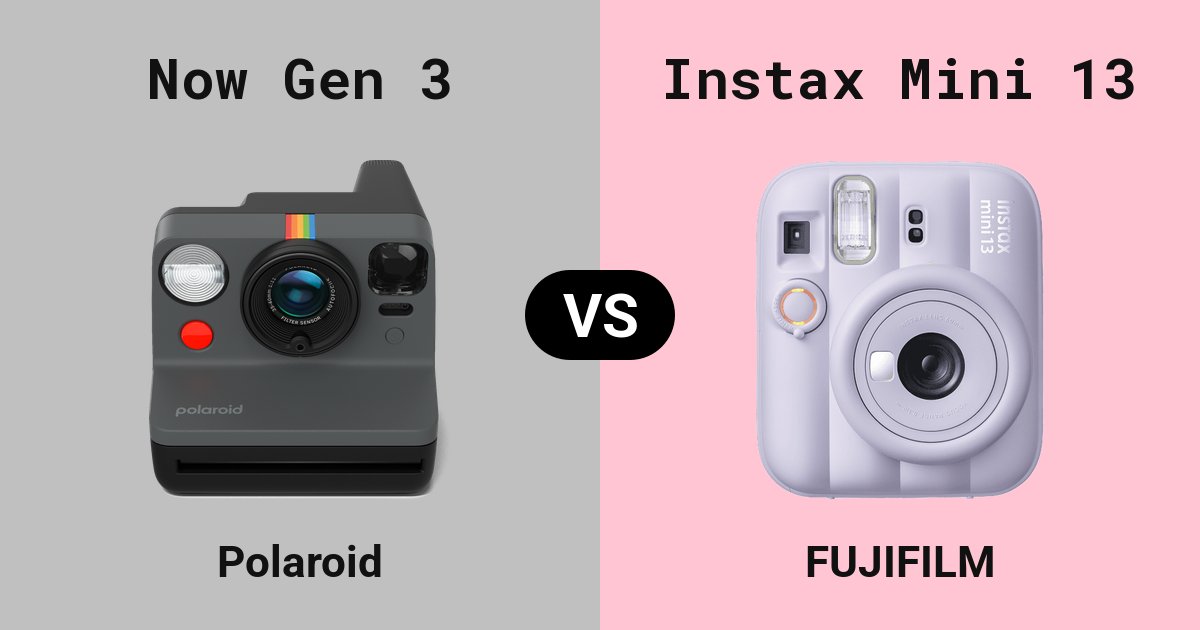
The Polaroid Now Generation 3 makes a picture a little over twice the size of the Instax Mini 13's, but its film costs about $2.40 a shot against about $0.95, and the camera costs $40 more. Buy the Mini 13 unless the big square Polaroid print is the reason you want an instant camera.
These two cameras sit $40 apart at list price, but they make very different pictures. Fujifilm launched the Instax Mini 13 in 2026 as the successor to the Mini 12, and it prints on Instax Mini film. Polaroid launched the Now Generation 3 in 2025, and it prints the classic square Polaroid picture on i-Type film. The film decides most of what follows.
What is actually different
Neither camera has manual exposure control. Both are point-and-shoot, both have a self-timer, and that is about where the overlap ends.
Focus works differently. The Now Generation 3 autofocuses by choosing between two fixed zones, 0.40 to 1.3 m and 1.0 m to infinity. The Mini 13 is fixed focus from 0.3 m, with a close-up mode for 0.3 to 0.5 m that corrects for parallax. Add the Mini 13’s selfie mirror and it is the easier camera to point at yourself. The Now has no selfie mirror and no close-up mode.
The Now has more features. It has double exposure, a tripod socket and a flash you can switch off with the flash button. The Mini 13 has none of those. Its flash fires on every shot, and there is no way to turn it off. The Mini 13’s strap includes a wedge that tilts the camera up for 2 second or 10 second timer shots.
Power is different too. The Now has a built-in battery that charges over USB-C and lasts about 120 shots, which Polaroid puts at up to 15 film packs. The Mini 13 takes two AA batteries and gets about 100 shots from a set.
And the Now is the bigger camera: 150.2 x 112.2 x 94 mm and 448 g, against 105.5 x 124.7 x 67.6 mm and 327 g for the Mini 13. That is 121 g more to carry.
Print size and film cost per shot
The Polaroid print is bigger and the Instax print is cheaper. A Now print is 107 x 88 mm with a 79 x 77 mm image, close to square. An Instax Mini print is 86 x 54 mm, about the size of a credit card, with a 62 x 46 mm image. The Polaroid image has a little over twice the area. Our instant film sizes guide puts every format side by side.
A Polaroid Color i-Type pack of 8 shots is $18.99 on Polaroid’s US store, about $2.40 a shot. An Instax Mini twin pack of 20 shots is often found for about $19, about $0.95 a shot. Every press of the button costs about $1.45 more on the Now.
Here is how that adds up over the first 80 pictures:
| Polaroid Now Gen 3 | Instax Mini 13 | |
|---|---|---|
| Camera | $129.99 | $89.95 |
| 80 shots of film | $189.90 (10 packs) | about $76 (4 twin packs) |
| Total | $319.89 | about $166 |
Camera prices are list prices. i-Type film is priced on Polaroid’s US store and Instax Mini film at a typical store price, checked in November 2026.
The $40.04 between the cameras is about 17 shots of i-Type film. The film is where the gap grows, at about $114 by the 80th picture. The Now also takes Polaroid 600 film.
Which one to buy
Buy the Instax Mini 13. It costs less, its film costs well under half as much a shot, and it has the selfie mirror and close-up mode that help you frame a picture of yourself. PCMag’s Jim Fisher calls it “the quintessential entry-level instant camera”.
Buy the Polaroid Now Generation 3 if the big square print is the point. Nothing else in this pair makes it, and the Now adds double exposure, a tripod socket and a flash you can turn off. Owners typically rate it about 4 out of 5. Go in knowing what each shot costs, and read PCMag’s verdict on the Now+ Generation 3, which Fisher says is physically identical on the outside to the Now apart from Bluetooth: “its basic autofocus misses too often to justify the cost per use.” For the brand-level picture, see Instax vs Polaroid.
What about the Polaroid Go Generation 3?
The Go is the closer match to the Mini 13 on price. It lists at $89.99, four cents more than the Mini 13. It is the smaller camera, 106.5 x 83.8 x 64.6 mm and 252 g, and it adds double exposure, which the Mini 13 lacks. Both have a selfie mirror and a self-timer.
The film still favours the Mini 13. A Polaroid Go Color double pack of 16 shots is $21.99 on Polaroid’s US store, about $1.40 a shot, against about $0.95 for Instax Mini. A Go print is 66.6 x 53.9 mm with a 47 x 46 mm image, so the Instax Mini image is about a third larger. The Go also has no close-up mode. Owners often rate it about 3.5 out of 5.
The Mini 13 takes the same picture through the same lens as the Mini 12, so our Polaroid Go vs Instax Mini 12 comparison covers the Go against an Instax Mini in full. If you are deciding between the two Polaroids, see Polaroid Go vs Polaroid Now.
And the Instax Mini 12 or the Now Generation 2?
The main change from the Mini 12 to the Mini 13 is the self-timer. The lens, exposure, film and always-on flash are the same, so the film and feature comparison above holds for the Mini 12, minus the timer. The Mini 12 is a little lighter at 306 g, and its price differs, so check it before you add it up. Instax Mini 12 vs Mini 13 covers the small differences.
The same goes for the Polaroid side. The Now Generation 2 takes the same film and makes the same 107 x 88 mm print as the Generation 3, so the film cost gap does not change. Polaroid Now Gen 2 vs Gen 3 has what changed between them.
Where to buy
 Polaroid Now Generation 3List price $129.99Check price on Amazon
 Instax Mini 13List price $89.95Check price on Amazon
Specs side by side
Same on both: Analog instant camera · Current · self timer · no bulb mode.
| Spec | Polaroid Now Generation 3 | Instax Mini 13 |
|---|---|---|
| Launched | 2025 | 2026 |
| Film or media | Polaroid i-Type (also takes Polaroid 600) | Instax Mini |
| Print size | 107 x 88 mm | 86 x 54 mm |
| Image size | 79 x 77 mm | 62 x 46 mm |
| Film cost per shot | about $2.40 | about $0.95 |
| Lens | Coated optical-grade polycarbonate and acrylic two-lens system; focal lengths not published for Generation 3 | 60 mm f/12.7, 2 components 2 elements |
| Focus | autofocus that picks between 2 fixed focus zones: 0.40 to 1.3 m and 1.0 m to infinity | fixed; 0.3 m and beyond; Close-up Mode 0.3 to 0.5 m with parallax correction |
| Exposure | automatic; Polaroid lists six usable apertures from f/64 to f/11. Polaroid support documents a three-position exposure compensation (brighten, neutral, darken) reached by holding the flash button on the Now line; not separately confirmed for Generation 3. PCMag's review of the physically identical Now+ Generation 3 wished the camera had basic EV compensation on the body | automatic, Lv 5.0 to 14.5 (ISO 800) |
| Shutter | custom shutter system driven by a precision step motor; retailer spec sheets list a 10 s maximum exposure. Polaroid does not publish the full speed range | programmed electronic shutter, 1/2 to 1/250 s, slow synchro for low light |
| Flash | built-in flash, fires automatically, can be switched off with the flash button | constant firing flash with automatic light adjustment; recycle time 7 s or less; effective range 0.3 to 2.2 m |
| Selfie mirror | No | Yes |
| Close-up mode | No | Yes |
| Double exposure | Yes | No |
| Tripod socket | Yes | No |
| Power | built-in lithium-ion battery, USB-C rechargeable | 2 x AA alkaline (LR6) or NiMH (HR6) |
| Shots per battery / prints per charge | 120 | 100 |
| App | Polaroid app for Scan & Share only; the Now Gen 3 has no Bluetooth and no app camera control | instax UP! |
| Dimensions | 150.2 x 112.2 x 94 mm | 105.5 x 124.7 x 67.6 mm |
| Weight | 448 g | 327 g |
| Colours | 7 (Black, Pebble White, Arctic Blue, plus 4 more) | 5 (Dreamy Purple, Frost Blue, Candy Pink, plus 2 more) |
| Price | List price $129.99 | List price $89.95 |
| Owner rating | About 4 out of 5 | n/a |
| Buy | Check price on Amazon | Check price on Amazon |
Specs from manufacturer pages; prices and ratings checked in November 2026.
What reviewers and owners say
Polaroid Now Generation 3
Published reviews of the Polaroid Now Generation 3:
- “Reviewing the Gen 3 body (as the Now+), Finnen concludes that if you are an avid photographer you will reap far bigger rewards from a vintage Polaroid such as the Impulse AF, and that the third generation does not change that.” (Dan Finnen, 2025-04)
- “Fisher reviewed the Now+ Generation 3 (3.0 out of 5) and notes the Now Generation 3 is physically identical on the outside but has no Bluetooth and no app-based manual control; his bottom line is that the Now+ is a stylish instant camera whose basic autofocus misses too often to justify the cost per use.” (PCMag (Jim Fisher), review of the Now+ Generation 3, 2025-06)
- “Reviewing the Gen 3 body in Now+ form, he says he has really enjoyed using it and finds it a lot of fun, while flagging the sealed internal battery and the ongoing film cost as the things to think about before buying.” (PhotographyBanzai, 2025-10)
Owners rate it about 4 out of 5 across hundreds of ratings.
Praised for: simple point-and-shoot operation, the classic Polaroid look and full-size prints, solid build and good colour choices, no Bluetooth means no phone in the way. Criticised for: film cost, eight shots a pack, exposure and sharpness can disappoint indoors and in mixed light, expensive for what owners call a novelty, viewfinder framing takes practice, the print shows more than you expect.
Instax Mini 13
Published reviews of the Instax Mini 13:
- “This is a simple continuation of the insanely popular Fujifilm Instax Mini line of cameras and is adorable for the same reasons that the previous models were.” (Chris Niccolls, PetaPixel, 2026-03)
- “The Fujifilm Instax Mini 13 is the quintessential entry-level instant camera, making it easy to snap wallet-size instant pictures thanks to its one-button operation, selfie mirror, and convenient AA battery power.” (Jim Fisher, PCMag, 2026-03)
- “The Instax Mini 13 has a vibrant design, is easy to use, and doesn't cost much. If you need an instant camera in 2026, this is a great choice.” (Harish Jonnalagadda, Android Central, 2026-05)
Praised for: twist-the-lens operation is easy for kids and first-timers, new 2 s and 10 s self-timer plus the wedge stand make group shots practical, close-up mode framing matches the selfie mirror closely. Criticised for: flash fires on every shot and cannot be switched off, no tripod socket and no double-exposure mode, nothing new for anyone who already owns a Mini 11 or Mini 12.
Frequently asked questions
Which is cheaper to run, the Polaroid Now Gen 3 or the Instax Mini 13?
The Instax Mini 13, by about $1.45 a shot. A Polaroid Color i-Type pack of 8 shots is $18.99 on Polaroid's US store, about $2.40 a shot, and an Instax Mini twin pack of 20 shots is often found for about $19, about $0.95 a shot. Eighty pictures cost $189.90 in i-Type film and about $76 in Instax Mini film.
Are Polaroid Now and Instax Mini photos the same size?
No. A Polaroid Now print is 107 x 88 mm with a 79 x 77 mm image, close to square. An Instax Mini print is 86 x 54 mm, about the size of a credit card, with a 62 x 46 mm image. The Polaroid image has a little over twice the area. The two films do not fit each other's cameras.
Which is better for selfies?
The Instax Mini 13. It has a selfie mirror and a close-up mode for 0.3 to 0.5 m with parallax correction, and owners report that close-up framing matches the selfie mirror closely. The Polaroid Now Generation 3 has no selfie mirror and no close-up mode, and its nearest focus zone starts at 0.40 m.
Is the Polaroid Go Gen 3 or the Instax Mini 13 the better buy?
The Instax Mini 13 for most people. At list price the two cameras are four cents apart, $89.95 for the Mini 13 and $89.99 for the Go. Instax Mini film is about $0.95 a shot against about $1.40 for Polaroid Go film, and the Mini image is about a third larger. Buy the Go if you want the smallest camera: it weighs 252 g against 327 g.
Do both cameras have a self-timer?
Yes. The Instax Mini 13 has 2 second and 10 second options, and its strap includes a wedge that tilts the camera up for timer shots. It has no tripod socket. The Polaroid Now Generation 3 has a self-timer and a tripod socket.