

The Polaroid Go Generation 3 is smaller and has more features, but its film costs about $1.36 a shot against about $0.91 for Instax Mini. Unless pocket size is the whole point, the Mini 12 is the cheaper camera to live with.
Both of these are entry-level point-and-shoot instant cameras and they sit within a dollar of each other. The Instax Mini 12 arrived in 2023, the Polaroid Go Generation 3 in 2026. The film is what separates them.
What is actually different
Neither camera gives you exposure control. Both pick the aperture and shutter speed themselves, both are fixed focus, both have a selfie mirror, and neither has a bulb mode, a tripod socket or a manual mode of any kind. The film going in decides most of what comes out, and the two take different film.
The Go prints on Polaroid Go film: a 66.6 x 53.9 mm print with a 47 x 46 mm image, which is close to square. The Mini 12 prints on Instax Mini film: an 86 x 54 mm print with a 62 x 46 mm image. The image areas are the same height, and the Instax one is 15 mm wider.
On features the Go is the fuller camera. It has a self timer and double exposure, neither of which the Mini 12 offers. You can switch its flash off with the flash button, though it turns itself back on for every shot, and that is still more than the Mini 12 gives you: its flash fires on every frame and cannot be turned off at all.
The Go charges over USB-C and gets about 120 shots a charge. The Mini 12 runs on two AA batteries and gets about 100. The Go also weighs less, 252 g against 306 g, and TechRadar’s Jon Stapley calls it “the smallest instant camera yet and bags of fun to shoot with”.
What the Mini 12 has and the Go does not is a close-up mode, which works from 0.3 to 0.5 m with parallax correction. The Go has no close-up setting and shows parallax error at close distances.
Film and cost per shot
Polaroid Go film works out at about $1.36 a shot and Instax Mini film at about $0.91, roughly 45 cents more every time you press the button on the Go. The packs say the same thing. A Polaroid Go Color double pack is 16 shots for $21.79 and an Instax Mini twin pack is 20 shots for $18.17, so you pay more and get four fewer pictures.
Shoot 100 frames and the Go film costs about $136 against about $91 for the Instax. That $45 gap is more than half the price of either camera. The Mini 12 was $82.94 and the Go was $82, against list prices of $79.95 and $89.99. We checked all of these prices on October 5, 2026.
Which one to buy
Buy the Instax Mini 12. It costs about the same as the Go, and its film is both cheaper a shot and wider in the image area. Digital Camera World’s line on it is that it is still the best bang-for-buck instant camera you can buy. Amazon buyers rate it 4.6 out of 5 across 1,554 ratings, against 3.8 out of 5 across 224 ratings for the Go.
Buy the Polaroid Go Generation 3 if the size is the point. It is the one that actually fits in a pocket, and it adds a self timer, double exposure, USB-C charging and a flash you can switch off for a shot. You pay for that with every pack of film. Stapley’s warning is worth reading first: it is easy for images to be overexposed to near-oblivion in bright sunlight.
If you want to set your own exposure, neither of these is your camera. Both are fully automatic, and that is what they are for.
Where to buy
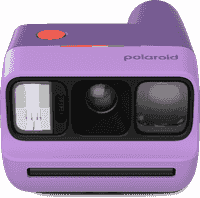 Polaroid Go Generation 3$82.00 (list $89.99)Check price on Amazon
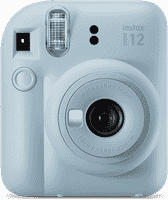 Instax Mini 12$82.94 (list $79.95)Check price on Amazon
Specs side by side
Same on both: Analog instant camera · Current · selfie mirror · no bulb mode · no tripod socket.
| Spec | Polaroid Go Generation 3 | Instax Mini 12 |
|---|---|---|
| Launched | 2026 | 2023 |
| Film or media | Polaroid Go | Instax Mini |
| Print size | 66.6 x 53.9 mm | 86 x 54 mm |
| Image size | 47 x 46 mm | 62 x 46 mm |
| Film cost per shot | $1.36 | $0.91 |
| Lens | 63.75 mm polycarbonate resin fixed-focus lens (about 42 mm equivalent), up from 51.1 mm on the Gen 2 | 60 mm f/12.7, 2 components 2 elements |
| Focus | fixed focus; no autofocus, parallax error at close distances | fixed; 0.3 m to infinity; close-up (selfie) mode 0.3 to 0.5 m with parallax correction |
| Exposure | automatic; apertures f/14.4 and f/32, selected by the camera | automatic, Lv 5.0 to 14.5 (ISO 800) |
| Shutter | 1/500 to 1 s | 1/2 to 1/250 s, slow synchro for low light |
| Flash | built-in vacuum discharge tube flash, stronger than the Gen 2; can be switched off with the flash button but defaults back on for every shot | auto, always fires |
| Close-up mode | No | Yes |
| Self timer | Yes | No |
| Double exposure | Yes | No |
| Power | built-in lithium-ion battery, USB-C rechargeable | 2 x AA alkaline |
| Shots per battery / prints per charge | 120 | 100 |
| App | Polaroid app for Scan & Share only; no Bluetooth camera control or remote trigger | instax UP! |
| Dimensions | 106.5 x 83.8 x 64.6 mm | 104 x 66 x 122 mm |
| Weight | 252 g | 306 g |
| Colours | 5 (White, Black, Teal Blue, plus 2 more) | 5 (Pastel Blue, Blossom Pink, Mint Green, plus 2 more) |
| Street price | $82.00 (checked October 5, 2026) | $82.94 (checked October 5, 2026) |
| Amazon rating | 3.8 (224 ratings) | 4.6 (1,554 ratings) |
| Buy | Check price on Amazon | Check price on Amazon |
Specs from manufacturer pages; prices and ratings checked October 5, 2026.
What reviewers and buyers say
Polaroid Go Generation 3
Published reviews of the Polaroid Go Generation 3:
- “The palm-sized Go Gen 3 is the smallest instant camera yet and bags of fun to shoot with, and the cheaper film makes it far more enjoyable to experiment with than the larger Polaroids, but watch yourself in bright sunlight because it is easy for images to be overexposed to near-oblivion.” (TechRadar (Jon Stapley), 2026-06)
- “Artaius calls it Polaroid's best miniature camera yet, giving the most consistent and highest-quality results of any Go thanks to the longer lens and improved exposure.” (Digital Camera World (James Artaius), 2026-07)
- “The Polaroid Go Generation 3 is a sensible update to what was already one of the most charming instant cameras around, staying focused on being small, approachable and easy to bring along.” (Keith Wee, 2026-06)
Amazon buyers rate it 3.8 out of 5 across 224 ratings.
Praised for: genuinely pocket-sized, Go film is much cheaper per shot than i-Type, selfie mirror and stronger flash make selfies work, simple enough for a child to use. Criticised for: prints blow out in bright sunlight, flash turns itself back on for every shot, no tripod thread despite having a self-timer, tiny image area.
Instax Mini 12
Published reviews of the Instax Mini 12:
- “The Mini 12's upgrades over the Mini 11 are worth the extra money if you mostly photograph people, though bright daylight can still cause over-exposure.” (Cameralabs, 2023)
- “The Mini 12 is easier to shoot with than the Mini 8 and delivers the joy and fun that's at the heart of Instax cameras without missing the older camera's extra modes.” (Amateur Photographer, 2023)
- “The Instax Mini 12 is still the best bang-for-buck instant camera you can buy.” (Digital Camera World, 2023)
- “The Mini 12 is an iterative update that keeps what works about the Mini 11 but makes it even better, and is the best Instax camera for jumping into instant film, despite a battery door that fits terribly.” (Dan Finnen, 2024-01)
Amazon buyers rate it 4.6 out of 5 across 1,554 ratings.
Praised for: easy enough for kids and first-timers, reliable auto-exposure in daylight, fun color options. Criticised for: flash always fires and cannot be turned off, feels plastic and toy-like, battery door fits poorly.
Frequently asked questions
Which has cheaper film, the Polaroid Go or the Instax Mini 12?
The Instax Mini 12, by a wide margin. Instax Mini film works out at about $0.91 a shot, from a twin pack of 20 shots at $18.17. Polaroid Go film works out at about $1.36 a shot, from a Polaroid Go Color double pack of 16 shots at $21.79. Both prices were checked in October 2026.
Which is smaller, the Polaroid Go or the Instax Mini 12?
The Polaroid Go Generation 3. It measures 106.5 x 83.8 x 64.6 mm and weighs 252 g. The Instax Mini 12 measures 104 x 66 x 122 mm and weighs 306 g. Jon Stapley at TechRadar calls the Go the smallest instant camera yet.
Are Polaroid Go and Instax Mini photos the same size?
No, and the two films are not interchangeable. A Polaroid Go print is 66.6 x 53.9 mm with a 47 x 46 mm image, which is close to square. An Instax Mini print is 86 x 54 mm with a 62 x 46 mm image. The image areas are the same height and the Instax one is 15 mm wider.
Which is better for kids?
The Instax Mini 12 on cost, because the film is about a third cheaper a shot and the camera itself costs about the same. It also has a close-up mode from 0.3 to 0.5 m with parallax correction, which the Go does not. The Go is the lighter camera at 252 g and adds a self timer and double exposure. Amazon buyers rate the Mini 12 4.6 out of 5 across 1,554 ratings and the Go 3.8 out of 5 across 224 ratings.