
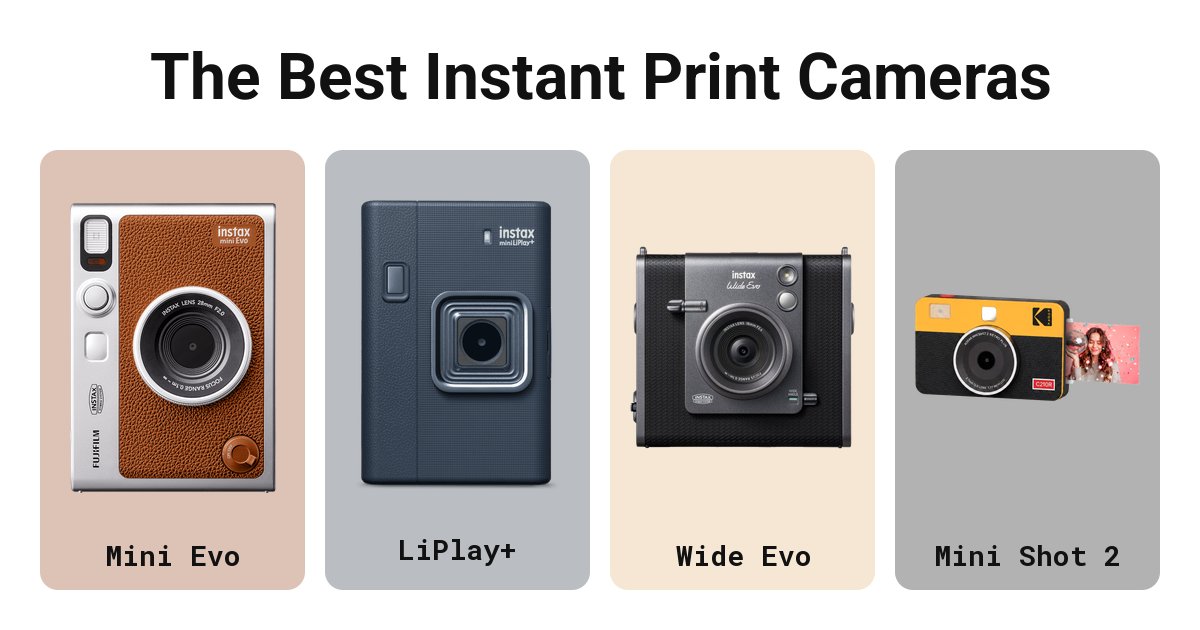
The Instax Mini Evo is the best instant print camera: shoot digitally, print only the shots you like on real Instax film, and use it as a phone printer too.
An instant print camera hands you a paper photo within a minute of pressing the shutter. Every camera below takes a digital picture first, and most let you look at it before anything prints. They print on three different kinds of paper, and that choice decides how the print looks and what each one costs to run.
Best overall: Instax Mini Evo
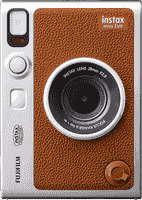
Instax Mini EvoBest overall
Street price: $199.00 (list $234.95)
Amazon rating: 4.6 out of 5 (2,008 ratings)
Pros
- 100 lens/film effect combinations make it feel like a real creative tool
- can review and choose which shots to print, so no wasted film
- retro dial-and-lever design feels premium
Cons
- photos look noticeably more digital/lower-resolution than analog Instax prints
- printing is slow if you shoot a lot
- no optical viewfinder
The Mini Evo is the hybrid most people should buy. It takes a digital photo, shows it on a 3.0-inch screen, and prints only the frames you choose on Instax Mini film. A ring around the lens picks one of 10 lens effects, a film dial picks one of 10 film effects, and a lever prints the shot. That is 100 combinations you can reach without opening an app. It also has autofocus, a flash you can switch off, a self-timer, and exposure compensation from -2 to +2 EV.
It stores about 45 pictures in its own memory plus whatever fits on a microSD card. Prints come out at 318 dpi in about 16 seconds, and one charge covers about 100 prints. It pairs with a phone app over Bluetooth.
Film costs about $0.91 a shot, the same as any Instax Mini camera. The saving is that you never pay for a blink. In our Instax Mini 99 vs Mini Evo comparison, the Evo won because fewer than 11 wasted frames on the analog Mini 99 cover the $9.95 price gap.
What you give up is the analog look. Buyers and reviewers say its prints look flatter and more digital than a picture exposed straight onto Instax film. There is no optical viewfinder, and it charges over Micro-B USB, not USB-C. TechRadar still calls it its favorite hybrid instant camera, and Digital Camera World said it has much to recommend it if you accept the digital-looking photos.
At $199 on October 5, 2026, it was 95 cents cheaper than the LiPlay+, with 2,008 Amazon ratings behind it against 19. Our Mini Evo vs Mini LiPlay comparison covers both in detail.
Best for selfies: Instax Mini LiPlay+
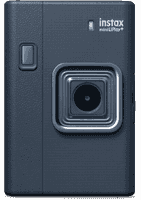
Instax Mini LiPlay+Best for selfies
Street price: $199.95 (list $234.95)
Amazon rating: 4.2 out of 5 (19 ratings)
Pros
- first Instax with a real rear selfie camera instead of a mirror
- understated design that looks more grown-up than the Mini Evo
- big, sharp 3-inch screen and easy Bluetooth printing from a phone
Cons
- the app will only pull across photos you have already printed
- noticeable shutter lag, so candid shots get missed
- priced the same as the Instax Mini Evo, which most reviewers prefer
The LiPlay+ is the first Instax with a real rear-facing selfie camera. You frame a selfie on the screen instead of in a small mirror, and a Layered Photo mode puts the front and rear cameras in one frame. The 3.0-inch screen has about 920,000 dots, twice the Mini Evo’s 460,000, and prints take about 13 seconds, three seconds quicker than the Evo. It also prints photos already on your phone, and Sound Print adds about three seconds of audio to a print as a QR code. Fujifilm keeps that audio for 24 months only.
The weak points are speed and image quality. Shutter lag is about 0.7 seconds without flash and 1.5 seconds with it, so candid shots get missed. The sensor is a 1/5-type chip of about 4.9 MP, so the digital files are good for choosing what to print and not much else. The app will only import photos you have already printed. There are no effect dials, no tripod socket and no touch screen.
It was $199.95 on October 5, 2026, against a $234.95 list price, the same money as the Mini Evo. Hillary K. Grigonis at Digital Camera World said it is well done but that she prefers the Mini Evo at about the same price. Its Amazon rating of 4.2 comes from only 19 ratings, too few to read much into.
Buy the LiPlay+ if selfies are what the camera is for. If they are not, the Evo gives you more for the same price. Our Mini Evo vs Mini LiPlay comparison sets the two side by side.
Best for big prints: Instax Wide Evo
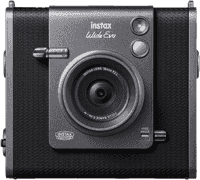
Instax Wide EvoBest for big prints
Street price: $365.89 (list $349.95)
Amazon rating: 4.3 out of 5 (104 ratings)
Pros
- big wide-format prints from a hybrid, review-before-you-print workflow
- extensive effects system carried over from the Mini Evo
Cons
- nearly double the price of the Mini Evo
- digital prints look flatter than analog Wide film
The Wide Evo applies the Mini Evo’s idea to Instax Wide film. The sheet is 86 x 108 mm, twice the area of an 86 x 54 mm Mini sheet, so group shots and landscapes have room. You get 10 lens effects, 10 film effects, 6 film styles and a wide-angle mode, a 3.5-inch screen, a selfie mirror and a self-timer. Unlike the Mini Evo and the LiPlay+, it has a tripod socket. It prints at 318 dpi, manages about 100 prints a charge and charges over USB-C.
The cost is the catch. It was $365.89 on October 5, 2026, above its $349.95 list price and $166.89 more than the Mini Evo. Wide film costs about $1.40 a shot, so 100 prints come to about $140, against about $91 on the Mini Evo. It is also big: 490 g and 138.7 x 125 x 62.8 mm.
Amateur Photographer found its auto exposure can misjudge back-lit or bright scenes. And as with the Mini Evo, the prints look flatter than an analog Wide shot.
In our Instax Wide Evo vs Wide 400 comparison, we picked the analog Wide 400. At $149.95 it was $215.94 cheaper, enough for about 154 shots of Wide film, and it makes a true analog print. Buy the Wide Evo only if choosing before you print matters more to you than that money. Amazon buyers rate it 4.3 out of 5 across 104 ratings.
Best budget hybrid: Kodak Mini Shot 2 Retro

Kodak Mini Shot 2 RetroBest budget hybrid
Street price: $114.99 (list $149.99)
Amazon rating: 4.3 out of 5 (4,962 ratings)
Pros
- colors print true to life and vibrant
- compact and genuinely pocketable
- straightforward controls anyone can pick up
Cons
- battery life is weaker than rival hybrid cameras and has no charge indicator
- no double-exposure mode
- small 2x3 print size limits detail
The Mini Shot 2 Retro does the same job as the Evo for less money, with a different kind of print. It takes a digital photo, shows it on a 1.77-inch screen so you can choose, and prints on Kodak’s 4PASS cartridges. Those hold the paper and the dye ribbon together, and the finished print gets a laminate layer. It also prints photos from your phone over Bluetooth through the Kodak Photo Printer app.
Prints cost about $0.42 each, from a 60-sheet refill at $24.99 checked in September 2026. That is less than half the Evo’s $0.91. At $114.99 the camera was also $84.01 cheaper than the Evo on October 5, 2026. One hundred prints come to about $42 against about $91.
Tom’s Guide found its color faithful and its low-light results the best of any instant camera it tested. It weighs 255 g and fits in a pocket.
What you give up: the prints are 53 x 86 mm, small enough that reviewers say the size limits detail, and each one takes about a minute. The battery lasts about 20 prints, the weakest here, and there is no battery indicator, so it can die without warning. The lens is fixed focus, and there is no face detection for selfies even though it has a mirror.
It holds 4.3 out of 5 across 4,962 ratings on its Amazon listing, the best of Kodak’s current hybrids. Our Kodak vs Polaroid comparison explains how 4PASS prints differ from Zink and film.
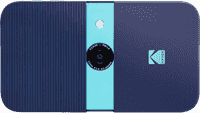
Best for kids: Kodak Smile
Pros
- the screen lets you choose which shots to print instead of wasting paper
- slide-open body is genuinely pocketable and cannot fire by accident
- prints are ready in well under a minute and have sticky backs
Cons
- print and image quality are only fair, and dull or indoor light defeats it
- the flash is weak beyond about two metres
- you have to press OK after the shutter or the photo is not saved
The Smile is the camera to hand a child. It has a screen on the back and a separate print button, so only the shots they like get printed. The slide-open case is the power switch and covers the lens, so it cannot fire by accident in a bag. At 122 x 79 x 23 mm it is thin enough for a pocket, unlike almost every Instax camera. It prints in about 35 seconds on sticky-backed 2 x 3-inch Zink paper, and one charge covers about 40 prints. A photo booth mode puts two shots on one sheet.
Paper costs about $0.49 a print, from 50 sheets at $24.37 checked in September 2026. That is about half the cost of Instax Mini film.
Print quality is fair at best, and dull or indoor light defeats it. The flash is weak beyond about two meters. Kodak markets it as 10 MP, but the sensor is 5 MP and Tom’s Guide measured the saved files at 854 x 640 pixels. You have to press OK after the shutter or the photo is not saved, which catches out anyone borrowing it. Internal memory holds only two to five photos, so a microSD card is close to essential. It has no Bluetooth, so it cannot print photos from a phone.
It was $99.99 on Kodak’s own store on October 5, 2026. Amazon buyers rate it 4.4 out of 5 across 2,078 ratings, and a minority report cameras dying within weeks. Tom’s Guide recommended it as a pocketable instant camera for under $100. Our Instax vs Zink comparison covers how the paper compares with film.
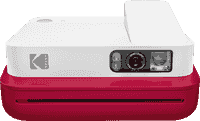
Biggest Zink prints: Kodak Smile Classic
Kodak Smile ClassicBiggest Zink prints
Street price: $119.99 (list $169.99)
Amazon rating: 3.8 out of 5 (225 ratings)
Pros
- prints are much bigger than any other Zink or Instax camera
- retro pop-up viewfinder and Polaroid-style body
- works as a Bluetooth printer for phone photos, which print better than camera shots
Cons
- units that arrive dead or stop printing full photos after a few days
- photos jam or come out partly printed
- Zink paper is expensive at about a dollar a sheet
The Smile Classic prints on 3.5 x 4.25-inch Zink paper, 89 x 108 mm, a touch wider than an Instax Wide sheet and the biggest print of any mainstream instant camera. The prints have a white border and sticky backs. It also works as a Bluetooth printer for phone photos, and buyers say those print better than the camera’s own shots. WIRED called its output the best Zink it had tested. The pop-up viewfinder and Polaroid-style body are much of the appeal.
It has no screen, so every shot prints, good or bad. Paper is about $1 a sheet, from 40 sheets at $39.99 checked in September 2026, about double the small Zink cameras. The camera holds 10 sheets at a time, one charge covers about 35 prints, and at 408 g it is not a pocket camera.
Reliability is the bigger worry. It was $119.99 on October 5, 2026, well under its $169.99 list price, but its Amazon listing sits at 3.8 out of 5 across 225 ratings. The one- and two-star reviews are dominated by cameras that will not power on, prints that stop halfway and paper jams.
Buy it for big sticky prints for a scrapbook, and buy it from a seller with an easy return policy. Our Instax vs Zink comparison compares Zink print quality with Instax.
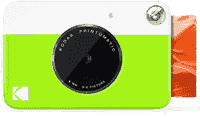
Cheapest: Kodak Printomatic
Pros
- easy for kids and beginners to point-and-shoot
- prints double as fun adhesive stickers
- cheap way to get both a print and a digital copy
Cons
- Zink prints look washed-out or pink-tinted compared to real film
- no preview, so bad shots print anyway
- image quality drops a lot indoors or in low light
The Printomatic was $69.99 on October 5, 2026, the lowest price on this page. It prints every shot on 2 x 3-inch sticky-backed Zink paper at about $0.49 a print, and it saves a digital copy to a microSD card of up to 32 GB, sold separately. A slider switches between color and black and white. It weighs 200 g and comes in five colors.
There is no screen and no preview. The camera prints a few seconds after every shot, and there is no way to skip a bad one. That changes the math. The Kodak Smile costs $30 more and lets you choose; at $0.49 a sheet, about 62 wasted prints on the Printomatic cover that gap.
Other trade-offs: the flash fires on its own in low light and cannot be switched off, there is no self-timer, and one charge covers about 25 prints. Prints look washed out or pink next to real film, and indoor shots suffer most. The box includes only 5 sheets of paper, so buy a pack with it.
Its Amazon listing shows 3.9 out of 5 across 26,595 ratings. Buyers like it as a simple first camera for a child and for parties. Our Kodak vs Polaroid comparison covers Kodak’s whole camera range.
Hybrid, Zink or dye-sub: what “instant print camera” means
Every camera on this page takes a digital picture with a sensor and then prints it. What differs is the paper.
Instax hybrids such as the Mini Evo, LiPlay+ and Wide Evo print on the same Instax film that analog Instax cameras use. Fujifilm says a Mini print develops in about 90 seconds. The print keeps the classic white frame and looks the best of the three. It also costs the most, about $0.91 a Mini print and $1.40 a Wide print.
Zink is paper with the color built in as three layers of heat-sensitive dye crystals. The camera’s print head brings the picture out with heat, with no ink or ribbon, and the print comes out finished and sticky-backed. Kodak’s Smile, Smile Classic and Printomatic use it. It costs about $0.49 a small print, but reviewers consistently rate the color and contrast below Instax. Our Instax vs Zink comparison goes through the differences.
4PASS is Kodak’s dye-sublimation system, used in the Mini Shot cameras. A cartridge holds the paper and a dye ribbon together, and a laminate layer finishes the print. Reviewers describe the prints as resisting water, fingerprints and fading, and they cost about $0.42 each on the Mini Shot 2 Retro.
If you mostly take photos on your phone, you may not need a camera at all. Our Instax printer vs camera comparison covers when a phone printer like the Mini Link 3 makes more sense.
Prefer pure film?
A hybrid’s print is a copy of a digital file. If you want the picture exposed straight onto the film through a lens, buy an analog camera instead. The Instax Mini 13 was $79.95 on October 5, 2026 and is the easiest one to use. The Instax Mini 99, at $189.05, adds a brightness dial, color effects, double exposure and bulb mode. The Polaroid Flip, at $210, makes a full-size Polaroid print with four-zone autofocus. Analog cameras print every shot, so the film bill depends on how careful you are.
A Mini 13 and an Instax Mini Link 3 printer together came to $179.90 on the same date, $19.10 less than the Mini Evo. That pair gives you an analog camera plus a printer for your phone photos, in two bodies instead of one. Our best instant cameras guide covers the film cameras in full.
Hybrids we left out
Instax Mini Evo Cinema. A Super 8-styled hybrid that also records short video clips, shared by printing a QR code. It was $389 against a $409.95 list price, and Amazon buyers rate it 3.7 out of 5 across only 23 ratings. Its sensor is about 5 MP and standard video is 600 x 800. Andy Westlake at Amateur Photographer called it “just an expensive toy”.
Kodak Smile+. It is on Digital Camera World’s list of hybrid cameras. It has a rotating effect lens and Bluetooth phone printing, but no screen, so every shot prints. It was $99.99, the same as the plain Smile, which has a screen and rates 4.4 against the Smile+’s 4.1 across 280 ratings.
Instax Mini LiPlay. The original LiPlay was $165, above its $159.95 list price. It is smaller than the Evo and records up to 10 seconds of audio as a QR code, but it has a 2.7-inch screen and sluggish single-point autofocus. If $34 off the Evo matters most, our Mini Evo vs Mini LiPlay comparison explains when it is worth buying.
How we chose
We have not tested most of these cameras in person yet. The picks come from each product’s published specs, prices and Amazon ratings checked on October 5, 2026, and from named professional reviews. Paper prices for the Kodak cameras were checked in September 2026. Cost per print is the regular price of the paper or film divided by the sheets in the pack, never a sale price, and totals for 100 prints are that per-print figure times 100. Our method is on the How We Test page.
At a glance
| Model | Pick | Street price | Film | Cost per shot | Print size | Amazon rating |
|---|---|---|---|---|---|---|
| Instax Mini Evo | Best overall | $199.00 | Instax Mini | $0.91 | 86 x 54 mm | 4.6 (2,008 ratings) |
| Instax Mini LiPlay+ | Best for selfies | $199.95 | Instax Mini | $0.91 | 86 x 54 mm | 4.2 (19 ratings) |
| Instax Wide Evo | Best for big prints | $365.89 | Instax Wide | $1.40 | 86 x 108 mm | 4.3 (104 ratings) |
| Kodak Mini Shot 2 Retro | Best budget hybrid | $114.99 | Kodak 4PASS 2.1x3.4 | $0.42 | 53 x 86 mm | 4.3 (4,962 ratings) |
| Kodak Smile | Best for kids | $99.99 | Zink 2x3 | $0.49 | 76 x 51 mm | 4.4 (2,078 ratings) |
| Kodak Smile Classic | Biggest Zink prints | $119.99 | Kodak Zink 3.5x4.25 | $1.00 | 89 x 108 mm | 3.8 (225 ratings) |
| Kodak Printomatic | Cheapest | $69.99 | Kodak Zink 2x3 | $0.49 | 76 x 51 mm | 3.9 (26,595 ratings) |
Prices and ratings checked October 5, 2026.
Frequently asked questions
Which instant print camera has the best quality?
Among hybrids, the Instax Mini Evo. It prints on real Instax Mini film at 318 dpi, and Amazon buyers rate it 4.6 out of 5 across 2,008 ratings. Reviewers and buyers do say its prints look flatter and more digital than a shot exposed straight onto film by an analog Instax camera.
Are instant print cameras worth it?
If you want to choose which shots to print, yes. A hybrid like the Mini Evo only spends film on the frames you keep, at about $0.91 a print. If you print everything you shoot anyway, an analog camera like the $79.95 Instax Mini 13 is cheaper to buy and uses the same film.
Is Kodak or Instax better?
Instax for print quality, Kodak for running cost. Kodak's small Zink cameras, the Smile and Printomatic, cost about $0.49 a print, about half the $0.91 of Instax Mini film, and the 4PASS Mini Shot 2 Retro prints for about $0.42. Reviewers consistently rate Zink prints below Instax for color and contrast.
What cameras can print photos instantly?
Analog Instax and Polaroid film cameras, which expose the film directly. Hybrid cameras like the Instax Mini Evo and Mini LiPlay+, which shoot digitally and print on Instax film. And Kodak's digital print cameras, such as the Smile on Zink paper and the Mini Shot 2 Retro on 4PASS dye-sublimation paper.
What is the best instant camera printer?
If you mean a camera that also prints photos from your phone, the Instax Mini Evo, the Mini LiPlay+ and the Kodak Mini Shot 2 Retro all do both over Bluetooth. The Kodak Smile Classic prints phone photos too, but it has no screen for its own shots. If you only want a printer, see our portable photo printer picks.