
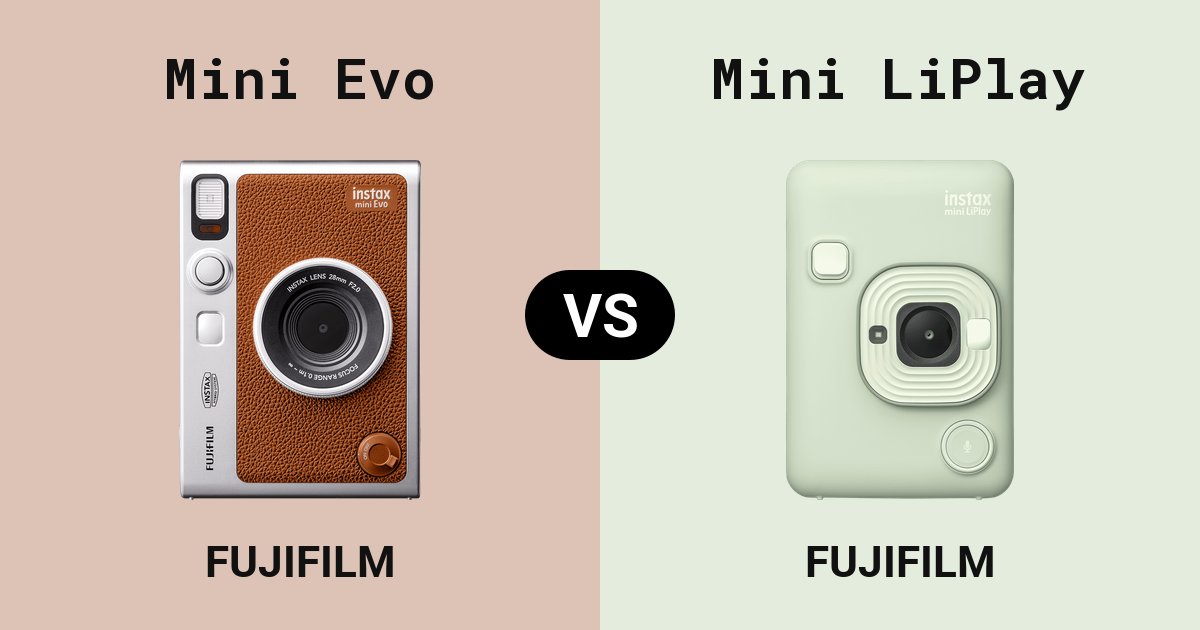
Both lines are hybrids that let you choose what gets printed, so this is a choice about controls, screens and price. The Mini Evo is the one to buy, and the newer LiPlay+ lists at the same $234.95 without beating it.
Fujifilm’s hybrid Instax cameras come in two lines. The Mini LiPlay launched in 2019, the Mini Evo in 2021, and the Mini LiPlay+ arrived in 2025 as the newer LiPlay. All three shoot digitally and print on the same Instax Mini film, so the choice is about the bodies rather than the pictures.
What is actually different
Hybrid means all three take the picture with a sensor, show it on a screen and print only what you pick. None of them spends film on a shot you have not looked at, so the differences are in how you drive them.
The Mini Evo is the one with dials. A ring around the lens picks one of 10 lens effects and a dial on top picks one of 10 film effects, so there are 100 combinations, and a lever prints the frame. The screen is a 3.0-inch colour LCD of about 460,000 dots. Prints come out at 318 dpi in about 16 seconds, 100 of them per charge. It holds about 45 pictures in internal memory plus whatever fits on a microSD card, connects over Bluetooth to the instax mini Evo app, weighs 285 g, comes in Black and Brown, and charges over Micro-B USB.
The original Mini LiPlay is the small one. Its screen is 2.7 inches, and its trick is sound: it records up to 10 seconds of audio and prints it as a QR code on the frame. It also works as a printer for photos already on your phone. It charges over USB-C and comes in Deep Bronze, Misty White, Matcha Green and Stone White. Focus is its weak point. Digital Camera World found the autofocus sluggish with only a single centre point, and rated print quality good rather than great, vibrant and contrasty but short of most dye-sub mini printers on colour accuracy. Tom’s Guide liked it as a camera and printer in one but called the audio-printing feature a hassle.
The LiPlay+ has two cameras, a main lens at F2.0 and a rear selfie camera at F2.2, both 28 mm equivalent, on a 1/5-type CMOS sensor of 2560 x 1920 pixels, about 4.9 MP. There is no selfie mirror because the second camera does that job, and a Layered Photo mode puts both cameras in one frame. The screen is 3.0 inches at about 920,000 dots, a big step up from the original LiPlay’s 2.7-inch 230,000-dot panel, though it is not a touch screen. Prints take 13 seconds at 318 dpi. It weighs 265 g, measures 83.3 x 123.5 x 38 mm and comes in Sand Beige and Midnight Blue. Sound Print records about three seconds of audio instead of 10, and Fujifilm keeps that audio for only 24 months.
The app will only pull across photos you have already printed, and there is shutter lag of about 0.7 seconds without flash and 1.5 seconds with it, so candid shots get missed. Mark Goldstein at Photography Blog scored it 4 and called the true selfie camera the highlight for its target audience. Hillary K. Grigonis at Digital Camera World said it is everything she expected and well done, but that she prefers the Mini Evo, which costs about the same. Jim Fisher at PCMag called it a good pick on a limited film budget.
Price and film cost
At the last price check, on September 9, 2026, the Mini Evo was $234 and the Mini LiPlay was $151.95, against list prices of $234.95 and $159.95. The LiPlay+ was checked a day later, on September 10, 2026, at $234.95, exactly its list price.
All three print on Instax Mini film, 86 x 54 mm with a 62 x 46 mm image, at about $0.88 a shot. A twin pack of 20 shots was $17.50 on September 9, 2026. All three spend film only on shots you have picked. The $82.05 between the LiPlay and the Evo is worth about 93 frames.
Which one to buy
Buy the Mini Evo. At $234 it undercuts the LiPlay+ by 95 cents and has the better record behind it, 4.6 out of 5 across 2,600 ratings against 4.0 across 17, and the effect dials are the reason to choose it. TechRadar calls it its favourite hybrid instant camera, and Casual Photophile described it as a camera that lets you shoot digitally, pick your favourites and print only the ones worth keeping.
Buy the Mini LiPlay if you want to spend less. It was $151.95, about $82 under the Evo, it is the smallest of the three, and buyers rate it 4.8 out of 5 across 82 ratings. It records 10 seconds of audio onto the QR print, longer than the LiPlay+’s three. Expect the sluggish single-point autofocus and prints that Digital Camera World rated good rather than great.
Buy the LiPlay+ only if you want the selfie camera. It is the Instax with a rear-facing camera instead of a mirror, and its 920,000-dot screen is the sharpest of the three. You give up the Evo’s effect dials for the same money, and you live with the shutter lag and an app that only imports photos you have already printed.
None of the three makes an analog print, and none has a tripod socket. A hybrid is the wrong camera if that is what you are after.
Where to buy
 Instax Mini Evo$234.00 (list $234.95)Check price on Amazon
 Instax Mini LiPlay$151.95 (list $159.95)Check price on Amazon
 Instax Mini LiPlay+$234.95Check price on Amazon
Specs side by side
Same on all three: Hybrid instant camera · Current · Instax Mini film · 86 x 54 mm print · 62 x 46 mm image · $0.88 a shot · no close-up mode · self timer · no double exposure · no bulb mode · no tripod socket.
| Spec | Instax Mini Evo | Instax Mini LiPlay | Instax Mini LiPlay+ |
|---|---|---|---|
| Launched | 2021 | 2019 | 2025 |
| Lens | 28 mm equivalent, 10 cm and beyond | 28 mm equivalent | main camera f = 28 mm equivalent, F2.0; rear selfie camera f = 28 mm equivalent, F2.2; 1/5-type CMOS sensor, 2560 x 1920 pixels (approx. 4.9 MP) |
| Focus | autofocus, 10 cm and beyond | autofocus | single AF with AF illuminator; main camera 10 cm to infinity, selfie camera 41 cm to infinity |
| Exposure | programmed AE, ISO 100-1600 automatic, -2.0 to +2.0 EV compensation | programmed AE | programmed AE; ISO 100 to 1600 auto; 256-segment TTL metering with multi metering for low light; exposure compensation |
| Shutter | 1/4 to 1/8000 s automatic | automatic | 1/4 to 1/8000 s (automatic switching) |
| Flash | auto / forced / suppressed, range approx. 50 cm to 1.5 m | auto / forced / suppressed | auto / forced / suppressed, main camera only; effective range approx. 50 cm to 1.5 m |
| Selfie mirror | Yes | Yes | No |
| Manual modes | 10 lens effects, 10 film effects, white balance, exposure compensation | sound recording printed as QR code | exposure compensation |
| Power | internal Li-ion, USB (Micro-B) charging | internal Li-ion, USB Type-C charging | internal lithium-ion battery (not removable), USB-C charging, approx. 2 to 3 hours to full charge |
| Shots per battery / prints per charge | 100 | n/a | 100 |
| Print resolution | 318 dpi | n/a | 318 dpi |
| Print time | 16 s | n/a | 13 s |
| Connectivity | Bluetooth (smartphone app) | Bluetooth (smartphone app) | Bluetooth; USB-C (charging only) |
| App | instax mini Evo app | instax mini LiPlay app | instax mini LiPlay app |
| Screen | 3.0-inch TFT color LCD, approx. 460,000 dots | 2.7-inch LCD | 3.0-inch TFT colour LCD, approx. 920,000 dots, not touch-sensitive |
| Storage | internal memory (approx. 45 images) plus microSD/microSDHC | internal memory plus microSD/microSDHC | internal memory approx. 45 images; microSD / microSDHC card (approx. 850 images per GB) |
| Dimensions | n/a | n/a | 83.3 x 123.5 x 38 (including the lens parts) |
| Weight | 285 g | n/a | 265 g |
| Colours | 2 (Black, Brown) | 4 (Deep Bronze, Misty White, Matcha Green, plus 1 more) | 2 (Sand Beige, Midnight Blue) |
| Street price | $234.00 (checked September 9, 2026) | $151.95 (checked September 9, 2026) | $234.95 (checked September 10, 2026) |
| Amazon rating | 4.6 (2,600 ratings) | 4.8 (82 ratings) | 4 (17 ratings) |
| Buy | Check price on Amazon | Check price on Amazon | Check price on Amazon |
Specs from manufacturer pages; prices and ratings checked September 10, 2026.
What reviewers and buyers say
Instax Mini Evo
Published reviews of the Instax Mini Evo:
- “If you're looking for one instant print camera that does it all, and you're satisfied with the digital-looking photographs from the device itself, the Instax Mini Evo has much to recommend it.” (Digital Camera World, 2022)
- “The Mini Evo is our favorite hybrid instant camera, putting fun first, though its digital-first approach and lack of optical viewfinder might put off fans of true analogue photography.” (TechRadar, 2022)
- “The Instax Mini Evo is a strong contender for the best instant camera for beginners thanks to its blend of digital control and analog instant prints.” (Amateur Photographer, 2022)
- “The Mini Evo is a genuinely fun hybrid camera that lets you shoot digitally, pick your favorite shots, and only print the ones worth keeping.” (Casual Photophile, 2022-11)
Amazon buyers rate it 4.6 out of 5 across 2,600 ratings.
Praised for: 100 lens/film effect combinations make it feel like a real creative tool, can review and choose which shots to print, so no wasted film, retro dial-and-lever design feels premium. Criticised for: photos look noticeably more digital/lower-resolution than analog Instax prints, printing is slow if you shoot a lot, no optical viewfinder.
Instax Mini LiPlay
Published reviews of the Instax Mini LiPlay:
- “Print quality is good rather than great, with vibrant, contrasty images that can't match most dye-sub mini printers for color accuracy, and autofocus is sluggish with only a single center AF point.” (Digital Camera World, 2019)
- “The Instax Mini LiPlay is a great hybrid instant camera and printer that lets you take retro photos and print your own from a smartphone, though the audio-printing feature can be a hassle.” (Tom's Guide, 2019)
- “Despite being one of the more expensive cameras tested, the Mini LiPlay offers unmatched creativity, making it worth the extra cost.” (TechGearLab, 2020)
Amazon buyers rate it 4.8 out of 5 across 82 ratings.
Praised for: compact, pocketable hybrid design, sound-to-QR-code feature is a novel touch, can review shots before printing. Criticised for: single, center-only autofocus point can hunt indoors, print quality trails dedicated dye-sub mini printers.
Instax Mini LiPlay+
Published reviews of the Instax Mini LiPlay+:
- “It's no threat to our Editors' Choice Instax Mini 99, which is analog and has internal lights that add optical filter effects to instant snaps, but the LiPlay+ is still a good pick if you have a limited budget for film packs.” (Jim Fisher, PCMag, 2026-01)
- “Overall, the Fujifilm Instax Mini LiPlay+ does what its name suggests, namely extends the functionality and widens the appeal of the rather quirky original model, with the addition of a true selfie camera being a particular highlight for its target audience.” (Mark Goldstein, Photography Blog, 2025-11)
- “Ultimately, the LiPlay+ is everything I expected and well done - but I prefer the Instax Mini Evo, which is about the same price.” (Hillary K. Grigonis, Digital Camera World)
Amazon buyers rate it 4 out of 5 across 17 ratings.
Praised for: first Instax with a real rear selfie camera instead of a mirror, understated design that looks more grown-up than the Mini Evo, big, sharp 3-inch screen and easy Bluetooth printing from a phone. Criticised for: the app will only pull across photos you have already printed, noticeable shutter lag, so candid shots get missed, priced the same as the Instax Mini Evo, which most reviewers prefer.
Frequently asked questions
What is the difference between the Instax Mini Evo and the Mini LiPlay?
Both are hybrid cameras that print the shots you choose on Instax Mini film. The Mini Evo, from 2021, has a lens ring and a film dial giving 10 lens effects and 10 film effects, 100 combinations in all, a 3.0-inch 460,000-dot screen, and 318 dpi prints in about 16 seconds. The Mini LiPlay, from 2019, is smaller, has a 2.7-inch screen, and records up to 10 seconds of audio that prints as a QR code on the frame. At the last check the Evo was $234 and the LiPlay was $151.95.
Is the Instax Mini LiPlay+ better than the Mini Evo?
Not for the money. Both list at $234.95, and at the last check the LiPlay+ was $234.95 and the Evo $234. The LiPlay+, from 2025, adds a rear selfie camera at F2.2, a 3.0-inch 920,000-dot screen and 13-second prints, but Digital Camera World's Hillary K. Grigonis still said she prefers the Mini Evo, which is about the same price. Amazon buyers rate the Evo 4.6 out of 5 across 2,600 ratings and the LiPlay+ 4.0 out of 5 across 17 ratings.
Which hybrid Instax is cheapest to run?
All three cost the same to run. The Mini Evo, the Mini LiPlay and the Mini LiPlay+ all print on Instax Mini film at about $0.88 a shot, and a twin pack of 20 shots was $17.50 at the last check, on September 9, 2026. Because all three are hybrids, film is only spent on pictures you have already chosen on the screen.
Does the Instax Mini Evo record sound?
No. Sound recording is a LiPlay feature. The original Mini LiPlay records up to 10 seconds of audio and prints it as a QR code on the frame, and the 2025 LiPlay+ records about three seconds as Sound Print, with Fujifilm keeping that audio for 24 months. The Mini Evo's extras are its 10 lens effects and 10 film effects instead.