
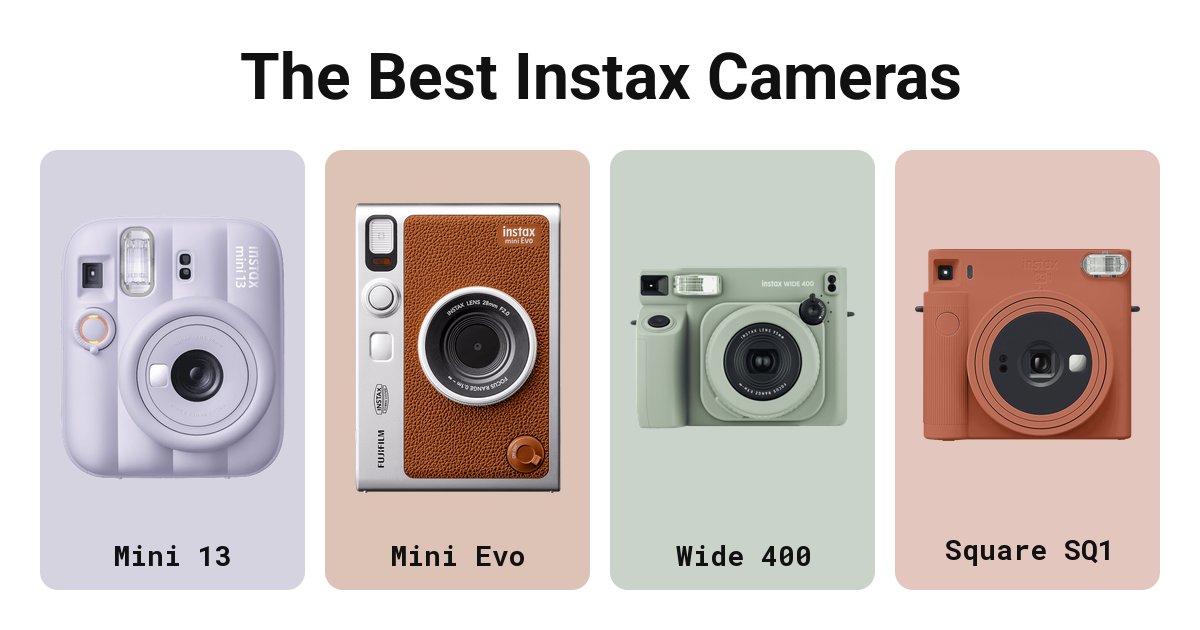
The Instax Mini 13 is the best Instax camera for most people: $79.95, a self-timer, and the cheapest Instax film at $0.91 a shot. Seven more ranked below.
Fujifilm’s US Instax site listed 15 cameras in October 2026, counting its Pal digital cameras that need a separate printer, and most of the differences come down to two choices: which film size you want, and whether the camera shoots straight to film or takes a digital photo first. Every current model in our database has a place below, ranked by how many people it suits.
Best overall: Instax Mini 13
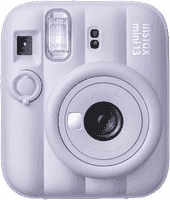
Instax Mini 13Best overall
Street price: $79.95 (list $93.95)
Amazon rating: 4.5 out of 5 (19 ratings)
Pros
- twist-the-lens operation is easy for kids and first-timers
- new 2 s and 10 s self-timer plus the wedge stand make group shots practical
- close-up mode framing matches the selfie mirror closely
Cons
- flash fires on every shot and cannot be switched off
- no tripod socket and no double-exposure mode
- nothing new for anyone who already owns a Mini 11 or Mini 12
Inside the Mini range, the Mini 13 is the one to start with. It shares the Mini 12’s 60 mm f/12.7 lens, automatic exposure and Instax Mini film, so the pictures are the same. What changes is a self-timer with 2 and 10 second settings, set by twisting the ring around the shutter button. The wrist strap folds into a stand that props the camera at an angle, which makes timer shots on a table easy.
The rest is as simple as Instax gets. Twist the lens to switch on, press the button, wait for the print. Two AA batteries run about 100 shots, and close-up mode corrects for parallax from 0.3 to 0.5 m.
You cannot switch the flash off, mount it on a tripod or adjust the exposure. If you already own a Mini 11 or Mini 12, there is little here for you.
On October 5, 2026 it cost $79.95 on Amazon, $2.99 less than the Mini 12 at $82.94 and $19.95 less than the Mini 41. Film runs about $0.91 a shot. It had only 19 Amazon ratings at that point, averaging 4.5, so the reviews say more: Android Central called it easy to use and inexpensive, and PetaPixel called it a simple continuation of the Mini line. See Instax Mini 12 vs Mini 13 for the full comparison.
Best hybrid: Instax Mini Evo
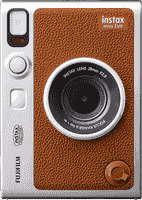
Instax Mini EvoBest hybrid
Street price: $199.00 (list $234.95)
Amazon rating: 4.6 out of 5 (2,008 ratings)
Pros
- 100 lens/film effect combinations make it feel like a real creative tool
- can review and choose which shots to print, so no wasted film
- retro dial-and-lever design feels premium
Cons
- photos look noticeably more digital/lower-resolution than analog Instax prints
- printing is slow if you shoot a lot
- no optical viewfinder
The Mini Evo is a digital camera with an Instax Mini printer built in. You frame and review on a 3.0-inch screen, and nothing goes onto film until you choose to print it. That makes it the Instax for people who hate wasting a frame.
It is also the most flexible Mini. Ten lens effects and ten film effects combine into 100 looks, exposure compensation runs from minus 2 to plus 2, the flash has an off setting, and autofocus works from 10 cm. Shots are saved to about 45 images of internal memory or a microSD card, and each print takes about 16 seconds.
The cost is the print itself. Because it starts as a digital file, reviewers and buyers find it looks flatter than a print from an analog Instax. Digital Camera World put it plainly: buy it if you are happy with digital-looking photographs. It has no optical viewfinder and charges over micro-USB.
It was $199 on October 5, 2026, with 4.6 out of 5 across 2,008 ratings, the biggest base of buyers of any pick here. Our Mini 99 vs Mini Evo comparison picked the Evo, and so did Mini Evo vs LiPlay.
Best for creative control: Instax Mini 99
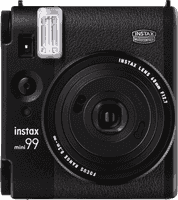
Instax Mini 99Best for creative control
Street price: $189.05 (list $199.95)
Amazon rating: 4.6 out of 5 (182 ratings)
Pros
- six color-effect filters and brightness dial give real creative control
- solid, premium-feeling build
- double exposure and bulb mode are rare on an analog Instax
Cons
- expensive next to the Mini 12/41
- color effects can be gimmicky for casual shooters
The Mini 13, Mini 12 and Mini 41 decide the exposure for you. The Mini 99 lets you step in. A brightness dial has five settings, from L+ to D-. There are modes for indoor and sports shots, a double exposure mode, and a bulb mode that holds the shutter open for up to 10 seconds. Six color-effect filters use lights inside the camera to tint the picture on the film itself, so the effect is analog, not a digital filter.
It also fixes the small annoyances of the cheaper Minis. You can turn the flash off. There is a tripod socket and a self-timer. A rechargeable NP-70S battery replaces AAs, and two shutter buttons let you hold it upright or sideways comfortably.
The downside is price. It was $189.05 on October 5, 2026, more than twice the Mini 13, for the same 62 x 46 mm picture. Casual shooters may find the color dial more fuss than fun.
Buyers rate it 4.6 out of 5 across 182 ratings, and TechRadar called it a ‘grown-up’ addition to the Instax family. Our Mini 41 vs Mini 99 comparison chose it over the Mini 41: the extra $89.15 buys every one of these controls.
Best for big prints: Instax Wide 400
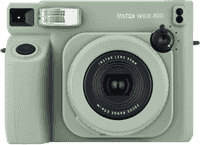
Pros
- large wide-format prints are great for group shots and events
- self-timer and angle-adjustment accessory are useful additions over the Wide 300
Cons
- very large and heavy to carry around
- no selfie mirror despite the size
If Mini prints feel like wallet photos, Wide is the fix. A Wide print is 86 x 108 mm, exactly twice the area of a Mini print, with a 62 x 99 mm picture. The Wide 400 is the only analog Wide camera Fujifilm still makes.
It is aimed at groups and events. The self-timer and tripod socket let the photographer get in the shot, and an angle-adjustment accessory in the box tilts the camera when it sits on a table. A separate close-up lens brings focus down to 0.4 to 0.5 m. Four AA batteries give about 100 shots.
It is big: 616 g and 162 x 98 x 123 mm, so it rides in a bag, not a pocket. It also has no selfie mirror. Buyers rate it 4.0 out of 5 across 331 ratings, a little lower than the Mini picks, and the recurring complaint is the bulk.
It was $149.95 on October 5, 2026. Wide film works out at about $1.40 a shot when bought as a five-pack of 100 shots for $139.95. For the older model, see Instax Wide 300 vs Wide 400.
Best square: Instax Square SQ1
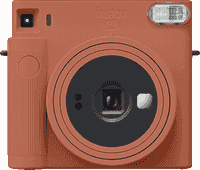
Instax Square SQ1Best square
Street price: $199.95 (list $119.95)
Amazon rating: 4.6 out of 5 (677 ratings)
Pros
- square format prints feel more premium than Mini prints
- simple point-and-shoot operation
- compact for a Square-format camera
Cons
- no self-timer, unlike the discontinued SQ6
- square film costs $1.57 a shot, more than Mini or Wide
- street price was well above Fujifilm's $119.95 list price in October 2026
Square film gives a 62 x 62 mm picture on an 86 x 72 mm print, a shape a lot of people prefer to the tall Mini frame. The SQ1 is the easiest way to shoot it. Twist the lens once to switch on and again for selfie mode, and the camera sets the exposure. A selfie mirror sits by the lens, and two CR2 lithium batteries last about 300 shots, three times what the Mini 13 gets from its AAs.
There is not much else. No self-timer, no tripod socket, no manual control, and the flash fires every time.
Watch the price. It was $199.95 on Amazon on October 5, 2026, against Fujifilm’s $119.95 list price. Check again before you buy. Square film is the most expensive Instax film at about $1.57 a shot, $31.40 for a twin pack of 20.
Buyers rate the SQ1 4.6 out of 5 across 677 ratings. Its sibling, the SQ40, uses the same lens and film in a black body, weighs 453 g against 390 g, and was $200 that day with 4.4 out of 5 across 401 ratings. Our SQ1 vs SQ40 comparison picked the SQ1.
Best classic look: Instax Mini 41
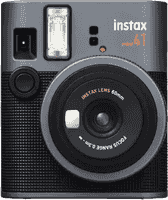
Instax Mini 41Best classic look
Street price: $99.90 (list $109.95)
Amazon rating: 4.4 out of 5 (334 ratings)
Pros
- classic retro look feels more grown-up than the Mini 12
- close-up mode framing is more accurate than earlier Minis
Cons
- still no manual exposure control at this price
- only one color available in the US
The Mini 41 is a styling choice. It wraps the same 60 mm f/12.7 lens, the same automatic exposure and the same Instax Mini film as the Mini 12 and Mini 13 in a black body with metallic accents. TechRadar called the design handsome, and buyers describe it as more grown-up than the Mini 12.
Cameralabs credits it with better parallax correction than the Mini 40 it replaced, and the close-up mode works from 0.3 to 0.5 m. Otherwise it behaves like the cheaper Minis. The flash always fires, and there is no manual control.
Know what you give up for the look. It has no self-timer, which the cheaper Mini 13 does. It weighs 345 g, and in the US it comes only in Vintage Black. It was $99.90 on October 5, 2026, $19.95 more than the Mini 13, and buyers rate it 4.4 out of 5 across 334 ratings.
Our Mini 12 vs Mini 41 comparison found the two take the same picture and picked the cheaper Mini 12. That still holds: buy the Mini 41 only if you want the retro body. If you want more control in a grown-up body, the Mini 99 is the step up.
Best for selfies: Instax Mini LiPlay+
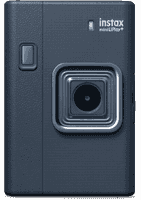
Instax Mini LiPlay+Best for selfies
Street price: $199.95 (list $234.95)
Amazon rating: 4.2 out of 5 (19 ratings)
Pros
- first Instax with a real rear selfie camera instead of a mirror
- understated design that looks more grown-up than the Mini Evo
- big, sharp 3-inch screen and easy Bluetooth printing from a phone
Cons
- the app will only pull across photos you have already printed
- noticeable shutter lag, so candid shots get missed
- priced the same as the Instax Mini Evo, which most reviewers prefer
Most Instax cameras frame selfies with a small mirror next to the lens. The LiPlay+ has a second camera on the back, so you can frame yourself on the 3-inch screen the way you would on a phone. A Layered Photo mode puts the front and rear views in one frame.
Like the Mini Evo, it shoots digitally and prints only what you choose, about 13 seconds a print. It also works as a phone printer for pictures already on your phone. Sound Print records about three seconds of audio and adds a QR code to the print, though Fujifilm keeps that audio for only 24 months. It charges over USB-C and weighs 265 g.
The weak spots are real. The 4.9 MP sensor produces files that are only good for deciding what to print. Shutter lag is about 0.7 seconds without flash and 1.5 seconds with it, so candid shots slip away. The app will only import photos you have already printed.
It was $199.95 on October 5, 2026, almost exactly the Mini Evo’s $199, and Digital Camera World’s Hillary K. Grigonis said she prefers the Evo at about the same price. Pick the LiPlay+ only if selfies come first. It has just 19 Amazon ratings so far. See Mini Evo vs LiPlay, which also covers the original LiPlay at $165.
Best hybrid for big prints: Instax Wide Evo
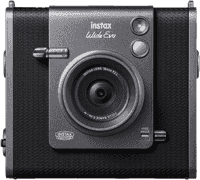
Instax Wide EvoBest hybrid for big prints
Street price: $365.89 (list $349.95)
Amazon rating: 4.3 out of 5 (104 ratings)
Pros
- big wide-format prints from a hybrid, review-before-you-print workflow
- extensive effects system carried over from the Mini Evo
Cons
- nearly double the price of the Mini Evo
- digital prints look flatter than analog Wide film
The Wide Evo is the Mini Evo idea on Wide film: shoot digitally, review on a 3.5-inch screen, and print the keepers at 86 x 108 mm. It carries over the 100 lens and film effect combinations, adds six film styles and a wide-angle mode, and uses autofocus with face recognition. It also has a tripod socket, which the Mini Evo lacks, plus a selfie mirror and self-timer. It charges over USB-C, prints about 100 shots a charge, and at 490 g is lighter than the Wide 400.
It sits last because of the price. It was $365.89 on October 5, 2026, above its $349.95 list price, and TechRadar noted it costs almost double the Mini Evo. Amateur Photographer found its auto exposure can be off in back-lit or bright scenes, and the prints share the flatter digital look of the Mini Evo.
Buyers rate it 4.3 out of 5 across 104 ratings. Our Wide Evo vs Wide 400 comparison picked the Wide 400: the $215.94 gap buys about 154 shots of Wide film, and the Wide 400 makes a true analog print. Buy the Wide Evo if you want big prints and refuse to waste film on bad frames.
Mini, Square or Wide film?
All three Instax films are 86 mm across. What changes is the height, and with it the price per shot.
- Instax Mini: 86 x 54 mm print, 62 x 46 mm picture, about $0.91 a shot ($18.17 for a twin pack of 20). The cheapest, and the film most Instax cameras take.
- Instax Square: 86 x 72 mm print, 62 x 62 mm picture, about $1.57 a shot ($31.40 for 20). The most expensive per shot.
- Instax Wide: 86 x 108 mm print, 62 x 99 mm picture, about $1.40 a shot ($139.95 for 100). Twice the area of Mini for about half as much again per shot.
Prices are regular Amazon prices checked October 5, 2026. At those figures, 100 shots cost about $91 on Mini, $157 on Square and $140 on Wide (the per-shot figure times 100; actual packs hold 20 or 100 shots).
Most people should start with Mini. It has the widest choice of cameras, from the $79.95 Mini 13 to the Mini 99 and both hybrids, and the lowest running cost. Pick Wide if you mostly shoot groups. Pick Square only if you love the shape, since it costs the most per shot. Instax Mini vs Square vs Wide has the full comparison.
Which Instax Mini is best?
Fujifilm’s US Instax site listed five analog Instax Mini cameras in October 2026, and all five use a 60 mm f/12.7 lens.
The Mini 13 ($79.95) and Mini 12 ($82.94) take the same picture; the Mini 13 adds the self-timer. The Mini 41 ($99.90) is the same camera again in a retro body, without a self-timer. The Mini 99 ($189.05) is the only one with shooting modes, double exposure, bulb, a tripod socket and a rechargeable battery.
The Mini SE ($69 list) is the odd one out. It has a brightness dial for manual exposure but a fixed 1/60 second shutter, no selfie mirror and no close-up mode, and it focuses from 0.6 m rather than 0.3 m. It launched as a US Walmart exclusive and now has its own page on Fujifilm’s US Instax site, but on Amazon it is sold as Renewed only. New stock was $64 at Walmart on October 5, 2026, with a 10-pack of film. Reviewers found the Mini 12 got the exposure right more often.
The hybrids, the Mini Evo and LiPlay+, use the same film but take a digital photo first. The Mini Evo Cinema, at $389, adds short video clips shared by a QR code on the print, but it held only 3.7 out of 5 from 23 ratings and reviewers called its picture quality, battery life and speed poor for the price.
For the head-to-heads, see Mini 12 vs Mini 13, Mini 12 vs Mini 41, Mini 41 vs Mini 99 and Mini SE vs Mini 12.
Older Instax cameras
Fujifilm has replaced several Minis that still turn up secondhand and in old buying guides. The Mini 12 has been succeeded by the Mini 13, though it was still on sale in October 2026. The Mini 11 was discontinued in 2023, the Mini 9 in 2020 and the Mini 8 in 2017. All of them take the same Instax Mini film as the current models, so film is not a problem if you are given one.
The Mini 9 and Mini 8 have a fixed shutter speed and a brightness dial you set by hand, and the Mini 9 focuses no closer than 0.6 m. The Mini 11 switched to automatic exposure, and the Mini 12 improved on it with a parallax-corrected close-up mode and a slow shutter for low light. If you are buying new, there is no reason to pick one of these over a Mini 13. See Mini 11 vs Mini 12 and Mini 9 vs Mini 12.
Instax printers
If most of your photos are already on your phone, an Instax printer may suit you better than a camera. The Instax Mini Link 3 prints phone photos onto the same Mini film in about 15 seconds and manages about 100 prints a charge. It was $99.95 on October 5, 2026, with 4.7 out of 5 across 742 ratings. Fujifilm also sells the Instax Pal, a tiny digital camera with no printer of its own that sends shots to a Link printer or a hybrid; it was $37. Our best portable photo printer guide ranks the printers, and Instax printer vs camera helps you decide between the two.
How we chose
We have not tested most of these cameras in person yet. The picks come from each product’s published specs, prices and Amazon ratings checked on October 5, 2026, and from named professional reviews, including PCMag, PetaPixel, TechRadar, Digital Camera World and DPReview. Our method is on the How We Test page.
The pages ranking for this search in October 2026 were forum threads and an older guide built around the discontinued Mini 11. We cover every current Instax camera in our database instead and give each a role. Where we have already compared two cameras head to head, the ranking here follows that verdict. That is why the Mini 13 leads the Mini 12, the SQ1 is the square pick over the SQ40, and the Mini 41 is here for its looks alone. For a list that includes Polaroid, see our best instant camera guide.
At a glance
| Model | Pick | Street price | Film | Cost per shot | Print size | Amazon rating |
|---|---|---|---|---|---|---|
| Instax Mini 13 | Best overall | $79.95 | Instax Mini | $0.91 | 86 x 54 mm | 4.5 (19 ratings) |
| Instax Mini Evo | Best hybrid | $199.00 | Instax Mini | $0.91 | 86 x 54 mm | 4.6 (2,008 ratings) |
| Instax Mini 99 | Best for creative control | $189.05 | Instax Mini | $0.91 | 86 x 54 mm | 4.6 (182 ratings) |
| Instax Wide 400 | Best for big prints | $149.95 | Instax Wide | $1.40 | 86 x 108 mm | 4.0 (331 ratings) |
| Instax Square SQ1 | Best square | $199.95 | Instax Square | $1.57 | 86 x 72 mm | 4.6 (677 ratings) |
| Instax Mini 41 | Best classic look | $99.90 | Instax Mini | $0.91 | 86 x 54 mm | 4.4 (334 ratings) |
| Instax Mini LiPlay+ | Best for selfies | $199.95 | Instax Mini | $0.91 | 86 x 54 mm | 4.2 (19 ratings) |
| Instax Wide Evo | Best hybrid for big prints | $365.89 | Instax Wide | $1.40 | 86 x 108 mm | 4.3 (104 ratings) |
Prices and ratings checked October 5, 2026.
Frequently asked questions
Which Instax Mini is the best?
The Mini 13 for most people. Choose the Mini 99 if you want exposure control and double exposures, or the Mini Evo if you want to see each shot and choose what prints.
What Instax should I get?
Decide on print size first. Instax Mini, at about $0.91 a shot, gives cheap wallet-size prints. Square, at $1.57, gives the square look. Wide, at $1.40, gives prints big enough for group photos. Then pick a camera that takes that film.
Is it worth buying a Fujifilm Instax?
For cheap, reliable instant prints, yes. Instax Mini film was about $0.91 a shot at regular Amazon prices on October 5, 2026, against $2.37 for Polaroid i-Type and $1.36 for Polaroid Go.
Which is the best Fujifilm Instax overall?
The Mini 13 for value and the Mini Evo for features. Both use the same Instax Mini film.
Related reading
- Instax Mini vs Square vs Wide: Which Film Size Should You Choose? (2026)
- Instax Mini 12 vs Mini 13: Which Should You Buy? (2026)
- Instax Mini 41 vs Mini 99: Which Should You Buy? (2026)
- Instax Mini 99 vs Mini Evo: Which Should You Buy? (2026)
- Instax vs Polaroid: Which Instant Camera Should You Buy? (2026)