
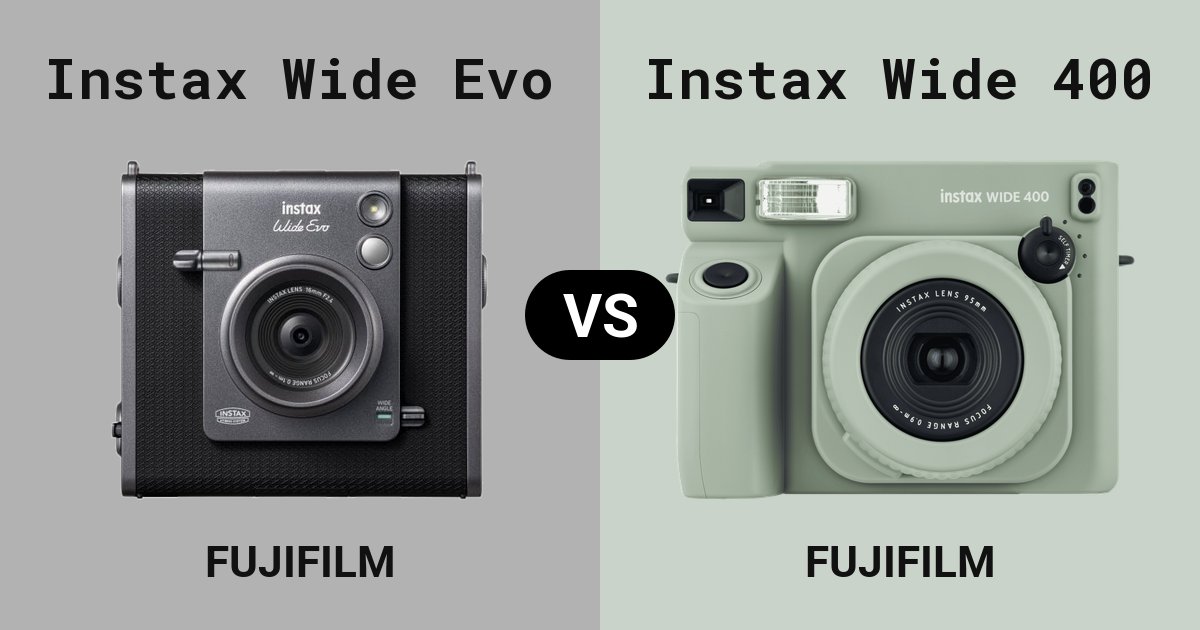
The Wide 400 exposes Instax Wide film directly, and the Wide Evo shoots digitally and prints only the frames you pick. Buy the Wide 400 for true analog prints at $149.95; pay $215.94 more for the Wide Evo only if you want to choose before you print.
Fujifilm currently makes two cameras for Instax Wide, its largest instant film. The Instax Wide 400 arrived in 2024 as the analog camera in the range, and the Instax Wide Evo followed in 2025 as a hybrid. They print the same size picture on the same film but get there in completely different ways.
What is actually different
The Wide 400 is analog. Light goes through its 95 mm f/14 lens and lands on the film, so every press of the shutter uses a frame whether the picture worked or not. Exposure is automatic across Lv 10.5 to 15 at ISO 800, and the shutter runs from 1/64 to 1/200 second. Focus has two ranges, Normal from 0.9 to 3 m and Landscape from 3 m onwards, plus a 0.4 to 0.5 m macro range with the close-up lens accessory. The flash fires automatically and reaches 0.9 to 3 m. There is no screen, so you see the result only when the print develops.
The Wide Evo is a hybrid, which means it is a digital camera with a printer built in. It takes the picture with a sensor and shows it on a 3.5-inch colour LCD of about 460,000 dots. Nothing comes out until you decide it should. Pictures sit in internal memory, about 45 of them, or on a microSD card, and you print the ones you want at 318 dpi. A charge covers about 100 prints. The lens is listed as 16 mm f/2.4 equivalent, with autofocus and face recognition from 10 cm. Exposure is programmed, the shutter automatic. We do not have flash details or a print time for the Wide Evo, so we cannot compare those.
On the Wide 400 you pay for every frame you shoot. On the Wide Evo you pay only for the frames you print.
The Wide Evo also adds effects to the digital file before printing: 10 lens effects, 10 film effects, 6 film styles and a wide-angle mode. It connects over Bluetooth to the instax WIDE Evo app. The Wide 400 has no effects and works with the instax UP! app. Both have a self-timer and a tripod socket. Only the Wide Evo has a selfie mirror, and reviewers list its absence on the Wide 400 as a complaint.
The catch is the print. Reviews and buyers note that the Wide Evo’s digital prints look flatter than analog Wide film. TechRadar called it one of the most stylish hybrid instant cameras yet, but at a hefty price. Amateur Photographer said it suits more serious photographers with cash to spend, though auto exposure can be off in back-lit or bright scenes. On the Wide 400, Digital Camera World called it a clear improvement on the Wide 300 but still as big as ever, and Amateur Photographer found it an easy point-and-shoot that experienced photographers might find unremarkable.
The Wide 400 measures 162 x 98 x 123 mm, weighs 616 g and runs on four AA batteries for about 100 shots. It comes in Sage Green and Jet Black. The Wide Evo measures 138.7 x 125 x 62.8 mm, weighs 490 g and charges an internal battery over USB Type-C. It comes in Black.
If you are choosing between the two Evo cameras instead, the Wide Evo carries over the Mini Evo’s effects system and prints on bigger, dearer film. TechRadar put its price at almost double the Mini Evo’s. Our Instax Mini 99 vs Mini Evo comparison covers the smaller hybrid.
Film and cost per shot
At the last price check, on October 5, 2026, the Wide 400 was $149.95, its list price, and the Wide Evo was $365.89 against a list price of $349.95. The gap is $215.94.
Both take Instax Wide film, 86 x 108 mm with a 62 x 99 mm picture. A 5-pack of 100 shots was $139.95 at Amazon on the same date, about $1.40 a shot. That makes the price gap worth about 154 frames.
The Wide Evo earns that back only through frames you would otherwise waste. If one shot in three on the Wide 400 goes in the bin, the Wide Evo saves about $0.47 for every picture you take and covers the gap at around 460 pictures. Shoot carefully and the Wide 400 stays the cheaper camera for much longer.
Which one to buy
Buy the Wide 400 if you want true analog Wide prints at the lowest price. It was $149.95 at the last check, it has a self-timer and a tripod socket for group shots, and the $215.94 it saves pays for about 154 prints. Amazon buyers rate it 4.0 out of 5 across 331 ratings. Expect a big, heavy camera with no screen and no selfie mirror.
Buy the Wide Evo if you want to see each picture before you spend film on it, or you want effects. It is lighter at 490 g, holds about 45 pictures internally and more on a card, and has a selfie mirror. Buyers rate it 4.3 out of 5 across 104 ratings. Accept that the prints look more digital than analog Wide film, and that you are paying $365.89 for that choice.
Where to buy
 Instax Wide Evo$365.89 (list $349.95)Check price on Amazon
 Instax Wide 400$149.95Check price on Amazon
Specs side by side
Same on both: Current · Instax Wide film · 86 x 108 mm print · 62 x 99 mm image · $1.40 a shot · self timer · no double exposure · no bulb mode · tripod socket · Shots per battery / prints per charge: 100.
| Spec | Instax Wide Evo | Instax Wide 400 |
|---|---|---|
| Type | Hybrid instant camera | Analog instant camera |
| Launched | 2025 | 2024 |
| Lens | 16 mm f/2.4 equivalent, autofocus with face recognition, 10 cm and beyond | retractable, 95 mm f/14, 2 components 2 elements |
| Focus | autofocus with face recognition | Normal 0.9-3 m, Landscape 3 m and beyond, Macro 0.4-0.5 m with close-up lens accessory |
| Exposure | programmed AE | automatic, Lv 10.5 to 15 (ISO 800) |
| Shutter | automatic | 1/64 to 1/200 s |
| Flash | n/a | automatic, effective range 0.9-3 m, recycle 7 s or less |
| Selfie mirror | Yes | No |
| Close-up mode | No | Yes |
| Manual modes | 10 lens effects, 10 film effects, 6 film styles, wide-angle mode | n/a |
| Power | internal Li-ion, USB Type-C charging | 4 x AA alkaline |
| Print resolution | 318 dpi | n/a |
| Connectivity | Bluetooth (smartphone app) | n/a |
| App | instax WIDE Evo app | instax UP! |
| Screen | 3.5-inch TFT color LCD, approx. 460,000 dots | n/a |
| Storage | internal memory (approx. 45 images) plus microSD/microSDHC | n/a |
| Dimensions | 138.7 x 125 x 62.8 mm | 162 x 98 x 123 mm |
| Weight | 490 g | 616 g |
| Colours | 1 (Black) | 2 (Sage Green, Jet Black) |
| Street price | $365.89 (checked October 5, 2026) | $149.95 (checked October 5, 2026) |
| Amazon rating | 4.3 (104 ratings) | 4 (331 ratings) |
| Buy | Check price on Amazon | Check price on Amazon |
Specs from manufacturer pages; prices and ratings checked October 5, 2026.
What reviewers and buyers say
Instax Wide Evo
Published reviews of the Instax Wide Evo:
- “The Wide Evo is one of the most stylish instant hybrid cameras yet, combining retro looks with large instant prints, though it comes at a hefty price, almost double the Mini Evo.” (TechRadar, 2025)
- “Dubbed 'the photographer's camera' by Fujifilm, the Wide Evo appeals to more serious photographers with cash to spend, though auto exposure can be off in back-lit or bright scenes.” (Amateur Photographer, 2025)
- “The Wide Evo brings the Mini Evo's creative effects to Fujifilm's largest instant film format, at a price that puts it well above its Mini sibling.” (Trusted Reviews, 2025)
Amazon buyers rate it 4.3 out of 5 across 104 ratings.
Praised for: big wide-format prints from a hybrid, review-before-you-print workflow, extensive effects system carried over from the Mini Evo. Criticised for: nearly double the price of the Mini Evo, digital prints look flatter than analog Wide film.
Instax Wide 400
Published reviews of the Instax Wide 400:
- “The Wide 400 is a decent option if you want an easy-to-use point-and-shoot that can take larger prints, though experienced photographers might find it a bit unremarkable.” (Amateur Photographer, 2024)
- “The Wide 400 is a clear improvement on the Wide 300, with a more appealing design and useful additions like a self-timer and angle-adjustment accessory, though it's still as big as ever.” (Digital Camera World, 2024)
- “The Wide 400 is a worthwhile update for anyone who wants big Instax Wide prints without needing an entirely new reason to buy one over the Wide 300.” (Dan Finnen, 2024-11)
Amazon buyers rate it 4 out of 5 across 331 ratings.
Praised for: large wide-format prints are great for group shots and events, self-timer and angle-adjustment accessory are useful additions over the Wide 300. Criticised for: very large and heavy to carry around, no selfie mirror despite the size.
Frequently asked questions
What is the difference between the Instax Wide Evo and the Wide 400?
The Wide 400 is analog and the Wide Evo is a hybrid. The Wide 400, from 2024, exposes Instax Wide film directly through a 95 mm f/14 lens, so every shutter press uses a frame. The Wide Evo, from 2025, records the picture digitally, shows it on a 3.5-inch screen and prints only the frames you choose, at 318 dpi. Both print on the same Instax Wide film at about $1.40 a shot.
Is the Instax Wide Evo worth the extra money over the Wide 400?
Only if you would throw away a lot of frames on the Wide 400. At the October 5, 2026 check the Wide Evo was $365.89 and the Wide 400 was $149.95, a gap of $215.94, or about 154 shots of Instax Wide film. If one shot in three on the Wide 400 would go in the bin, the Wide Evo pays back the difference at around 460 pictures.
What is the difference between the Instax Wide Evo and the Mini Evo?
Print size and price. Both are hybrids with the same 10 lens effects and 10 film effects, about 45 pictures of internal memory, a microSD slot and 318 dpi printing. The Wide Evo prints on Instax Wide film, 86 x 108 mm at about $1.40 a shot, and has a 3.5-inch screen and a tripod socket. The Mini Evo prints on Instax Mini film, 86 x 54 mm at about $0.91 a shot, with a 3.0-inch screen. On October 5, 2026 the Wide Evo was $365.89 and the Mini Evo $199.
Do the Wide Evo and Wide 400 use the same film?
Yes. Both take Instax Wide film, which prints 86 x 108 mm with a 62 x 99 mm picture. A 5-pack of 100 shots was $139.95 at Amazon on October 5, 2026, about $1.40 a shot.