

Instax film costs about $0.91 a shot and Polaroid i-Type film about $2.37, so this choice is mostly a choice about running cost. Polaroid gives you the big white-framed square print, and Instax gives you more cameras, more print sizes and cheaper film.
Instax film costs about $0.91 a shot and Polaroid i-Type film costs about $2.37 a shot. Most of this comparison comes down to that gap. Buy Instax if you want to shoot freely and pass the camera round at a party. Buy Polaroid if you want the 107 x 88 mm print with the square image and the white frame, and will pay nearly three times as much per picture to get it.
The short answer
Instax suits most first-time buyers. The cheapest current camera, the Instax Mini SE, was $69.95 at the last price check, and the film is the cheapest of any instant format. Fujifilm sells thirteen current cameras across three print sizes, so there is a body at almost every price.
Polaroid suits people who want the particular Polaroid picture. Nothing in the Instax range prints a square image in a tall white frame. Polaroid sells five current cameras and two film formats, and every i-Type frame costs about $2.37 whichever camera you put it in.
There is a third answer for anyone who wants a big print without the Polaroid running cost. Instax Wide prints 86 x 108 mm with a 62 x 99 mm image, which is a slightly larger image area than Polaroid i-Type, at about $1.40 a shot.
Film cost per shot
| Film | Instax Mini | Instax Square | Instax Wide | Polaroid Go | Polaroid i-Type | Polaroid 600 |
|---|---|---|---|---|---|---|
| Print size | 86 x 54 mm | 86 x 72 mm | 86 x 108 mm | 66.6 x 53.9 mm | 107 x 88 mm | 107 x 88 mm |
| Image size | 62 x 46 mm | 62 x 62 mm | 62 x 99 mm | 47 x 46 mm | 79 x 77 mm | 79 x 77 mm |
| Film cost per shot | about $0.91 | about $1.57 | about $1.40 | about $1.36 | about $2.37 | about $2.62 |
| Current cameras | Instax Mini 12, Instax Mini 13, Instax Mini 41, Instax Mini 99, Instax Mini Evo, Instax Mini Evo Cinema and 9 more | Diana Instant Square, Instax Square SQ1, Instax Square SQ40, Lomo'Instant Square Glass, MiNT InstantFlex TL70 Plus, MiNT InstantKon SF70 and 1 more | Instax Wide 400, Instax Wide Evo, Lomo'Instant Wide, Lomo'Instant Wide Glass, MiNT InstantKon RF70 | Polaroid Go Generation 3 | MiNT SLR670 MAX, Polaroid Flip, Polaroid I-2, Polaroid Now Generation 3, Polaroid Now+ Generation 3 | MiNT SLR670 MAX, Polaroid Flip, Polaroid I-2, Polaroid Now Generation 3, Polaroid Now+ Generation 3 |
| Current printers | Instax Mini Link 3, Instax Mini Link+ | Instax Square Link | Instax Link Wide, Instax Link Wide 2 | n/a | Polaroid Lab Instant Printer | Polaroid Lab Instant Printer |
Sizes and costs per shot from the product records; film prices checked October 15, 2026.
Prices on this page were checked October 2026. An Instax Mini twin pack holds 20 shots and cost $18.17, so each frame is about $0.91. A Polaroid Color i-Type pack holds 8 shots and cost $18.99, which is about $2.37 a frame. Colour 600 film costs a little more again, about $2.62 a shot, because every pack carries the battery that powers a vintage 600 camera.
Run those numbers out to 100 pictures and Instax Mini comes to about $91, Polaroid Go to about $136, Instax Wide to about $140 and Polaroid i-Type to about $237. The spread between the cheapest and the dearest is about $146, which is more than the cheapest camera from either brand costs.
Camera prices barely move the answer. The Instax Mini 12 was $82.94 and the Polaroid Now Generation 3 was $129.99, so the bodies are $47 apart. At the difference in film cost, about 32 frames closes that gap. Whichever brand you pick, the camera is a one-off and the film is the bill that keeps arriving.
Print size and image size
Every instant print is a sheet of paper with a smaller image inside it. Both brands quote the two numbers separately, and the image size is the one that matters. Our instant film sizes page lists every format in mm and inches, with a to-scale drawing.
The two biggest images are close. Instax Wide gives about 6,140 mm² of picture and Polaroid i-Type gives about 6,080 mm², a difference of about one percent. The shapes are another matter: Instax Wide is a tall rectangle and i-Type is almost square at 79 x 77 mm. Choose on shape rather than size.
At the small end, Polaroid Go is the smallest image of the six formats, about 2,160 mm², below the Instax Mini image at about 2,850 mm². The Go print is the smallest sheet of paper too, 66.6 x 53.9 mm against 86 x 54 mm for Instax Mini. Anyone cross-shopping those two should read our Polaroid Go vs Instax Mini 12 page.
Instax Square sits between them at 62 x 62 mm of image on an 86 x 72 mm print. It is the closest Fujifilm gets to the Polaroid shape, and at about $1.57 a shot it is the most expensive Instax film to run.
How the prints look
Film speed and development time
Fujifilm rates instax film at ISO 800. Polaroid rates colour i-Type, 600 and Go film at ASA 640, which is the same measurement under an older name. Under half a stop separates them, so film speed is not why the two brands look different.
Development time is a real difference. Fujifilm quotes about 90 seconds for an instax mini print, varying with the ambient temperature. Polaroid quotes 10 to 15 minutes for colour i-Type, 600 and Go film. An instax print is finished before you have put the camera down. A Polaroid is not, and that changes how you use it.
Handling the print
Polaroid asks you to shield the print from light. The film shield on the camera covers the photo for the first few seconds while the blue opacification layer spreads over the frame. Polaroid says the print stays sensitive after that and should be kept away from strong light for the whole development time, face down on a table or inside a pocket. The stated payoff is deeper saturation, sharper detail and an image that is not washed out. Fujifilm’s instax mini film page carries no equivalent instruction.
Light and temperature
Polaroid publishes a working range for its film: 13 to 28 C, or 55 to 82 F. Below that, Polaroid says photos tend to emerge over-exposed, lacking colour contrast and with a green tint, and it recommends letting them develop inside a jacket. Above it, colour photos tend to develop with a yellow or red tint, and Polaroid suggests cooling the packs in a fridge first. Fujifilm’s instax mini film page gives a wider range for its film, 5 to 40 C. Shooting outdoors in a cold winter or a hot summer is where that difference shows up on the paper.
Strong sun catches both brands’ cheap cameras. Cameralabs wrote of the Instax Mini 12 that bright daylight can still cause over-exposure. TechRadar’s Jon Stapley wrote of the Polaroid Go Generation 3 to watch yourself in bright sunlight because it is easy for images to be overexposed to near-oblivion. A blown-out Polaroid frame costs $2.37 and a blown-out Instax Mini frame costs $0.91, which is the whole argument for learning on Instax.
The cameras you can buy
Fujifilm
| Model | Type | Film or media | Street price | Amazon rating |
|---|---|---|---|---|
| Instax Mini SE | Analog instant camera | Instax Mini | $64.00 | 4.2 (58 ratings) |
| Instax Mini 13 | Analog instant camera | Instax Mini | $79.95 | 4.5 (19 ratings) |
| Instax Mini 12 | Analog instant camera | Instax Mini | $82.94 | 4.6 (1,554 ratings) |
| Instax Mini 41 | Analog instant camera | Instax Mini | $99.90 | 4.4 (334 ratings) |
| Instax Wide 400 | Analog instant camera | Instax Wide | $149.95 | 4 (331 ratings) |
| Instax Mini LiPlay | Hybrid instant camera | Instax Mini | $165.00 | 4.8 (84 ratings) |
| Instax Mini 99 | Analog instant camera | Instax Mini | $189.05 | 4.6 (182 ratings) |
| Instax Mini Evo | Hybrid instant camera | Instax Mini | $199.00 | 4.6 (2,008 ratings) |
| Instax Mini LiPlay+ | Hybrid instant camera | Instax Mini | $199.95 | 4.2 (19 ratings) |
| Instax Square SQ1 | Analog instant camera | Instax Square | $199.95 | 4.6 (677 ratings) |
| Instax Square SQ40 | Analog instant camera | Instax Square | $200.00 | 4.4 (401 ratings) |
| Instax Wide Evo | Hybrid instant camera | Instax Wide | $365.89 | 4.3 (104 ratings) |
| Instax Mini Evo Cinema | Hybrid instant camera | Instax Mini | $389.00 | 3.7 (23 ratings) |
Prices and ratings checked October 5, 2026.
Of the thirteen current cameras, nine take Instax Mini film, two take Square and two take Wide. Eight are analog and five are hybrids, which shoot to a screen and print only the frames you choose.
Prices run from $69.95 for the Instax Mini SE to $389 for the Instax Mini Evo Cinema. The Mini 12 at $82.94 is the one most people end up with, and Digital Camera World called it still the best bang-for-buck instant camera you can buy. The Mini 41 at $99.90 is the same camera in a retro black body, which we cover in Instax Mini 12 vs Mini 41. The Mini 99 at $189.05 is the enthusiast body, with five brightness levels, bulb mode and double exposure. The Mini Evo at $199 is the hybrid answer to expensive film: you review the shot on a 3-inch screen and print only the keepers.
Polaroid
| Model | Type | Film or media | Street price | Amazon rating |
|---|---|---|---|---|
| Polaroid Go Generation 3 | Analog instant camera | Polaroid Go | $82.00 | 3.8 (224 ratings) |
| Polaroid Now Generation 3 | Analog instant camera | Polaroid i-Type (also takes Polaroid 600) | $129.99 | 4.3 (540 ratings) |
| Polaroid Now+ Generation 3 | Analog instant camera | Polaroid i-Type (also takes Polaroid 600) | $149.99 | 4.2 (251 ratings) |
| Polaroid Flip | Analog instant camera | Polaroid i-Type (also takes Polaroid 600) | $210.00 | 4.7 (8 ratings) |
| Polaroid I-2 | Analog instant camera | Polaroid i-Type (also takes Polaroid 600 and SX-70) | $599.99 | 3.8 (22 ratings) |
Prices and ratings checked October 5, 2026.
Polaroid sells five current cameras. The Go Generation 3 at $82 takes Go film. The Now Generation 3 at $129.99, the Now+ Generation 3 at $149.99, the Flip at $210 and the I-2 at $599.99 list all take i-Type film and Polaroid 600 film.
The Flip is the one reviewers point at. PCMag made it their Editors’ Choice for I-Type cameras and called it the best instant camera Polaroid has made to date. Dan Finnen called it the best i-Type camera Polaroid has ever made. The cheaper Now Generation 3 gets a cooler reception: PCMag’s Jim Fisher scored it 3.0 and called it a stylish instant camera that wins nostalgia points for its classic square I-Type film format but whose basic autofocus misses too often to justify the cost per use. On $2.37 film, a camera that misses focus is an expensive camera. Our Polaroid Go vs Polaroid Now page covers the two cheapest bodies in more detail.
The I-2 is the only modern Polaroid with aperture and shutter dials on the body. It also lists at $599.99, and Finnen would not recommend it: he wrote that this 600 dollar camera cannot compete with a sub-100 dollar camera that is decades old.
The four bodies people cross-shop
Same on all four: Analog instant camera · Current · no bulb mode.
| Spec | 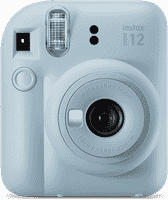 Instax Mini 12 Instax Mini 12 | 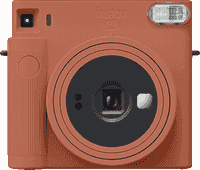 Instax Square SQ1 Instax Square SQ1 | 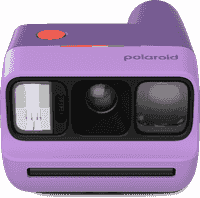 Polaroid Go Generation 3 Polaroid Go Generation 3 | 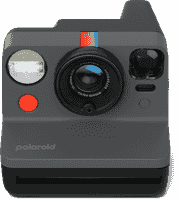 Polaroid Now Generation 3 Polaroid Now Generation 3 |
|---|---|---|---|---|
| Launched | 2023 | 2020 | 2026 | 2025 |
| Film or media | Instax Mini | Instax Square | Polaroid Go | Polaroid i-Type (also takes Polaroid 600) |
| Print size | 86 x 54 mm | 86 x 72 mm | 66.6 x 53.9 mm | 107 x 88 mm |
| Image size | 62 x 46 mm | 62 x 62 mm | 47 x 46 mm | 79 x 77 mm |
| Film cost per shot | $0.91 | $1.57 | $1.36 | $2.37 |
| Lens | 60 mm f/12.7, 2 components 2 elements | 65.75 mm f/12.6, 2 components 2 elements | 63.75 mm polycarbonate resin fixed-focus lens (about 42 mm equivalent), up from 51.1 mm on the Gen 2 | Coated optical-grade polycarbonate and acrylic two-lens system; focal lengths not published for Generation 3 |
| Focus | fixed; 0.3 m to infinity; close-up (selfie) mode 0.3 to 0.5 m with parallax correction | fixed; 0.5 m and beyond, selfie mode 0.3 to 0.5 m | fixed focus; no autofocus, parallax error at close distances | autofocus that picks between 2 fixed focus zones: 0.40 to 1.3 m and 1.0 m to infinity |
| Exposure | automatic, Lv 5.0 to 14.5 (ISO 800) | automatic, Lv 5.0 to 15.5 (ISO 800) | automatic; apertures f/14.4 and f/32, selected by the camera | automatic; Polaroid lists six usable apertures from f/64 to f/11. Polaroid support documents a three-position exposure compensation (brighten, neutral, darken) reached by holding the flash button on the Now line, though PCMag's reviewer treated the Gen 3 as having no on-body exposure control |
| Shutter | 1/2 to 1/250 s, slow synchro for low light | 1.6 to 1/400 s, slow synchro for low light | 1/500 to 1 s | custom shutter system driven by a precision step motor; Amazon's spec sheet lists a 10 s maximum exposure. Polaroid does not publish the full speed range |
| Flash | auto, always fires | constant firing flash, automatic light adjustment, recycle 7.5 s or less, range 0.3-2.2 m | built-in vacuum discharge tube flash, stronger than the Gen 2; can be switched off with the flash button but defaults back on for every shot | built-in flash, fires automatically, can be switched off with the flash button |
| Selfie mirror | Yes | Yes | Yes | No |
| Close-up mode | Yes | Yes | No | No |
| Self timer | No | No | Yes | Yes |
| Double exposure | No | No | Yes | Yes |
| Tripod socket | No | No | No | Yes |
| Power | 2 x AA alkaline | 2 x CR2 lithium | built-in lithium-ion battery, USB-C rechargeable | built-in lithium-ion battery, USB-C rechargeable |
| Shots per battery / prints per charge | 100 | 300 | 120 | 120 |
| App | instax UP! | instax UP! | Polaroid app for Scan & Share only; no Bluetooth camera control or remote trigger | Polaroid app for Scan & Share only; the Now Gen 3 has no Bluetooth and no app camera control |
| Dimensions | 104 x 66 x 122 mm | n/a | 106.5 x 83.8 x 64.6 mm | 150.2 x 112.2 x 94 mm |
| Weight | 306 g | 390 g | 252 g | 448 g |
| Colours | 5 (Pastel Blue, Blossom Pink, Mint Green, plus 2 more) | 3 (Chalk White, Terracotta Orange, Glacier Blue) | 5 (White, Black, Teal Blue, plus 2 more) | 7 (Black, Pebble White, Arctic Blue, plus 4 more) |
| Street price | $82.94 (checked October 5, 2026) | $199.95 (checked October 5, 2026) | $82.00 (checked October 5, 2026) | $129.99 (checked October 5, 2026) |
| Amazon rating | 4.6 (1,554 ratings) | 4.6 (677 ratings) | 3.8 (224 ratings) | 4.3 (540 ratings) |
| Buy | Check price on Amazon | Check price on Amazon | Check price on Amazon | Check price on Amazon |
Specs from manufacturer pages; prices and ratings checked October 5, 2026.
All four are point-and-shoot cameras with automatic exposure and no manual modes. The Instax Mini 12 and Square SQ1 run on disposable batteries and fire the flash on every frame. The Polaroid Go and Now charge over USB-C, give about 120 shots a charge and let you switch the flash off, though the Go turns it back on before every frame.
Mixing film between the brands
Instax film fits Instax cameras only, and each Instax format fits only the cameras built for it. A Mini pack will not load in a Square or Wide body.
Polaroid is a little more flexible inside its own range. Polaroid says i-Type and 600 film both work in current cameras such as the Now, Now+, Flip and I-2, with the difference that a 600 pack carries a battery for vintage bodies. Go film fits the Go and nothing else. Vintage folding SX-70 cameras need their own film, which Polaroid says is roughly a quarter the sensitivity of 600 film.
Who should buy Instax
Buy Instax if the number of pictures matters more to you than the size of each one. At about $0.91 a shot on Mini film you can hand the camera to a child or a party guest without counting frames.
Buy Instax if you want a choice of bodies. Thirteen current cameras run from $69.95 to $389 across three print sizes, with manual brightness on the Mini 99 and a 3-inch screen on the Mini Evo. Polaroid has nothing under $82, and no Polaroid camera lets you see a shot before it prints.
Buy Instax Wide, specifically, if you want a large print at a sane running cost. It gives you a slightly larger image than Polaroid i-Type for about 40 percent less per shot, in an 86 x 108 mm print. The Wide 400 was $149.95 and weighs 616 g, so the trade is bulk.
Who should buy Polaroid
Buy Polaroid if you want the print itself. The square image in the tall white frame is what most people have in mind when they think of instant film, and no Instax camera makes it.
Buy Polaroid if you shoot slowly. Eight frames a pack, 10 to 15 minutes of development and a print that has to stay out of the light all suit a slower way of working. Shooting fast on i-Type film is expensive.
Buy the Flip rather than the Now if you can stretch to it. It was $210 against $129.99, and it has four-zone sonar autofocus instead of the Now’s two zones, exposure compensation on the body, and a viewfinder LED that warns you before you waste a frame. On film this expensive, the frames it saves pay for the difference.
Sources
- Product records in
src/data/products, prices and ratings checked 2026-10-05: camera prices, film cost per shot, print and image sizes, specifications, Amazon ratings and the reviewer verdicts quoted above. - https://www.fujifilm.com/us/en/consumer/instax/film/mini : instax film rated Hi-Speed ISO 800, 10 photos per cartridge, and the 5 to 40 C range.
- https://www.fujifilm.com/us/en/consumer/instax/cameras/mini12/specifications : Instax Mini film size 86 x 54 mm, picture size 62 x 46 mm, development time approximately 90 seconds varying with ambient temperature.
- https://www.polaroid.com/en_us/products/color-itype-instant-film : i-Type ASA 640, 8 photos per pack, 107 x 88 mm format, 79 x 77 mm image area, 10 to 15 minutes development, $18.99 a pack.
- https://www.polaroid.com/en_us/products/color-600-instant-film : 600 film ASA 640, 8 photos per pack, same print and image size as i-Type, 10 to 15 minutes development, battery in every pack.
- https://www.polaroid.com/en_us/products/color-go-instant-film : Go film ASA 640, 16 photos per pack, 66.6 x 53.9 mm format, 47 x 46 mm image area, 10 to 15 minutes development.
- https://support.polaroid.com/hc/en-us/articles/115012361067-How-does-temperature-affect-Polaroid-film : the 13 to 28 C working range, the green tint below it and the yellow or red tint above it.
- https://support.polaroid.com/hc/en-us/articles/115012362807-Shielding-your-photos-from-light : the film shield, the blue opacification layer, and shielding the print for the full development time.
- https://support.polaroid.com/hc/en-us/articles/115012394347-What-film-do-I-use-with-Polaroid-cameras : which Polaroid films fit which cameras, and SX-70 film at roughly a quarter the sensitivity of 600 film.
- https://www.cameralabs.com/fujifilm-instax-mini-12-review/ : bright daylight can still cause over-exposure on the Mini 12.
- https://www.digitalcameraworld.com/reviews/instax-mini-12-review : the Mini 12 as the best bang-for-buck instant camera you can buy.
- https://www.techradar.com/cameras/instant-cameras/polaroid-go-gen-3-review : Jon Stapley on overexposure in bright sunlight on the Go Generation 3.
- https://me.pcmag.com/en/cameras-1/30522/polaroid-now-generation-3 : Jim Fisher’s 3.0 score and his verdict on the Now Generation 3 autofocus.
- https://www.pcmag.com/reviews/polaroid-flip : PCMag’s Editors’ Choice verdict on the Polaroid Flip.
- https://danfinnen.com/review/polaroid-flip-instant-film-camera-review/ : Dan Finnen on the Flip as the best i-Type camera Polaroid has made.
- https://danfinnen.com/review/polaroid-i-2-instant-film-camera-review/ : Dan Finnen’s verdict on the I-2.
Frequently asked questions
Is Instax or Polaroid cheaper?
Instax, on both counts. Instax Mini film works out at about $0.91 a shot against about $2.37 for Polaroid i-Type film, so 100 pictures cost about $91 on Instax Mini and about $237 on i-Type. The cheapest current Instax camera, the Mini SE, was $69.95 at the last price check and the cheapest current Polaroid, the Go Generation 3, was $82.
Why is Instax so much cheaper than Polaroid?
Pack size is most of it. An Instax Mini twin pack holds 20 shots and cost $18.17, while a Polaroid Color i-Type pack holds 8 shots and cost $18.99. Polaroid 600 film costs more again, about $2.62 a shot, because every pack carries the battery that powers a vintage 600 camera.
Which has better picture quality?
They print at similar sizes and similar film speeds, so it depends on the format you pick. Fujifilm rates instax film at ISO 800 and Polaroid rates i-Type, 600 and Go film at ASA 640. The largest Instax image, Instax Wide at 62 x 99 mm, is within one percent of the Polaroid i-Type image area of 79 x 77 mm, and costs about $1.40 a shot against $2.37.
Are Instax and Polaroid film interchangeable?
No. Instax film fits only Instax cameras, and each Instax format fits only the cameras built for it. On the Polaroid side, i-Type and 600 film both work in current Polaroid cameras such as the Now, Now+, Flip and I-2, but Polaroid Go film fits the Go and nothing else.
How long does each film take to develop?
Fujifilm quotes about 90 seconds for an instax mini print, varying with the ambient temperature. Polaroid quotes 10 to 15 minutes for colour i-Type, 600 and Go film, and asks you to keep the print shielded from light for that whole time.
Is Polaroid Now better than Instax?
It gives you a much bigger print for much more money. The Now Generation 3 was $129.99 and prints 107 x 88 mm with a 79 x 77 mm image at about $2.37 a shot. The Instax Mini 12 was $82.94 and prints 86 x 54 mm with a 62 x 46 mm image at about $0.91 a shot. PCMag's Jim Fisher scored the Now Generation 3 3.0 and called its basic autofocus too unreliable to justify the cost per use.
Related comparisons
- Kodak vs Polaroid Instant Cameras: Which Should You Buy? (2026)
- Polaroid Go vs Instax Mini 12: Which Should You Buy? (2026)
- Polaroid Go vs Polaroid Now: Which Should You Buy? (2026)
- Instax Mini 12 vs Mini 41: Which Should You Buy? (2026)
- Instant Film Sizes: Polaroid and Instax Picture Sizes in Inches and mm