
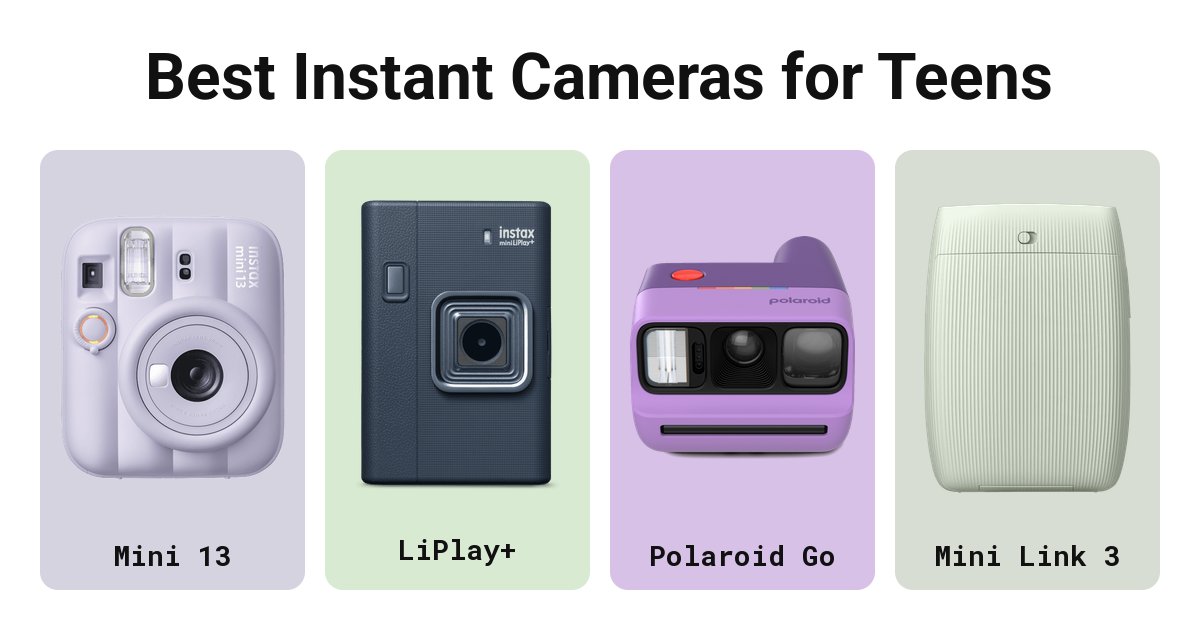
The Instax Mini 13 is the best instant camera for most teens: $79.95, one button and a self-timer for group shots. Picks for selfies and phone users follow.
A teen’s instant camera mostly gets used for selfies and pictures of friends, at parties, sleepovers and on school trips. The camera is a one-off cost. Film is the bill that keeps coming, and a parent often ends up paying it, so every pick below says what a print costs.
Best overall: Instax Mini 13
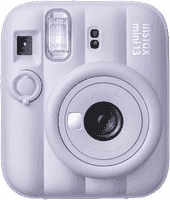
Instax Mini 13Best overall
Street price: $79.95 (list $93.95)
Amazon rating: 4.5 out of 5 (19 ratings)
Pros
- twist-the-lens operation is easy for kids and first-timers
- new 2 s and 10 s self-timer plus the wedge stand make group shots practical
- close-up mode framing matches the selfie mirror closely
Cons
- flash fires on every shot and cannot be switched off
- no tripod socket and no double-exposure mode
- nothing new for anyone who already owns a Mini 11 or Mini 12
The Mini 13 is the easiest instant camera to hand over. Twist the lens to turn it on, look through the viewfinder and press the one button. The camera sets the exposure itself and fires the flash on every shot. There is nothing to set.
It does the two things teens shoot most. A selfie mirror next to the lens and a close-up mode with parallax correction mean selfies land where the mirror shows them. The new self-timer runs for 2 or 10 seconds, and the wrist strap doubles as a wedge stand that tilts the camera up, so the whole group can be in the photo. Two AA batteries last about 100 shots and can be bought anywhere.
Instax Mini film is the cheapest instant film on this page, at about $0.91 a shot; only the Kodak Smile’s Zink paper costs less. Prints are credit-card sized, 86 x 54 mm.
What you give up: the flash cannot be turned off, there is no exposure control at all, and there is no tripod socket. Holding it sideways is awkward because of where the shutter button sits.
It was $79.95 on October 5, 2026. Its own Amazon rating is 4.5 out of 5 from only 19 ratings, because it is new in 2026. The near-identical Mini 12, without the self-timer, has 4.6 out of 5 from 1,554 ratings, and was $82.94 on the same date. If the Mini 13 is out of stock, the Mini 12 is the fallback. Our Instax Mini 12 vs Mini 13 comparison covers the differences.
Best for selfies: Instax Mini LiPlay+
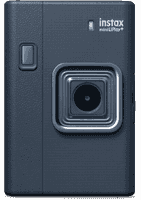
Instax Mini LiPlay+Best for selfies
Street price: $199.95 (list $234.95)
Amazon rating: 4.2 out of 5 (19 ratings)
Pros
- first Instax with a real rear selfie camera instead of a mirror
- understated design that looks more grown-up than the Mini Evo
- big, sharp 3-inch screen and easy Bluetooth printing from a phone
Cons
- the app will only pull across photos you have already printed
- noticeable shutter lag, so candid shots get missed
- priced the same as the Instax Mini Evo, which most reviewers prefer
If the camera is mostly for selfies, the LiPlay+ is the one. It is the first Instax with a real rear-facing selfie camera, so a teen frames the shot on a 3.0-inch screen instead of guessing in a mirror. A Layered Photo mode puts the front and rear cameras in one frame.
Because it is a hybrid, it saves every shot digitally and prints only the ones they choose, in about 13 seconds each. That matters for the film bill. A teen who would burn through packs on an analog camera only spends $0.91 on the frames worth keeping. It also prints photos already on their phone over Bluetooth, so it doubles as a phone printer. Sound Print adds about three seconds of audio to a print as a QR code, though Fujifilm keeps that audio for 24 months only.
The downsides: shutter lag of about 0.7 seconds, or 1.5 seconds with flash, so quick candid shots get missed. The sensor is about 4.9 MP, fine for choosing prints and not much else. The app only imports photos that have already been printed. The selfie-camera switch sits right next to the power button and is easy to hit by mistake.
It was $199.95 on October 5, 2026, and Amazon buyers rate it 4.2 out of 5 from only 19 ratings. The Instax Mini Evo costs about the same, and reviewers, including Digital Camera World’s Hillary K. Grigonis, prefer it. Choose the LiPlay+ only if selfies are the point. Our Mini Evo vs Mini LiPlay comparison compares the two.
Best Polaroid for teens: Polaroid Go Generation 3
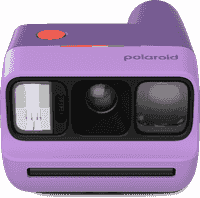
Polaroid Go Generation 3Best Polaroid for teens
Street price: $82.00 (list $89.99)
Amazon rating: 3.8 out of 5 (224 ratings)
Pros
- genuinely pocket-sized
- Go film is much cheaper per shot than i-Type
- selfie mirror and stronger flash make selfies work
Cons
- prints blow out in bright sunlight
- flash turns itself back on for every shot
- no tripod thread despite having a self-timer
Some teens want a Polaroid by name. The Go Generation 3 is the one to buy them. It weighs 252 g and measures 106.5 x 83.8 x 64.6 mm. TechRadar calls it the smallest instant camera yet, and it fits a jacket pocket at a festival. It has a selfie mirror, a self-timer and double exposure, and its battery charges over USB-C and lasts about 120 shots.
Go film is the cheapest Polaroid film, at about $1.36 a shot, against about $2.37 for full-size i-Type film. That is still about 45 cents more than Instax Mini. The prints are small: the picture is 47 x 46 mm on a 66.6 x 53.9 mm sheet.
Two habits cost film. It overexposes easily in strong sun, and TechRadar warned that images can wash out almost completely in bright light. The flash also switches itself back on before every shot, so it has to be turned off each time. There is no tripod socket.
It was $82 on October 5, 2026. Amazon buyers rate it 3.8 out of 5 across 224 ratings, lower than the 4.2 of the Go Generation 2 it replaced. TechRadar scored it 4 out of 5, and Digital Camera World’s James Artaius called it Polaroid’s best miniature camera yet.
Our Polaroid Go vs Instax Mini 12 comparison picked the Instax because the film is cheaper. Buy the Go if the Polaroid name or the pocket size is the whole point.
Best if they shoot on a phone: Instax Mini Link 3

Instax Mini Link 3Best if they shoot on a phone
Street price: $99.95
Amazon rating: 4.7 out of 5 (742 ratings)
Pros
- easy setup and fast Bluetooth pairing
- vibrant, true-to-screen color
- compact enough to carry everywhere
Cons
- occasional bad batches of film hurt print quality
- AR/Instax AiR Studio features feel gimmicky
- still costs more per print than Zink or dye-sub rivals
Most teens already take their photos on a phone. The Mini Link 3 skips the camera and prints those photos onto the same Instax Mini film. It connects over Bluetooth, prints in about 15 seconds at 318 dpi, and one charge covers about 100 prints. At 210 g it fits in a bag for a party. A teen can print the best shot of the night instead of hoping the camera caught it.
The printer is the cheapest way to avoid wasted film. Nothing prints until they choose it, so a blink or a bad angle costs nothing. Film is the same $0.91 a print as the Mini 13. Buyers praise the easy setup, fast pairing and true-to-screen color. It charges over USB-C, and two color modes, Instax-Rich and Instax-Natural, change the look of a print.
The catch is that it is not a camera. There is no shutter to press at the party, and the prints are the same small Mini size. Some buyers report occasional bad batches of film, and the app’s AR effects feel like a gimmick to many.
It was $99.95 on October 5, 2026, and Amazon buyers rate it 4.7 out of 5 across 742 ratings, the best score on this page. Our Instax Mini Link 1 vs 2 vs 3 comparison explains why the Link 3 is the one to buy, and our Instax printer vs camera comparison helps if you are deciding between this and a camera.
Best for creative teens: Instax Mini Evo
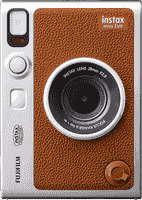
Instax Mini EvoBest for creative teens
Street price: $199.00 (list $234.95)
Amazon rating: 4.6 out of 5 (2,008 ratings)
Pros
- 100 lens/film effect combinations make it feel like a real creative tool
- can review and choose which shots to print, so no wasted film
- retro dial-and-lever design feels premium
Cons
- photos look noticeably more digital/lower-resolution than analog Instax prints
- printing is slow if you shoot a lot
- no optical viewfinder
The Mini Evo suits a teen who likes playing with filters and effects. It is a hybrid camera with real dials: a ring around the lens picks one of 10 lens effects and a film dial picks one of 10 film effects, 100 combinations in all. A lever prints the shot. They can review every frame on the 3.0-inch screen and print only the ones they like, which keeps the film bill down.
It also has autofocus, a self-timer, a flash that can be switched off and room for about 45 photos plus a microSD card. Prints take about 16 seconds, and one charge covers about 100 of them. It pairs with a phone over Bluetooth.
The trade-off is the look. Its prints come from a digital file, and reviewers and buyers say they look flatter than a shot from an analog Instax. There is no optical viewfinder.
It was $199 on October 5, 2026, and Amazon buyers rate it 4.6 out of 5 across 2,008 ratings. That is about the same price as the LiPlay+, with far more buyers behind it. Our Mini 99 vs Mini Evo comparison and our Mini Evo vs Mini LiPlay comparison both pick the Evo.
Best on a small budget: Kodak Smile

Pros
- the screen lets you choose which shots to print instead of wasting paper
- slide-open body is genuinely pocketable and cannot fire by accident
- prints are ready in well under a minute and have sticky backs
Cons
- print and image quality are only fair, and dull or indoor light defeats it
- the flash is weak beyond about two metres
- you have to press OK after the shutter or the photo is not saved
The Smile costs more to buy than the Mini 13 but less to run. It was $99.99 on Kodak’s own store on October 5, 2026, $20.04 more than the Mini 13. Its sticky-backed Zink prints cost about $0.49 each, against $0.91 for Instax Mini. After about 48 prints, the Smile is the cheaper of the two, and its screen means a teen only prints the shots they pick.
It slides open to turn on, which also protects the lens, and at 23 mm thick it fits in a pocket. Prints come out in about 35 seconds, and the sticky backs suit journals, lockers and scrapbooks. One charge covers about 40 prints.
The prints are the weak point. Zink prints are small and lose contrast and warmth next to Instax, and dull or indoor light defeats the camera. The flash is weak beyond about two meters. After pressing the shutter they have to press OK, or the photo is not saved. Internal memory holds only a handful of shots, so add a microSD card. It has no Bluetooth, so it cannot print phone photos.
Amazon buyers rate it 4.4 out of 5 across 2,078 ratings, though a minority report cameras dying within weeks. Our Instax vs Zink comparison shows how the prints compare.
Best for a teen getting into photography: Instax Mini 99
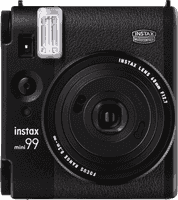
Instax Mini 99Best for a teen getting into photography
Street price: $189.05 (list $199.95)
Amazon rating: 4.6 out of 5 (182 ratings)
Pros
- six color-effect filters and brightness dial give real creative control
- solid, premium-feeling build
- double exposure and bulb mode are rare on an analog Instax
Cons
- expensive next to the Mini 12/41
- color effects can be gimmicky for casual shooters
The Mini 99 is for a teen who wants to learn how a picture is made, on film. It has a brightness dial with five levels, a color effect dial, double exposure and a bulb mode that holds the shutter open for up to 10 seconds. A three-zone focus setting covers close-ups, standard shots and landscapes, and a tripod socket makes long exposures possible. It also has a selfie mirror and a self-timer, and a rechargeable battery that lasts about 100 shots.
Unlike the hybrids, every shot goes straight onto the film, so mistakes cost $0.91 each. For a teen learning exposure, that is part of the lesson.
It was $189.05 on October 5, 2026, and Amazon buyers rate it 4.6 out of 5 across 182 ratings. TechRadar called it a “grown-up” Instax with room for creative experimentation. The color effects can be too much for a casual shooter, who would be happier with the Mini 13.
If the teen wants creative effects more than film itself, the Mini Evo is the better buy for $9.95 more. Our Mini 99 vs Mini Evo comparison explains why.
Film costs: what a teen will spend
The camera is the cheap part. The table shows what 100 prints cost on each film, using each record’s per-shot price times 100. Film comes in packs of 8 to 50, so the real bill moves in steps.
| Film | Used by | Cost per print | 100 prints |
|---|---|---|---|
| Kodak Zink 2 x 3 | Kodak Smile | about $0.49 | about $49 |
| Instax Mini | Mini 13, LiPlay+, Mini Link 3, Mini Evo, Mini 99 | about $0.91 | about $91 |
| Polaroid Go | Go Generation 3 | about $1.36 | about $136 |
| Polaroid i-Type | Now Generation 3, Flip | about $2.37 | about $237 |
Instax Mini and i-Type prices were checked on October 5, 2026. Zink and Go film were checked in September 2026. All are regular Amazon prices, not sales.
The other way to save is to print less. The LiPlay+, the Mini Evo, the Mini Link 3 and the Kodak Smile only print the shots a teen chooses. The Mini 13, the Go and the Mini 99 print every shot.
Camera or phone printer?
Ask what the teen photographs with now. If it is always the phone, the Mini Link 3 prints those photos on the same film as a Mini 13, and nothing is wasted. If the fun is pressing a shutter and passing a print around at a party, a camera is the better gift.
A Mini 13 and a Mini Link 3 together came to $179.90 on October 5, 2026, less than the Mini Evo or the LiPlay+, which do both jobs in one body. Our Instax printer vs camera comparison covers the choice in more detail.
Gift bundles: buy film with it
Buy film with the camera, or the gift stops working after the first pack. An Instax Mini twin pack of 20 shots was $18.17 at Amazon on October 5, 2026, and it fits the Mini 13, LiPlay+, Mini Link 3, Mini Evo and Mini 99. A Polaroid Go double pack of 16 shots was $21.79 in September 2026. A 50-sheet pack of Kodak’s sticky-backed 2 x 3 Zink paper was $24.37 in September 2026.
Check the film type before you buy. Go film fits only Polaroid Go cameras, not i-Type or 600 cameras. Instax Mini, Square and Wide films are not interchangeable either.
How we chose
We have not tested most of these cameras in person yet. The picks come from each product’s published specs, prices and Amazon ratings checked on October 5, 2026, and from named professional reviews. Film for the Polaroid Go and paper for the Kodak Smile were last priced in September 2026. Our method is on the How We Test page.
At a glance
| Model | Pick | Street price | Film or paper | Cost per shot or print | Print size | Amazon rating |
|---|---|---|---|---|---|---|
| Instax Mini 13 | Best overall | $79.95 | Instax Mini | $0.91 | 86 x 54 mm | 4.5 (19 ratings) |
| Instax Mini LiPlay+ | Best for selfies | $199.95 | Instax Mini | $0.91 | 86 x 54 mm | 4.2 (19 ratings) |
| Polaroid Go Generation 3 | Best Polaroid for teens | $82.00 | Polaroid Go | $1.36 | 66.6 x 53.9 mm | 3.8 (224 ratings) |
| Instax Mini Link 3 | Best if they shoot on a phone | $99.95 | Instax Mini | $0.91 | 86 x 54 mm | 4.7 (742 ratings) |
| Instax Mini Evo | Best for creative teens | $199.00 | Instax Mini | $0.91 | 86 x 54 mm | 4.6 (2,008 ratings) |
| Kodak Smile | Best on a small budget | $99.99 | Zink 2x3 | $0.49 | 76 x 51 mm | 4.4 (2,078 ratings) |
| Instax Mini 99 | Best for a teen getting into photography | $189.05 | Instax Mini | $0.91 | 86 x 54 mm | 4.6 (182 ratings) |
Prices and ratings checked October 5, 2026.
Frequently asked questions
Who makes the best instant camera?
For most teens, Fujifilm. Its Instax Mini film is the cheapest instant film here at about $0.91 a shot, and its simplest cameras, like the $79.95 Instax Mini 13, set the exposure for you. Polaroid's full-size i-Type prints are bigger and more classic-looking, but its film costs more.
Is Polaroid film expensive?
Yes, compared with Instax. Polaroid i-Type film works out at about $2.37 a shot and Polaroid Go film at about $1.36, against about $0.91 for Instax Mini. Those are regular Amazon prices: Instax and i-Type checked on October 5, 2026, and Go film in September 2026.
What are some cheap Polaroid cameras?
The Polaroid Go Generation 3, at $82 on October 5, 2026, is the cheapest current Polaroid. It makes small prints on Go film. The Polaroid Now Generation 3, at $129.99, is the cheapest current camera that makes full-size Polaroid prints.
What is a good instant camera for a beginner?
The Instax Mini 13. Twist the lens to turn it on, press one button, and the camera sets the exposure itself. It has a selfie mirror, a close-up mode and a self-timer, and it runs on two AA batteries.