
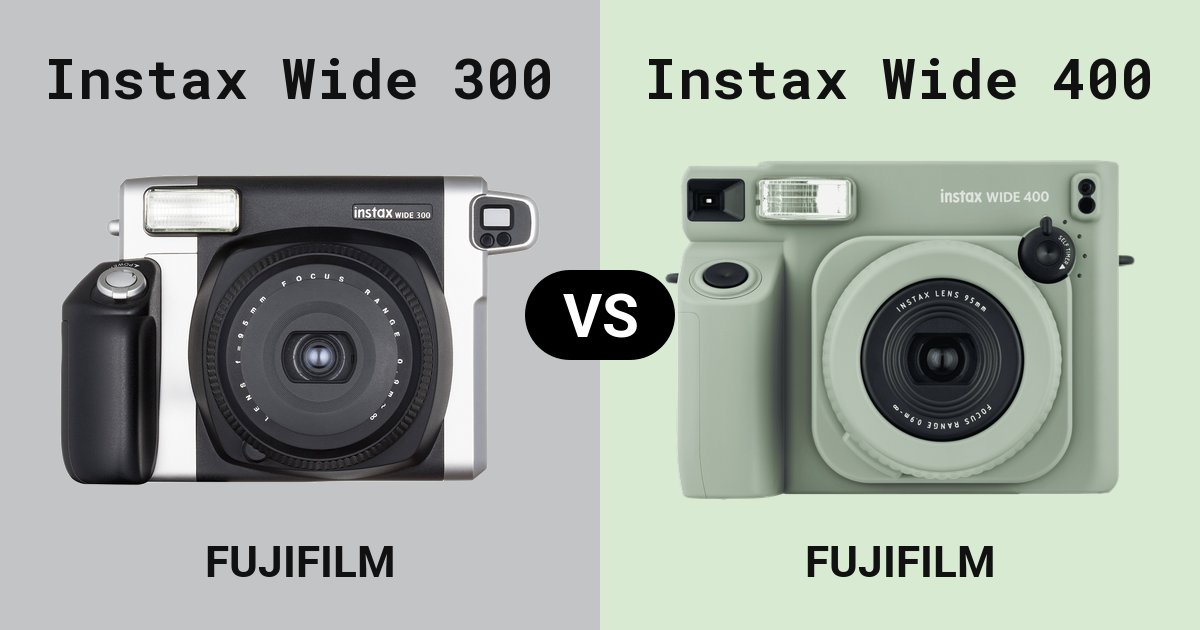
The Wide 400 replaced the Wide 300, which Fujifilm no longer makes, and both carry the same $149.95 list price. Buy the Wide 400: same lens, film and exposure, plus a self-timer and an angle-adjustment accessory.
Fujifilm launched the Instax Wide 300 in 2014 and sold it for about a decade. The Wide 400 replaced it, arriving in 2024, and the Wide 300 is now discontinued. You can still find one as leftover stock or used, so the question is whether the older camera is worth buying when the new one costs the same at list.
What is actually different
Less than ten years would suggest. Both cameras use a 95 mm f/14 lens, set exposure automatically across Lv 10.5 to 15 at ISO 800, and run a 1/64 to 1/200 second shutter. Both focus in two ranges, Normal from 0.9 to 3 m and Landscape from 3 m onwards. The flash fires automatically and reaches 0.9 to 3 m on each. Four AA batteries power either camera for about 100 shots. Both have a tripod socket and take a close-up lens. Fujifilm puts the close-up lens attachment in the Wide 300’s box, though we do not have a close-up range for it; the Wide 400 focuses from 0.4 to 0.5 m with its close-up lens accessory. Neither has a selfie mirror, double exposure, bulb mode or any manual shooting mode.
The Wide 400 has a self-timer, so you can get into your own group shot, which the Wide 300 cannot do. It ships with a removable angle-adjustment accessory for tilting the camera when it sits on a table. And it works with the instax UP! app, which the Wide 300 does not list.
The Wide 300 has one thing the Wide 400’s spec sheet does not mention: exposure compensation of plus or minus 2/3 EV. We do not have a figure for the Wide 400, so we cannot say whether it has the same control.
Fujifilm gives the Wide 300 a recycle time of 0.2 to 6 seconds and the Wide 400 a recycle time of 7 seconds or less. The lens description differs too: the Wide 400’s is a retractable design with two components in two elements, and the Wide 300’s is listed as plastic optics.
Neither camera is small. The Wide 300 measures 167.8 x 94.7 x 120.9 mm and weighs 612 g. The Wide 400 measures 162 x 98 x 123 mm and weighs 616 g. The Wide 300 came in Black only. The Wide 400 comes in Sage Green and Jet Black.
Reviewers liked the changes without calling the Wide 400 a new kind of camera. Digital Camera World called it a clear improvement on the Wide 300, with a more appealing design and a useful self-timer and angle-adjustment accessory, though still as big as ever. Dan Finnen called it a worthwhile update for anyone who wants big Instax Wide prints. Amateur Photographer found it a decent easy point-and-shoot for larger prints that experienced photographers might find a bit unremarkable.
Film and cost per shot
At the last price check, on October 5, 2026, the Wide 400 was $149.95, its list price. The Wide 300 has no current price, because Fujifilm no longer makes it. Its list price was also $149.95. Whatever a seller asks for one today depends on the stock they have left. A Wide 300 at or near $149.95 is a bad deal when a new Wide 400 costs the same.
Film costs the same in both. They take Instax Wide film, which prints 86 x 108 mm with a 62 x 99 mm picture. A 5-pack of 100 shots was $139.95 at Amazon on the same date, which works out at about $1.40 a shot. One 5-pack costs almost as much as the Wide 400, and over the life of either camera film is the larger cost by a long way.
So a discount on a Wide 300 is worth less than it looks: saving $40 on the body pays for about 29 shots.
Which one to buy
Buy the Wide 400. It is in production, it was $149.95 at the last check, and it adds a self-timer and an angle-adjustment accessory over the Wide 300 without changing the lens or the film. Amazon buyers rate it 4.0 out of 5 across 331 ratings. Reviewers’ main complaint is its size and weight, and the Wide 300 is no better there.
Buy the Wide 300 only if you find one well under the Wide 400’s price from a seller you trust. You get the same 95 mm lens, the same Wide prints, a tripod socket and a close-up lens in the box. You give up the self-timer and the angle-adjustment accessory, and you buy a camera nobody makes any more.
If you already own a Wide 300 that works, keep it and spend the money on film. If you want Wide prints but would rather choose which shots to print, read our Instax Wide Evo vs Wide 400 comparison.
Where to buy
 Instax Wide 300DiscontinuedList $149.95
 Instax Wide 400$149.95Check price on Amazon
Specs side by side
Same on both: Analog instant camera · Instax Wide film · 86 x 108 mm print · 62 x 99 mm image · $1.40 a shot · no selfie mirror · no double exposure · no bulb mode · tripod socket · Power: 4 x AA alkaline · Shots per battery / prints per charge: 100.
| Spec | Instax Wide 300 | Instax Wide 400 |
|---|---|---|
| Status | Discontinued | Current |
| Launched | 2014 | 2024 |
| Lens | 95 mm f/14 prime, plastic optics | retractable, 95 mm f/14, 2 components 2 elements |
| Focus | Normal 0.9-3 m, Landscape 3 m and beyond, motor-driven 2-range switching; close-up lens attachment included in the box | Normal 0.9-3 m, Landscape 3 m and beyond, Macro 0.4-0.5 m with close-up lens accessory |
| Exposure | automatic, Lv 10.5-15 (ISO 800), +/- 2/3 EV compensation | automatic, Lv 10.5 to 15 (ISO 800) |
| Shutter | 1/64 to 1/200 s, programmed electronic | 1/64 to 1/200 s |
| Flash | automatic, recycle 0.2-6 s, range 0.9-3 m | automatic, effective range 0.9-3 m, recycle 7 s or less |
| Close-up mode | No | Yes |
| Self timer | No | Yes |
| App | n/a | instax UP! |
| Dimensions | 167.8 x 94.7 x 120.9 mm | 162 x 98 x 123 mm |
| Weight | 612 g | 616 g |
| Colours | 1 (Black) | 2 (Sage Green, Jet Black) |
| Street price | n/a | $149.95 (checked October 5, 2026) |
| Amazon rating | n/a | 4 (331 ratings) |
| Buy | n/a | Check price on Amazon |
Specs from manufacturer pages; prices and ratings checked October 5, 2026.
What reviewers and buyers say
Instax Wide 300
Published reviews of the Instax Wide 300:
- “The Wide 300 was Fujifilm's long-running large-format point-and-shoot Instax, replaced by the redesigned Wide 400 in 2024.” (B&H Photo)
Instax Wide 400
Published reviews of the Instax Wide 400:
- “The Wide 400 is a decent option if you want an easy-to-use point-and-shoot that can take larger prints, though experienced photographers might find it a bit unremarkable.” (Amateur Photographer, 2024)
- “The Wide 400 is a clear improvement on the Wide 300, with a more appealing design and useful additions like a self-timer and angle-adjustment accessory, though it's still as big as ever.” (Digital Camera World, 2024)
- “The Wide 400 is a worthwhile update for anyone who wants big Instax Wide prints without needing an entirely new reason to buy one over the Wide 300.” (Dan Finnen, 2024-11)
Amazon buyers rate it 4 out of 5 across 331 ratings.
Praised for: large wide-format prints are great for group shots and events, self-timer and angle-adjustment accessory are useful additions over the Wide 300. Criticised for: very large and heavy to carry around, no selfie mirror despite the size.
Frequently asked questions
What is the difference between the Instax Wide 300 and Wide 400?
The extras around the camera, not the picture. Both use a 95 mm f/14 lens, a 1/64 to 1/200 second shutter, automatic exposure across Lv 10.5 to 15, a tripod socket, a close-up lens option and four AA batteries. The Wide 400, launched in 2024, adds a self-timer, an angle-adjustment accessory and instax UP! app support. The Wide 300 launched in 2014.
Is the Instax Wide 300 discontinued?
Yes. Fujifilm replaced it with the Wide 400, and B&H Photo describes the switch as happening in 2024. We do not have a confirmed year the Wide 300 left production. What is left is remaining stock and used bodies, so there is no reliable current price. Its list price was $149.95.
Should I upgrade from the Wide 300 to the Wide 400?
Only if you want a self-timer. Both already have a tripod socket and a close-up lens option, and the lens, shutter, exposure range and film are the same, so your prints will look much the same. The Wide 400 was $149.95 at the October 5, 2026 check, which buys about 107 shots of Instax Wide film instead.
How much does Instax Wide film cost per shot?
About $1.40. A 5-pack of Instax Wide film, 100 shots in total, was $139.95 at Amazon on October 5, 2026. Each print is 86 x 108 mm with a 62 x 99 mm picture, and both the Wide 300 and Wide 400 take the same film.