
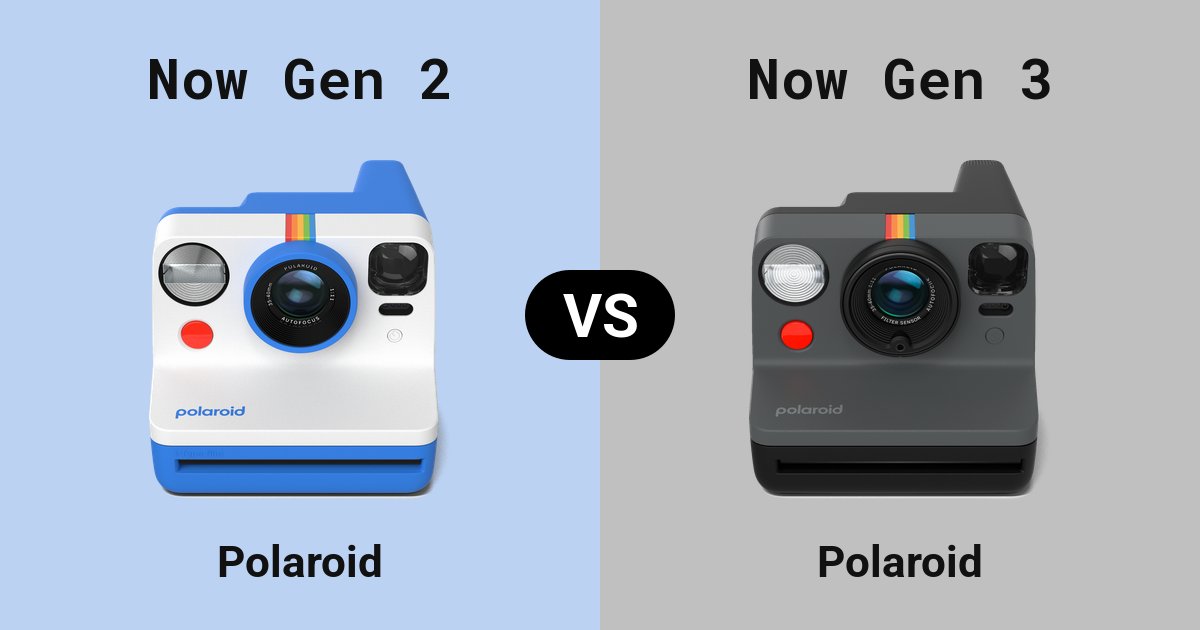
Polaroid replaced the Now Generation 2 with the Generation 3 in 2025, and the changes are small but real. The Generation 3 is the one to buy, unless leftover Generation 2 stock is cheap enough to forgive the missing tripod socket.
Polaroid launched the Now Generation 2 in 2023 and the Generation 3 in 2025. The bodies are the same size, they take the same film, and at arm’s length you cannot tell them apart. Polaroid stopped selling the Generation 2 itself in 2026, so this is partly a question of what the third generation added and partly a question of whether the stock left over is worth buying.
What is actually different
Both cameras take Polaroid i-Type film and also take Polaroid 600. Both print 107 x 88 mm with a 79 x 77 mm image. Both measure 150.2 x 112.2 x 94 mm, charge over USB-C and manage about 120 shots a charge. Both have a self-timer and double exposure. Neither has a selfie mirror, a close-up mode, a bulb mode or any manual control, and neither has Bluetooth. On both, the Polaroid app scans finished prints and does nothing else.
The Generation 3 is 8 g lighter, 448 g against 456 g. Both use a coated two-lens system in polycarbonate and acrylic, and Polaroid does not publish focal lengths for the Generation 3.
Focus is the change that matters. Both autofocus by picking between two fixed zones. Polaroid gives the Generation 3 zones as 0.40 to 1.3 m and 1.0 m to infinity. The Generation 2 page reads 0.55 to 1.3 m and 0.6 m to infinity, and that second figure looks like a typo for 1.3 m to infinity. Taken at face value, the Generation 3 focuses about 15 cm closer.
Polaroid lists a tripod socket on the Generation 3 and lists none on the Generation 2, which is odd, because the Now+ Generation 2 had one. Both cameras have a self-timer, and a self-timer needs somewhere to stand the camera.
Polaroid publishes six usable apertures for the Generation 3, from f/64 to f/11, and describes its shutter as a custom system driven by a precision step motor, with Amazon’s spec sheet listing a 10 second maximum exposure. For the Generation 2 it publishes no shutter range at all. Polaroid support documents the same three-position exposure compensation for the Now line, brighten, neutral and darken, held on the flash button, though PCMag’s Jim Fisher treated the Generation 3 as having no on-body exposure control.
Colours went from five to seven. The Generation 2 came in Black, White, Red, Vintage White and Black & White. The Generation 3 comes in Black, Pebble White, Arctic Blue, Coral, Purple, Yellow and Pink.
Reviewers do not treat the change of generation as a big step. Fisher scored the Generation 3 3.0 and called it a stylish instant camera that wins nostalgia points for its classic square I-Type film format, but whose basic autofocus misses too often to justify the cost per use. Digital Camera World’s James Artaius scored the Generation 2 body 5 and said it was still one of the very best instant cameras you can buy, while pointing out that the jump from the original Now came down to a logo, 5.5 g of weight and a USB-C port. Myles Katherine Photography calls the Generation 2 an affordable, basic Polaroid that anyone can use, with photos that are not super sharp but have a candidness that captures the moment.
Film and cost per shot
At the last price check, on September 10, 2026, a Polaroid Color i-Type single pack of 8 shots was $18.99, which works out at about $2.37 a shot. Both cameras also take Polaroid 600 film.
On the same date the Generation 3 was $129.99, against a list price of $119.99. The Generation 2 was $109, but that was third-party stock rather than a live Polaroid line, so treat it as what the remaining cameras were going for on the day rather than a price you can go out and pay. The $21 between them is about nine shots of film. Chris Kendrick Photography put the Generation 2’s running cost at roughly £1.70 to £2.12 a shot and warned that it could leave a sizeable hole in your bank account.
Which one to buy
Buy the Generation 3. It is the camera Polaroid still sells, it has a tripod socket, it focuses about 15 cm closer and it comes in seven colours. At the last check it was $129.99, and Amazon buyers rate it 4.2 out of 5 across 515 ratings.
Buy the Generation 2 if you find it clearly cheaper than $129.99 and do not want a tripod socket. It takes the same film and makes the same picture, and it is rated 4.3 out of 5 across about 1,300 ratings, on a much longer history than the Generation 3 has. The risk is the stock rather than the camera. Polaroid stopped selling it in 2026, shop listings often get the generation wrong, and the battery is sealed into a body that is no longer current.
If you already own a Generation 2, there is nothing here to upgrade for. The film costs the same and the autofocus guesses the same way.
Where to buy
 Polaroid Now Generation 2Discontinued$109.00Check price on Amazon
 Polaroid Now Generation 3$129.99 (list $119.99)Check price on Amazon
Specs side by side
Same on both: Analog instant camera · Polaroid i-Type (also takes Polaroid 600) film · 107 x 88 mm print · 79 x 77 mm image · $2.37 a shot · no selfie mirror · no close-up mode · self timer · double exposure · no bulb mode · Power: built-in lithium-ion battery, USB-C rechargeable · Shots per battery / prints per charge: 120 · Dimensions: 150.2 x 112.2 x 94 mm.
| Spec | Polaroid Now Generation 2 | Polaroid Now Generation 3 |
|---|---|---|
| Status | Discontinued (2026) | Current |
| Launched | 2023 | 2025 |
| Lens | Coated optical-grade polycarbonate and acrylic two-lens autofocus system | Coated optical-grade polycarbonate and acrylic two-lens system; focal lengths not published for Generation 3 |
| Focus | autofocus across 2 fixed focus zones. Polaroid's page gives these as 0.55 to 1.3 m and 0.6 m to infinity, which looks like a typo for 1.3 m to infinity | autofocus that picks between 2 fixed focus zones: 0.40 to 1.3 m and 1.0 m to infinity |
| Exposure | automatic, with a three-position exposure compensation (brighten, neutral, darken) reached by holding the flash button, per Polaroid support | automatic; Polaroid lists six usable apertures from f/64 to f/11. Polaroid support documents a three-position exposure compensation (brighten, neutral, darken) reached by holding the flash button on the Now line, though PCMag's reviewer treated the Gen 3 as having no on-body exposure control |
| Shutter | not published by Polaroid for the Gen 2 | custom shutter system driven by a precision step motor; Amazon's spec sheet lists a 10 s maximum exposure. Polaroid does not publish the full speed range |
| Flash | built-in flash, fires automatically, can be switched off | built-in flash, fires automatically, can be switched off with the flash button |
| Tripod socket | n/a | Yes |
| App | Polaroid app for Scan & Share only; no Bluetooth camera control | Polaroid app for Scan & Share only; the Now Gen 3 has no Bluetooth and no app camera control |
| Weight | 456 g | 448 g |
| Colours | 5 (Black, White, Red, plus 2 more) | 7 (Black, Pebble White, Arctic Blue, plus 4 more) |
| Street price | $109.00 (checked September 10, 2026) | $129.99 (checked September 10, 2026) |
| Amazon rating | 4.3 (1,300 ratings) | 4.2 (515 ratings) |
| Buy | Check price on Amazon | Check price on Amazon |
Specs from manufacturer pages; prices and ratings checked September 10, 2026.
What reviewers and buyers say
Polaroid Now Generation 2
Published reviews of the Polaroid Now Generation 2:
- “She calls it an affordable, basic Polaroid camera that anyone can use, giving the full experience of Polaroid photography without complication, and says the photos are not super sharp but have a candidness that captures the moment.” (Myles Katherine Photography, 2026-03)
- “Kendrick calls it a great fun little camera that delivers a huge hit of nostalgia, but warns that at roughly £1.70 to £2.12 a shot you could end up with a sizeable hole in your bank account.” (Chris Kendrick Photography, 2026-04)
- “Reviewing the same Gen 2 body in Now+ form, Artaius says image quality is great and it is still one of the very best instant cameras you can buy, but the generational change comes down to a logo, 5.5 g of weight and USB-C, so it is not worth upgrading from the original.” (Digital Camera World (James Artaius), 2024-10)
Amazon buyers rate it 4.3 out of 5 across 1,300 ratings.
Praised for: simple point-and-shoot operation with nothing to learn, solid, chunky, nostalgic build, USB-C rechargeable battery, self-timer and double exposure. Criticised for: film cost, roughly $2 a shot, images are not sharp corner to corner, bulky to carry, no selfie mirror, needs plenty of light or the flash.
Polaroid Now Generation 3
Published reviews of the Polaroid Now Generation 3:
- “Reviewing the Gen 3 body (as the Now+), Finnen concludes that if you are an avid photographer you will reap far bigger rewards from a vintage Polaroid such as the Impulse AF, and that the third generation does not change that.” (Dan Finnen, 2025-04)
- “Fisher, who notes the Now Gen 3 is physically identical to the Now+ he tested apart from Bluetooth, calls it a stylish instant camera that wins nostalgia points for its classic square I-Type film format but whose basic autofocus misses too often to justify the cost per use.” (PCMag (Jim Fisher), 2025-06)
- “Reviewing the Gen 3 body in Now+ form, he says he has really enjoyed using it and finds it a lot of fun, while flagging the sealed internal battery and the ongoing film cost as the things to think about before buying.” (PhotographyBanzai, 2025-10)
Amazon buyers rate it 4.2 out of 5 across 515 ratings.
Praised for: simple point-and-shoot operation, the classic Polaroid look and full-size prints, solid build and good colour choices, no Bluetooth means no phone in the way. Criticised for: film cost, eight shots a pack, exposure and sharpness can disappoint indoors and in mixed light, expensive for what buyers call a novelty, viewfinder framing takes practice, the print shows more than you expect.
Frequently asked questions
What is the difference between the Polaroid Now Generation 2 and Generation 3?
Focus, a tripod socket, weight and colours. The Generation 3 launched in 2025 with focus zones of 0.40 to 1.3 m and 1.0 m to infinity, a tripod socket, seven colours and a weight of 448 g. The Generation 2 launched in 2023 with a near zone starting at 0.55 m, no tripod socket listed by Polaroid, five colours and a weight of 456 g. The body is 150.2 x 112.2 x 94 mm on both, and both take Polaroid i-Type and Polaroid 600 film.
Is the Polaroid Now Generation 3 worth upgrading to?
Not if you already own a Generation 2. The film, the print size, the self-timer, the double exposure, the USB-C charging and the 120 shots a charge are the same on both, and the two-zone autofocus works the same way. The Generation 3 adds a tripod socket and a focus zone that starts 15 cm closer, which is not worth $129.99 when you already have a working camera.
Can you still buy the Polaroid Now Generation 2?
Only as leftover stock. Polaroid's own product page read out of stock in 2026 and the camera is marked discontinued. At the last price check, on September 10, 2026, remaining third-party stock was $109, against $129.99 for the Generation 3. Shop listings often mislabel which generation they are selling, so check the focus zones and the tripod socket before you pay.
Do the Polaroid Now Generation 2 and Generation 3 use the same film?
Yes. Both take Polaroid i-Type film and also take Polaroid 600 film, and both print 107 x 88 mm with a 79 x 77 mm image. At the last check a Polaroid Color i-Type single pack of 8 shots was $18.99, which is about $2.37 a shot on either camera.