
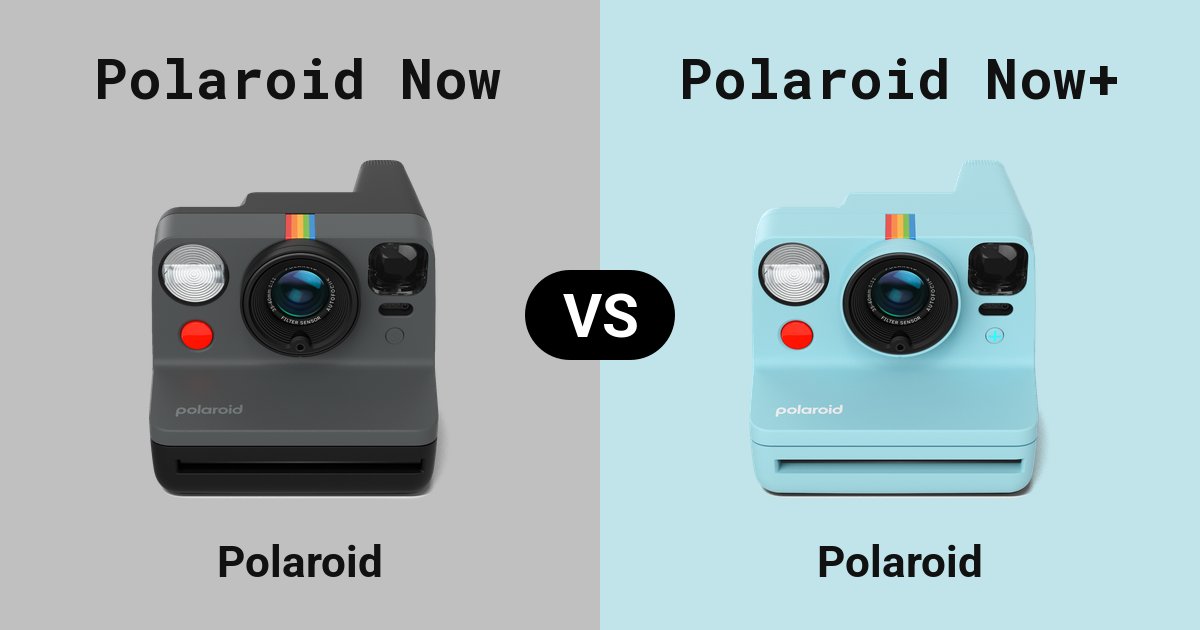
The Now+ is the same camera as the Now with Bluetooth and an app added, for $20 more. Most people should buy the plain Now Generation 3 and put the difference towards a pack of film.
Polaroid sells the Now and the Now+ side by side. Both are Generation 3 cameras, both launched in 2025, and from the front the only difference is a blue plus button. The Now+ costs $20 more and adds Bluetooth and an app. Without a phone involved, the two behave the same.
What is actually different
Most of the spec sheet is shared. Both take Polaroid i-Type film and also take Polaroid 600, and both print 107 x 88 mm with a 79 x 77 mm image. Autofocus on each picks between the same two fixed zones, 0.40 to 1.3 m and 1.0 m to infinity, and both list six usable apertures, f/64 to f/11. Either camera gives you a self-timer, double exposure, a tripod socket, a flash that fires automatically and can be switched off, and a sealed USB-C battery good for about 120 shots. Neither has a selfie mirror, a close-up mode or a bulb mode. PCMag’s Jim Fisher, who tested both, noted that the Now Generation 3 is physically identical to the Now+ apart from Bluetooth.
The Now+ is 2 mm deeper, 150.2 x 112.2 x 96 mm against 150.2 x 112.2 x 94 mm, and 4 g heavier at 452 g against 448 g. You will not notice either.
The app is the whole case for the Now+. On the plain Now, the Polaroid app scans finished prints and nothing more. On the Now+, it adds manual exposure, aperture priority, light painting, portrait mode, a remote trigger, tripod mode and EV compensation, on iOS and Android. Amazon’s spec sheet lists a 10 second maximum exposure for the Now and 30 seconds for the Now+ in app mode. With the Now+, a tripod and a phone you can hold the shutter open for half a minute and paint with a torch, which the Now has no way of doing.
What the app does not do is give you control on the camera itself. Polaroid support documents a three-position exposure compensation for the Now line, held on the flash button, though Fisher treated the Generation 3 body as having no on-body exposure control at all. Either way, any real exposure change on the Now+ means getting the phone out first, and settings on the Now+ Generation 2 did not survive a power cycle.
The Now+ Generation 2 also shipped with a five-piece lens filter kit: starburst, red vignette, orange, yellow and blue. The Generation 3 does not include it, which removes one of the clearer reasons to pay for a Now+.
The plain Now comes in seven colours: Black, Pebble White, Arctic Blue, Coral, Purple, Yellow and Pink. The Now+ comes in four: Arctic Blue, Black, Coral and White.
Reviewers split on whether the app earns its money. PhotographyBanzai says he has really enjoyed the Now+ Generation 3 and calls it a lot of fun with some very cool features through the app, while flagging the sealed internal battery and the cost of eight-shot packs. Fisher scored both cameras 3.0, calling the Now+ a stylish instant camera that wins nostalgia points for its classic square I-Type film format but whose basic autofocus misses too often to justify the cost per use. Dan Finnen goes further: if you are an avid photographer who wants to shoot Polaroid, he says you will reap far bigger rewards from a vintage camera such as the Impulse AF, and the third generation does not change that.
Film and cost per shot
The film is the same on both. At the last price check, on September 10, 2026, a Polaroid Color i-Type single pack of 8 shots was $18.99, which works out at about $2.37 a shot.
On the same date the Now was $129.99 against a list price of $119.99, and the Now+ was $149.99 against a list price of $139.99. The $20 between the cameras is one pack of film and change. Over a year of shooting, the film bill dwarfs that gap.
Which one to buy
Buy the plain Now Generation 3 if you want to pick the camera up and press the button. It takes the same picture as the Now+, costs $20 less, comes in seven colours instead of four, and has no pairing step between you and the shot. Amazon buyers rate it 4.2 out of 5 across 515 ratings. Its listed strengths include first Polaroids, parties and weddings, and gifts, and one of the things buyers like about it is that no Bluetooth means no phone in the way.
Buy the Now+ Generation 3 if you want to experiment and are willing to slow down. Manual mode, aperture priority, light painting, a remote trigger for group shots and 30 second exposures are real additions. Know what you are not getting: the filter kit is no longer in the box, there is no lens cap, and nothing the app adds can be reached from the body itself.
Neither camera fixes the complaint that dominates buyer reviews of the Now+, which is dark prints indoors even with the flash. The app can only help with that if you are prepared to put the camera on a tripod and hold the shutter open.
Where to buy
 Polaroid Now Generation 3$129.99 (list $119.99)Check price on Amazon
 Polaroid Now+ Generation 3$149.99 (list $139.99)Check price on Amazon
Specs side by side
Same on both: Analog instant camera · Current · launched 2025 · Polaroid i-Type (also takes Polaroid 600) film · 107 x 88 mm print · 79 x 77 mm image · $2.37 a shot · Lens: Coated optical-grade polycarbonate and acrylic two-lens system; focal lengths not published for Generation 3 · Focus: autofocus that picks between 2 fixed focus zones: 0.40 to 1.3 m and 1.0 m to infinity · Flash: built-in flash, fires automatically, can be switched off with the flash button · no selfie mirror · no close-up mode · self timer · double exposure · no bulb mode · tripod socket · Power: built-in lithium-ion battery, USB-C rechargeable · Shots per battery / prints per charge: 120.
| Spec | Polaroid Now Generation 3 | Polaroid Now+ Generation 3 |
|---|---|---|
| Exposure | automatic; Polaroid lists six usable apertures from f/64 to f/11. Polaroid support documents a three-position exposure compensation (brighten, neutral, darken) reached by holding the flash button on the Now line, though PCMag's reviewer treated the Gen 3 as having no on-body exposure control | automatic on the body, with a three-position exposure compensation reached by holding the flash button per Polaroid support; aperture priority, manual and finer EV compensation through the Polaroid app. Six usable apertures f/64 to f/11 |
| Shutter | custom shutter system driven by a precision step motor; Amazon's spec sheet lists a 10 s maximum exposure. Polaroid does not publish the full speed range | custom shutter system driven by a precision step motor; Amazon's spec sheet lists a 30 s maximum exposure in app mode |
| Manual modes | n/a | manual (app), aperture priority (app), light painting (app), portrait (app), remote trigger (app), tripod (app), EV compensation (app) |
| Connectivity | n/a | Bluetooth |
| App | Polaroid app for Scan & Share only; the Now Gen 3 has no Bluetooth and no app camera control | Polaroid app (iOS and Android) for manual mode, aperture priority, remote, light painting, self-timer and double exposure |
| Dimensions | 150.2 x 112.2 x 94 mm | 150.2 x 112.2 x 96 mm |
| Weight | 448 g | 452 g |
| Colours | 7 (Black, Pebble White, Arctic Blue, plus 4 more) | 4 (Arctic Blue, Black, Coral, plus 1 more) |
| Street price | $129.99 (checked September 10, 2026) | $149.99 (checked September 10, 2026) |
| Amazon rating | 4.2 (515 ratings) | 4.2 (241 ratings) |
| Buy | Check price on Amazon | Check price on Amazon |
Specs from manufacturer pages; prices and ratings checked September 10, 2026.
What reviewers and buyers say
Polaroid Now Generation 3
Published reviews of the Polaroid Now Generation 3:
- “Reviewing the Gen 3 body (as the Now+), Finnen concludes that if you are an avid photographer you will reap far bigger rewards from a vintage Polaroid such as the Impulse AF, and that the third generation does not change that.” (Dan Finnen, 2025-04)
- “Fisher, who notes the Now Gen 3 is physically identical to the Now+ he tested apart from Bluetooth, calls it a stylish instant camera that wins nostalgia points for its classic square I-Type film format but whose basic autofocus misses too often to justify the cost per use.” (PCMag (Jim Fisher), 2025-06)
- “Reviewing the Gen 3 body in Now+ form, he says he has really enjoyed using it and finds it a lot of fun, while flagging the sealed internal battery and the ongoing film cost as the things to think about before buying.” (PhotographyBanzai, 2025-10)
Amazon buyers rate it 4.2 out of 5 across 515 ratings.
Praised for: simple point-and-shoot operation, the classic Polaroid look and full-size prints, solid build and good colour choices, no Bluetooth means no phone in the way. Criticised for: film cost, eight shots a pack, exposure and sharpness can disappoint indoors and in mixed light, expensive for what buyers call a novelty, viewfinder framing takes practice, the print shows more than you expect.
Polaroid Now+ Generation 3
Published reviews of the Polaroid Now+ Generation 3:
- “If you are an avid photographer and want to shoot Polaroid, Finnen says you will reap huge rewards by digging up a vintage camera such as the Impulse AF, because they are still the best Polaroid cameras out there and the third generation does not change that.” (Dan Finnen, 2025-04)
- “The Polaroid Now+ Generation 3 is a stylish instant camera that wins nostalgia points for its classic square I-Type film format, but its basic autofocus misses too often to justify the cost per use.” (PCMag (Jim Fisher), 2025-06)
- “He has really enjoyed using the Now+ Generation 3, calling it a lot of fun with some very cool features through the app, while warning about the sealed internal battery and the ongoing cost of eight-shot film packs.” (PhotographyBanzai, 2025-10)
Amazon buyers rate it 4.2 out of 5 across 241 ratings.
Praised for: easy to hand round at weddings and parties, sturdy, good-looking body, prints look like the Polaroids people remember, app modes add real creative range. Criticised for: prints come out dark indoors, even with flash, exposure and dynamic range are worse than Instax, film cost, one-star reviewers report blurry, flat pictures, no lens cap in the box.
Frequently asked questions
What is the difference between the Polaroid Now and the Polaroid Now+?
Bluetooth and the app. The Now+ Generation 3 connects to the Polaroid app for manual mode, aperture priority, light painting, portrait mode, a remote trigger, tripod mode and EV compensation, and Amazon's spec sheet lists a 30 second maximum exposure in app mode. The plain Now Generation 3 has no Bluetooth, and its app only scans finished prints; its maximum exposure is listed as 10 seconds. Otherwise both launched in 2025, take Polaroid i-Type and 600 film, focus across the same two zones of 0.40 to 1.3 m and 1.0 m to infinity, and have a tripod socket.
Is the Polaroid Now+ worth the extra money?
Only if you will use the app. At the last price check, on September 10, 2026, the Now+ was $149.99 and the Now was $129.99, a gap of $20, which is about one pack of film at $18.99 for 8 shots. Amazon buyers rate both cameras 4.2 out of 5, across 515 ratings for the Now and 241 for the Now+.
What does the Polaroid app add on the Now+?
Manual exposure, aperture priority, light painting, portrait mode, a remote trigger, tripod mode and EV compensation, on iOS and Android. Both cameras have the same six usable apertures, f/64 to f/11, but only the Now+ lets you choose between them. Every exposure change on the Now+ needs the phone, because the body itself has no aperture or shutter control.
Does the Polaroid Now+ come with lens filters?
Not the Generation 3. The Now+ Generation 2 shipped with a five-piece lens filter kit of starburst, red vignette, orange, yellow and blue filters, and the Generation 3 dropped it. If you want the filters, you are looking at leftover Generation 2 stock, which was $141.19 at the last check on September 10, 2026.
Related comparisons
- Polaroid Go vs Polaroid Now: Which Should You Buy? (2026)
- Polaroid Flip vs Polaroid Now and Now+: Which Should You Buy? (2026)
- Polaroid Now Gen 2 vs Gen 3: What Changed and Which to Buy (2026)
- Instax Mini 11 vs Mini 12: Which Should You Buy? (2026)
- Instax Mini 41 vs Mini 99: Which Should You Buy? (2026)