
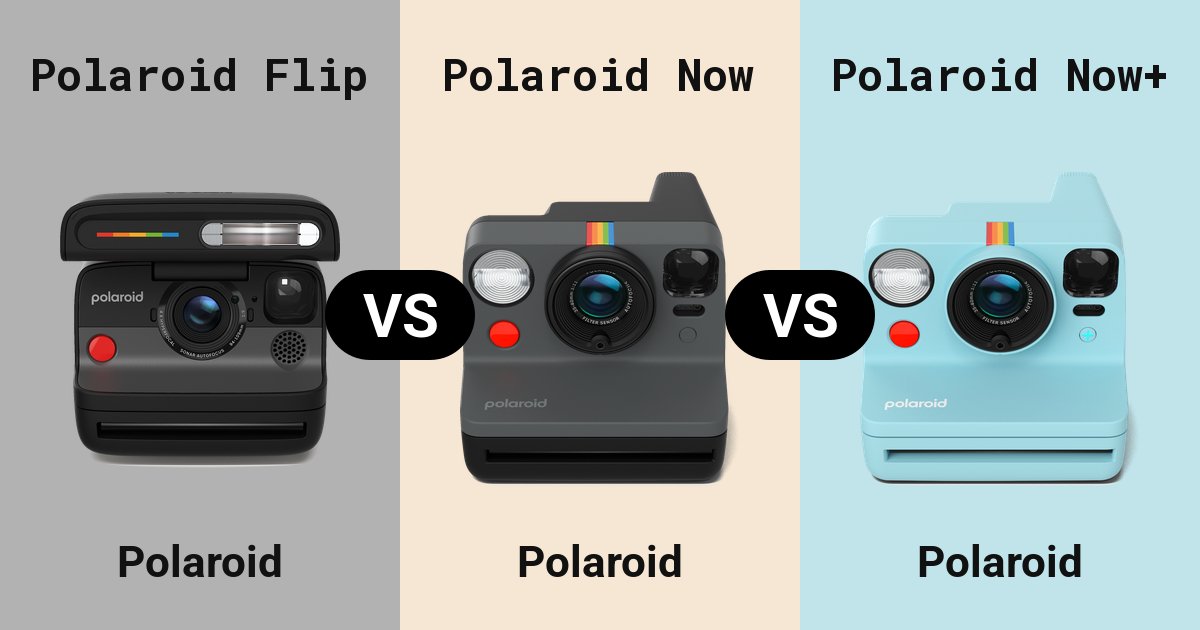
All three cameras take the same i-Type film and make the same size print, so the difference is how often each one gets the shot right. The Flip's four-zone sonar autofocus and stronger flash make it the one to buy, at $50 more than the Now.
Polaroid launched all three of these in 2025. The Now Generation 3 is the entry camera, the Now+ Generation 3 is the same body with Bluetooth and an app, and the Flip sits above both. They load the same film and print the same picture, so the question is what each one does with the frame before it comes out.
What is actually different
The Now and the Now+ pick between two fixed zones, 0.40 to 1.3 m and 1.0 m to infinity. You half-press the shutter and hear the lens shift. The Flip has a two-lens structure on a rotating gear giving four hyperfocal zones, driven by sonar: 0.4 to 0.77 m, 0.77 to 1.03 m, 1.03 to 1.68 m, and 1.68 m to infinity. All three stop at 0.4 m and none has a selfie mirror, so a frame-filling selfie is out on any of them.
PCMag’s Jim Fisher scored the Now Generation 3 and the Now+ 3.0, calling them stylish cameras that win nostalgia points for the classic square I-Type format but whose basic autofocus misses too often to justify the cost per use. He found the two bodies physically identical apart from Bluetooth. PCMag made the Flip its Editors’ Choice for I-Type cameras, saying it gets the most out of expensive I-Type film thanks to a reliable sonar-driven focus system and is the best instant camera Polaroid has made to date. Dan Finnen, who thinks an avid photographer is better off with a vintage Polaroid such as the Impulse AF than a Now+, says of the Flip that Polaroid has finally released a truly great i-Type camera, though the build feels cheap in places.
The Now and Now+ have a built-in flash that fires automatically and can be switched off. Underexposed indoor prints are the most common complaint from Now+ buyers, flash or no flash. The Flip’s flash sits above the lens in the lid, is the most powerful Polaroid has made, and adapts its power to subject distance out to 4.5 m at f/8. It switches itself back on every time you open the lid, which can overexpose bright scenes.
For exposure, the Now Generation 3 is automatic, with six usable apertures from f/64 to f/11. Polaroid’s support pages document a three-position exposure compensation reached by holding the flash button, though PCMag’s reviewer treated the camera as having no on-body control. The Now+ adds Bluetooth and the Polaroid app, which brings manual mode, aperture priority, light painting, a remote trigger and finer EV compensation, and pushes the maximum exposure to 30 seconds against 10 seconds on the Now. The lens filters that came with the Generation 2 Now+ are no longer included. The Flip does more without a phone: scene analysis, a viewfinder LED that warns of over- and under-exposure before you waste the frame, and plus or minus 1 EV on the body. Its shutter runs 1/200 to 30 seconds, with a bulb mode of up to 99 hours through the app, and its apertures run f/8.5 to f/66 depending on the focus zone.
The Flip weighs 648 g and measures 163.5 x 117.2 x 89.7 mm with the lid closed. The Now is 448 g at 150.2 x 112.2 x 94 mm, the Now+ 452 g and 2 mm deeper. The Now comes in seven colours, the Now+ in four, the Flip in Black or White. All three have a tripod socket, a self-timer, double exposure, USB-C charging and about 120 shots per charge.
The Now Generation 3 is rated 4.2 out of 5 across 515 ratings and the Now+ 4.2 out of 5 across 241. The Flip’s camera-only listing is rated 4.7 out of 5 across 7 ratings, too few to lean on, while Polaroid’s Flip and film bundle sits at 4.1 across 206 ratings.
Film and cost per shot
All three take Polaroid i-Type film and also Polaroid 600, printing 107 x 88 mm with a 79 x 77 mm image. At the last price check, on September 10, 2026, a Polaroid Color i-Type single pack of 8 shots was $18.99, which works out at about $2.37 a shot.
The cameras on the same date were $129.99 for the Now Generation 3, $149.99 for the Now+ and $179.99 for the Flip. The list prices are $119.99, $139.99 and $199.99. The $50 between the Now and the Flip is about 21 frames of film. If the sharper focus and the exposure warning save you that many frames over the life of the camera, the Flip is the cheaper one to own.
Which one to buy
Buy the Flip. It focuses across four zones instead of two, reads subject distance for the flash and warns you in the viewfinder before a bad exposure, so fewer frames of $2.37 film go to waste. Accept the weight, 648 g, and that it will not focus closer than 0.4 m.
Buy the Now Generation 3 if $129.99 is the budget and you want the big square print with nothing to learn. It has the same tripod socket, self-timer and double exposure as the others, seven colours to choose from, and no Bluetooth to bother with. Expect to lose some frames to the two-zone focus.
Buy the Now+ Generation 3 if you want to try long exposures and light painting and are happy to open an app to do it. At $149.99 it is $20 above the Now for Bluetooth, manual and aperture priority modes, a remote trigger and a 30 second maximum exposure. It is the wrong camera for quick candids, because any exposure change means a phone.
If you want aperture and shutter dials on the camera itself rather than in an app, none of these three has them, and the Polaroid I-2 at a $599.99 list price is the one that does.
Where to buy
 Polaroid Flip$179.99 (list $199.99)Check price on Amazon
 Polaroid Now Generation 3$129.99 (list $119.99)Check price on Amazon
 Polaroid Now+ Generation 3$149.99 (list $139.99)Check price on Amazon
Specs side by side
Same on all three: Analog instant camera · Current · launched 2025 · Polaroid i-Type (also takes Polaroid 600) film · 107 x 88 mm print · 79 x 77 mm image · $2.37 a shot · no selfie mirror · no close-up mode · self timer · double exposure · tripod socket · Shots per battery / prints per charge: 120.
| Spec | Polaroid Flip | Polaroid Now Generation 3 | Polaroid Now+ Generation 3 |
|---|---|---|---|
| Lens | Two-lens structure arranged on a rotating gear giving four hyperfocal zones; roughly a 35 mm equivalent at infinity, tightening to about 40 mm for close-ups | Coated optical-grade polycarbonate and acrylic two-lens system; focal lengths not published for Generation 3 | Coated optical-grade polycarbonate and acrylic two-lens system; focal lengths not published for Generation 3 |
| Focus | sonar autofocus across 4 zones (0.4 to 0.77 m, 0.77 to 1.03 m, 1.03 to 1.68 m, 1.68 m to infinity); minimum focus 0.4 m; a lid-display alert warns when the subject is too close | autofocus that picks between 2 fixed focus zones: 0.40 to 1.3 m and 1.0 m to infinity | autofocus that picks between 2 fixed focus zones: 0.40 to 1.3 m and 1.0 m to infinity |
| Exposure | automatic with scene analysis; a viewfinder LED warns of over- and under-exposure; plus or minus 1 EV compensation on the body; full manual through the Polaroid app. Apertures f/8.5 to f/66 depending on the focus zone | automatic; Polaroid lists six usable apertures from f/64 to f/11. Polaroid support documents a three-position exposure compensation (brighten, neutral, darken) reached by holding the flash button on the Now line, though PCMag's reviewer treated the Gen 3 as having no on-body exposure control | automatic on the body, with a three-position exposure compensation reached by holding the flash button per Polaroid support; aperture priority, manual and finer EV compensation through the Polaroid app. Six usable apertures f/64 to f/11 |
| Shutter | 1/200 to 30 s, plus a bulb mode of up to 99 hours through the app | custom shutter system driven by a precision step motor; Amazon's spec sheet lists a 10 s maximum exposure. Polaroid does not publish the full speed range | custom shutter system driven by a precision step motor; Amazon's spec sheet lists a 30 s maximum exposure in app mode |
| Flash | Polaroid's most powerful flash, sits above the lens in the lid, adapts power to subject distance out to 4.5 m at f/8; switches itself on every time the lid is opened | built-in flash, fires automatically, can be switched off with the flash button | built-in flash, fires automatically, can be switched off with the flash button |
| Bulb mode | Yes | No | No |
| Manual modes | EV compensation on-camera, +1 / 0 / -1, manual (app), program (app), aperture and shutter control (app), light painting (app), remote trigger (app) | n/a | manual (app), aperture priority (app), light painting (app), portrait (app), remote trigger (app), tripod (app), EV compensation (app) |
| Power | built-in lithium-ion polymer soft-pack battery, USB-C rechargeable | built-in lithium-ion battery, USB-C rechargeable | built-in lithium-ion battery, USB-C rechargeable |
| Connectivity | Bluetooth | n/a | Bluetooth |
| App | Polaroid app for full manual exposure, remote control, light painting and double exposure | Polaroid app for Scan & Share only; the Now Gen 3 has no Bluetooth and no app camera control | Polaroid app (iOS and Android) for manual mode, aperture priority, remote, light painting, self-timer and double exposure |
| Screen | LED status display on the lid showing shots left, flash state, battery and active mode | n/a | n/a |
| Dimensions | 163.5 x 117.2 x 89.7 lid closed, 163.5 x 117.2 x 121.6 lid open | 150.2 x 112.2 x 94 mm | 150.2 x 112.2 x 96 mm |
| Weight | 648 g | 448 g | 452 g |
| Colours | 2 (Black, White) | 7 (Black, Pebble White, Arctic Blue, plus 4 more) | 4 (Arctic Blue, Black, Coral, plus 1 more) |
| Street price | $179.99 (checked September 10, 2026) | $129.99 (checked September 10, 2026) | $149.99 (checked September 10, 2026) |
| Amazon rating | 4.7 (7 ratings) | 4.2 (515 ratings) | 4.2 (241 ratings) |
| Buy | Check price on Amazon | Check price on Amazon | Check price on Amazon |
Specs from manufacturer pages; prices and ratings checked September 10, 2026.
What reviewers and buyers say
Polaroid Flip
Published reviews of the Polaroid Flip:
- “PCMag's Editors' Choice for I-Type cameras: the Flip is reasonably priced and gets the most out of its expensive I-Type film thanks to a reliable sonar-driven focus system, and is the best instant camera Polaroid has made to date.” (PCMag (Jim Fisher), 2025-06)
- “The Flip's point-and-shoot simplicity is great for beginners and saves wasted shots when you hand it round at parties; experienced photographers may find the automatic settings limiting, but most will enjoy how well the sonar autofocus and multiple lenses give sharp shots with little experience.” (TechRadar (Lauren Scott), 2025-04)
- “After the disappointment of the Now and I-2 series, Finnen says Polaroid has finally released a truly great i-Type camera and the Flip is the best i-Type camera they have ever made, even if the build feels cheap in places.” (Dan Finnen, 2025-05)
- “Digital Camera World's reviewer says Polaroid brought back all his favourite features in this brilliant camera: sonar autofocus, manual control through the app and a big flash.” (Digital Camera World, 2025)
Amazon buyers rate it 4.7 out of 5 across 7 ratings.
Praised for: sonar autofocus produces sharp shots without effort, the flip-up lid protects the lens and switches the camera off, exposure compensation, self-timer and double exposure work without a phone, battery lasts several packs. Criticised for: film cost, about $2.40 a shot, no lens filters or external flash support, cannot focus close enough for a frame-filling selfie, heavy for its class.
Polaroid Now Generation 3
Published reviews of the Polaroid Now Generation 3:
- “Reviewing the Gen 3 body (as the Now+), Finnen concludes that if you are an avid photographer you will reap far bigger rewards from a vintage Polaroid such as the Impulse AF, and that the third generation does not change that.” (Dan Finnen, 2025-04)
- “Fisher, who notes the Now Gen 3 is physically identical to the Now+ he tested apart from Bluetooth, calls it a stylish instant camera that wins nostalgia points for its classic square I-Type film format but whose basic autofocus misses too often to justify the cost per use.” (PCMag (Jim Fisher), 2025-06)
- “Reviewing the Gen 3 body in Now+ form, he says he has really enjoyed using it and finds it a lot of fun, while flagging the sealed internal battery and the ongoing film cost as the things to think about before buying.” (PhotographyBanzai, 2025-10)
Amazon buyers rate it 4.2 out of 5 across 515 ratings.
Praised for: simple point-and-shoot operation, the classic Polaroid look and full-size prints, solid build and good colour choices, no Bluetooth means no phone in the way. Criticised for: film cost, eight shots a pack, exposure and sharpness can disappoint indoors and in mixed light, expensive for what buyers call a novelty, viewfinder framing takes practice, the print shows more than you expect.
Polaroid Now+ Generation 3
Published reviews of the Polaroid Now+ Generation 3:
- “If you are an avid photographer and want to shoot Polaroid, Finnen says you will reap huge rewards by digging up a vintage camera such as the Impulse AF, because they are still the best Polaroid cameras out there and the third generation does not change that.” (Dan Finnen, 2025-04)
- “The Polaroid Now+ Generation 3 is a stylish instant camera that wins nostalgia points for its classic square I-Type film format, but its basic autofocus misses too often to justify the cost per use.” (PCMag (Jim Fisher), 2025-06)
- “He has really enjoyed using the Now+ Generation 3, calling it a lot of fun with some very cool features through the app, while warning about the sealed internal battery and the ongoing cost of eight-shot film packs.” (PhotographyBanzai, 2025-10)
Amazon buyers rate it 4.2 out of 5 across 241 ratings.
Praised for: easy to hand round at weddings and parties, sturdy, good-looking body, prints look like the Polaroids people remember, app modes add real creative range. Criticised for: prints come out dark indoors, even with flash, exposure and dynamic range are worse than Instax, film cost, one-star reviewers report blurry, flat pictures, no lens cap in the box.
Frequently asked questions
What is the difference between the Polaroid Flip and the Polaroid Now?
Focusing, flash and exposure control. The Flip uses sonar autofocus across four zones (0.4 to 0.77 m, 0.77 to 1.03 m, 1.03 to 1.68 m and 1.68 m to infinity), has a flash that adapts its power to subject distance out to 4.5 m, offers plus or minus 1 EV on the body and full manual through the Polaroid app. The Now Generation 3 picks between two zones, 0.40 to 1.3 m and 1.0 m to infinity, has no Bluetooth and no app camera control. The Flip weighs 648 g and was $179.99 at the last check. The Now weighs 448 g and was $129.99.
What does the Now+ add over the Now?
Bluetooth and the Polaroid app. The Now+ Generation 3 adds manual mode, aperture priority, light painting, portrait mode, a remote trigger and finer EV compensation through the app, and its maximum exposure runs to 30 seconds in app mode against 10 seconds on the Now. It was $149.99 against $129.99 at the last check. The lens filters that came with the Generation 2 Now+ are no longer in the box.
Is the Polaroid Flip worth the extra money?
Yes, if you shoot regularly. i-Type film costs about $2.37 a shot, so the $50 between the Flip and the Now Generation 3 is about 21 frames. PCMag made the Flip its Editors' Choice for I-Type cameras and called it the best instant camera Polaroid has made, while scoring the Now Generation 3 and Now+ 3.0 for autofocus that misses too often to justify the cost per use.
Do all three take the same film?
Yes. The Flip, the Now Generation 3 and the Now+ Generation 3 all take Polaroid i-Type film and also take Polaroid 600 film. Each prints 107 x 88 mm with a 79 x 77 mm image. At the last check a Polaroid Color i-Type single pack of 8 shots was $18.99, about $2.37 a shot.