
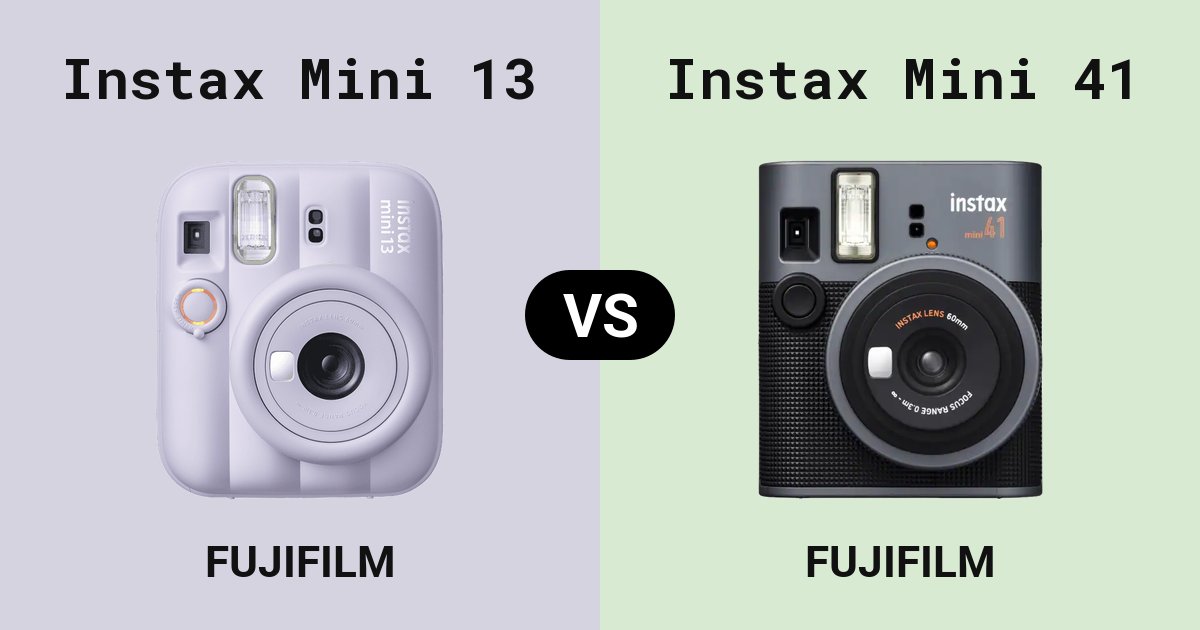
The Instax Mini 13 and Mini 41 share a lens, automatic exposure and film. The Mini 13 adds a self-timer and costs less; the Mini 41 has the black retro body. Buy the Mini 13.
The difference is the self-timer, the body and the price. The Mini 13 has a timer and costs less; the Mini 41 has the black retro body. Both use the same lens, automatic exposure and film. The Mini 13 is Fujifilm’s 2026 entry Mini, and the Mini 41 came out in 2025 as the classic-styled one.
What is actually different
Start with what you can’t change on either camera. Both use the same 60 mm f/12.7 lens. Both set exposure themselves between Lv 5.0 and 14.5 at ISO 800, with a 1/2 to 1/250 second shutter and a slow synchro mode for low light. Both have a flash that fires on every shot and adjusts its own output, with a recycle time of 7 seconds or less and a range of 0.3 to 2.2 m. Each has a selfie mirror and a close-up mode for 0.3 to 0.5 m with parallax correction, so close shots land where you framed them. Two AA batteries run either one for about 100 shots. Neither has manual exposure, bulb mode, double exposure or a tripod socket.
So if you were hoping the Mini 41 gives you more control, it doesn’t. TechRadar said it is hard to call the Mini 41’s pictures better than the Mini 12’s, because the lens and film are close to identical, and the Mini 13 shares that lens.
The self-timer is the one feature that splits them. The Mini 13 has a 2 second and a 10 second timer, set with the ring around the shutter button: twist once for 2 seconds, twist and hold for 10. Its wrist strap doubles as a wedge that tilts the camera up for timer shots. The Mini 41 has no timer. TechRadar listed that among its reasons to avoid it, so group shots mean handing the camera to someone else.
Then there’s the body. The Mini 41 has a textured body and comes in Vintage Black in the US. TechRadar described it as the “mature” alternative to the playful Mini 12 and summed it up as “Handsome looks, simple operation and great-looking photos, delivered fast.” It weighs 345 g. The Mini 13 is 327 g and comes in five colours: Dreamy Purple, Frost Blue, Candy Pink, Lagoon Green and Clay White. PCMag scored it 4 out of 5 and made it an Editors’ Choice for value shoppers.
If you are also weighing the Mini 12: it shares the same lens, exposure and film, has no self-timer, weighs 306 g and comes in five pastel colours. The Mini 12 vs Mini 13 and Mini 12 vs Mini 41 pages cover those pairs in full.
Price and film cost
The Mini 13 lists at $89.95 and the Mini 41 at $109.95. The Mini 41 is often found for about $105, so the gap is usually about $15. The Mini 12 is often found for about $85. Prices move, so check before you buy.
Film costs the same on both. Each takes Instax Mini film, 86 x 54 mm prints with a 62 x 46 mm image. A twin pack of 20 shots is often found for about $19, about $0.95 a shot. One twin pack costs more than the usual gap between the two cameras, and the film bill keeps coming whichever you pick.
Which one to buy
Buy the Mini 13. It has the same lens, exposure and film as the Mini 41, adds a self-timer and a stand for group shots, weighs a little less and costs less.
Buy the Mini 41 if you want the black retro body and don’t mind paying extra for it. You get the same camera in a different shell, so the look has to be the reason.
If you want to adjust brightness or switch the flash off, neither one will do it. The Mini 99 does both; the Mini 41 vs Mini 99 page compares it.
Where to buy
 Instax Mini 13List price $89.95Check price on Amazon
 Instax Mini 41List price $109.95Check price on Amazon
Specs side by side
Same on both: Analog instant camera · Current · Instax Mini film · 86 x 54 mm print · 62 x 46 mm image · about $0.95 a shot · Lens: 60 mm f/12.7, 2 components 2 elements · Exposure: automatic, Lv 5.0 to 14.5 (ISO 800) · selfie mirror · close-up mode · no double exposure · no bulb mode · no tripod socket · Shots per battery / prints per charge: 100 · App: instax UP!.
| Spec | Instax Mini 13 | Instax Mini 41 |
|---|---|---|
| Launched | 2026 | 2025 |
| Focus | fixed; 0.3 m and beyond; Close-up Mode 0.3 to 0.5 m with parallax correction | fixed; 0.3 m and beyond; close-up mode 0.3 to 0.5 m with parallax correction |
| Shutter | programmed electronic shutter, 1/2 to 1/250 s, slow synchro for low light | 1/2 to 1/250 s, slow synchro for low light |
| Flash | constant firing flash with automatic light adjustment; recycle time 7 s or less; effective range 0.3 to 2.2 m | auto, always fires, recycle 7 s or less, effective range 0.3 to 2.2 m |
| Self timer | Yes | No |
| Power | 2 x AA alkaline (LR6) or NiMH (HR6) | 2 x AA alkaline |
| Dimensions | 105.5 x 124.7 x 67.6 mm | 104.5 x 122.5 x 67.5 mm |
| Weight | 327 g | 345 g |
| Colours | 5 (Dreamy Purple, Frost Blue, Candy Pink, plus 2 more) | 1 (Vintage Black) |
| Price | List price $89.95 | List price $109.95 |
| Owner rating | n/a | About 4 out of 5 |
| Buy | Check price on Amazon | Check price on Amazon |
Specs from manufacturer pages; prices and ratings checked in November 2026.
What reviewers and owners say
Instax Mini 13
Published reviews of the Instax Mini 13:
- “This is a simple continuation of the insanely popular Fujifilm Instax Mini line of cameras and is adorable for the same reasons that the previous models were.” (Chris Niccolls, PetaPixel, 2026-03)
- “The Fujifilm Instax Mini 13 is the quintessential entry-level instant camera, making it easy to snap wallet-size instant pictures thanks to its one-button operation, selfie mirror, and convenient AA battery power.” (Jim Fisher, PCMag, 2026-03)
- “The Instax Mini 13 has a vibrant design, is easy to use, and doesn't cost much. If you need an instant camera in 2026, this is a great choice.” (Harish Jonnalagadda, Android Central, 2026-05)
Praised for: twist-the-lens operation is easy for kids and first-timers, new 2 s and 10 s self-timer plus the wedge stand make group shots practical, close-up mode framing matches the selfie mirror closely. Criticised for: flash fires on every shot and cannot be switched off, no tripod socket and no double-exposure mode, nothing new for anyone who already owns a Mini 11 or Mini 12.
Instax Mini 41
Published reviews of the Instax Mini 41:
- “The Mini 41 is a fun, easy-to-use instant camera with a handsome design and a great price, continuing the Instax Mini tradition of simple point-and-shoot operation.” (TechRadar, 2025)
- “The Mini 41 is an extremely easy to use point-and-shoot instant camera, a really good choice if you're looking for something quick, fun and easy to use.” (Amateur Photographer, 2025)
- “The Mini 41 refines the Mini 40's formula with better parallax correction and automatic flash control in a similarly classic-looking body.” (Cameralabs, 2025)
Owners rate it about 4 out of 5 across hundreds of ratings.
Praised for: classic retro look feels more grown-up than the Mini 12, close-up mode framing is more accurate than earlier Minis. Criticised for: still no manual exposure control at this price, only one color available in the US.
Frequently asked questions
What is the difference between the Instax Mini 13 and Mini 41?
The self-timer, the body and the price. Both use a 60 mm f/12.7 lens, automatic exposure from Lv 5.0 to 14.5, a 1/2 to 1/250 second shutter, a flash that fires on every shot, two AA batteries and Instax Mini film. The Mini 13 has a 2 second and 10 second self-timer, weighs 327 g and comes in five colours. The Mini 41 has no self-timer, weighs 345 g and comes in Vintage Black in the US.
Does the Mini 41 have more exposure control than the Mini 13?
No. Both set exposure on their own between Lv 5.0 and 14.5 at ISO 800, and both adjust the flash output automatically. Neither has manual exposure, bulb mode, double exposure or a way to turn the flash off.
Does the Instax Mini 41 have a self-timer?
No. Fujifilm's spec sheet for the Mini 41 lists no timer, and TechRadar named the missing self-timer as one of its reasons to avoid it. The Mini 13 has a 2 second and a 10 second timer.
Instax Mini 12 vs 13 vs 41: which one should I get?
All three use the same lens, the same automatic exposure and the same film. The Mini 13 is the only one with a self-timer. The Mini 12 is usually the cheapest, often found for about $85, and comes in five colours. The Mini 41 costs the most, often found for about $105, and is the one to pick for the black retro body.
Do the Mini 13 and Mini 41 use the same film?
Yes. Both take Instax Mini film, which prints 86 x 54 mm with a 62 x 46 mm image. A twin pack of 20 shots is often found for about $19, about $0.95 a shot.