
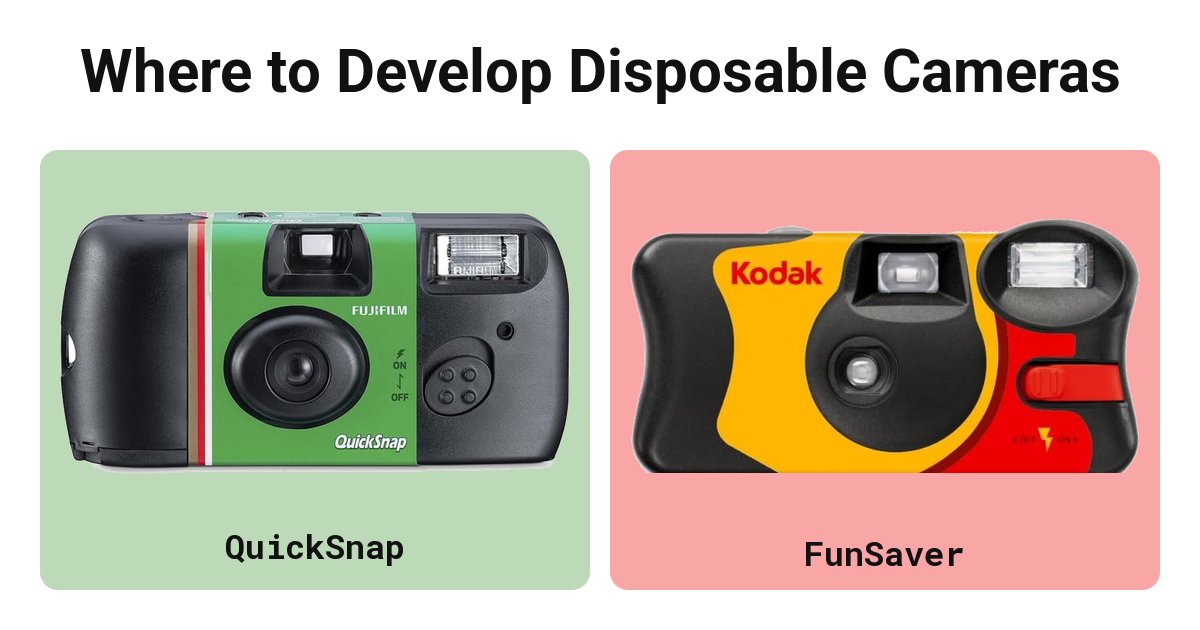
CVS, Walgreens and Walmart still develop disposable cameras, and all three send the film out. Target and Costco no longer do. Prices, wait times and negatives by store, checked November 2026.
Drop the camera at a drugstore or Walmart for 4x6 prints in about a week. Post it to a lab for scans and, in most cases, your negatives. Rite Aid is gone too.
The short answer
Store rows were checked on November 11, 2026 (CVS from an archived July 2026 copy of its page), and lab rows on October 14, 2026, from each store’s or lab’s own page unless noted. Shipping is extra unless the row says so.
| Where | Develops disposables? | Price for one disposable | Turnaround | Negatives back |
|---|---|---|---|---|
| CVS | Yes | Not on CVS’s page; about $15 a roll (PetaPixel) | 7 to 10 days (CVS) | Do not expect them |
| Walgreens | Yes | $15.99 for 24 exposures, photo CD included | 3 to 5 business days | No |
| Walmart | Yes, at stores with a photo center | Not on Walmart’s page; $10.96 for 27 exposures with prints (Shotkit) | About 6 days (Walmart) | No, per Shotkit |
| Target | No | n/a | n/a | n/a |
| Costco | No | n/a | n/a | n/a |
| The Darkroom | Yes, by mail | $17 with standard scans | 2 to 4 days in the lab, plus 2 to 6 days in the mail | Yes, always |
| Old School Photo Lab | Yes, by mail | $25, round-trip shipping included | 4 to 5 business days after arrival | Yes, shipping included |
| Mpix | Yes, by mail | $13.95 with standard scans | Scans online 1 to 3 days after arrival | Optional |
| Reformed Film Lab | Yes, by mail | $12 (small scans) to $23 (TIFF) | Not stated | Optional, $5.95 return shipping |
| Process One | Yes, by mail | $5.99 to develop, plus $8.99 for scans only | Usually starts 1 to 2 days after arrival | Yes, always |
Does CVS develop disposable cameras?
Yes. CVS’s film page says it develops 35mm film and disposable cameras and prints them on 4x6 photo paper, with orders ready in 7 to 10 days.
How it works. You drop the camera off at a CVS pharmacy. Not every store offers it, so CVS points you to its store finder to check first. CVS sends the film to an outside lab rather than developing it in the store, according to Kubus Photo (February 2026) and PetaPixel. Kubus says the wait often runs 10 to 14 business days in practice. Other film types, such as APS, 110, black and white and slide, take about three weeks by CVS’s own page.
Price. CVS’s film page does not list a price, so we cannot confirm one from CVS. PetaPixel (updated January 5, 2026) lists about $15 a 35mm roll. Kubus, a Brooklyn lab, says to expect $15 to $18 with 4x6 prints, and closer to $12 at some stores without prints. Ask at the counter before you leave the camera.
Negatives. CVS’s page does not say. PetaPixel says CVS does not return them, and Kubus says it varies by store: some return them, some only if you ask, some throw them away. If you want them, write the request on the envelope and do not count on it.
Checked: November 11, 2026. CVS’s site is blocked outside the US, so we read an archived copy of its film page from July 20, 2026.
Does Walgreens process disposable cameras?
Yes. The Walgreens Photo film page says it prints from film, negatives or a disposable camera, and it also lists 110 and APS film.
How it works. You drop the camera at a Walgreens photo counter. Call your store first to check it takes film. Walgreens does not develop in the store: The Darkroom reports that it ended in-house processing on April 16, 2015.
Turnaround and price. A banner on the Walgreens Photo page reads “$15.99 Film Processing per 24 exposures, 35mm film”, with a free photo CD of the images, ready for pickup in 3 to 5 business days. The banner does not say whether prints are included, or what a 27-exposure disposable costs.
Negatives. No. The same banner says orders “will not include negatives”.
Checked: November 11, 2026, on the Walgreens Photo film processing page.
Does Walmart still develop disposable cameras?
Yes, at stores with a photo center. Walmart’s photo site, now branded Walmart Custom Print, says it “can process your one-time use cameras & film”.
How it works. You take the camera to the photo center at your nearest Walmart. Shotkit says you put it in a developing envelope and fill in an order form. Walmart sends the film out: Shotkit (updated January 2025) says it stopped developing in-house in 2022.
Turnaround. Walmart says most orders are ready in about six days. Shotkit says it can take up to three weeks in practice.
Price. Walmart’s page lists no price. Shotkit quotes $10.96 for 27 exposures with single prints and $14.96 with double prints. Treat those as a guide, not a quote. Walmart’s page offers 4x6 or 5x7 prints and says a USB or CD of the images costs “a small extra charge”. Shotkit says the CD is included, so ask which applies at your store.
Negatives. Walmart’s page does not say. Shotkit says Walmart does not return them.
Checked: November 11, 2026, on the Walmart Custom Print film processing page.
Does Target develop disposable cameras?
No. Target does not offer film developing at any of its stores, according to Kubus Photo (February 2026), and Shutter Junkies says the same. Target still sells disposable cameras, so you can buy one there and take it to CVS, Walgreens, Walmart or a lab.
Checked: November 11, 2026. We could not find a statement on Target’s own site.
Does Costco develop disposable cameras?
No. Costco closed the photo centers in all its warehouses in mid-February 2021, according to Fox Business. Its email to members blamed “the continued decline of prints”. Kubus said in 2026 that Costco has not brought film developing back.
Checked: November 11, 2026.
Rite Aid is not an option either. It closed its last stores in late September 2025, so any guide that tells you to try Rite Aid is out of date.
Should you use a mail-in lab instead?
Yes, if you want digital files or your negatives. You post the camera, the lab develops it, and you download the scans. Most labs return the negatives, which the stores above do not promise. These prices were checked on October 14, 2026.
The Darkroom (San Clemente, California) charges $17 for a disposable with standard scans. Enhanced scans add $2 and super scans add $4 more, so $23 for the top tier. Standard scans are 1024x1536 pixels, enhanced 2048x3072, super 4492x6774. A set of 4-inch prints adds $10, 5-inch adds $18. The lab takes 2 to 4 days, plus 2 to 6 days for the mail to reach it, and there is no rush service. Negatives always come back cut and sleeved. Its FAQ says the prepaid label for sending film in is free; return shipping cost is not listed. The $17 price was still on its page on November 11, 2026.
Old School Photo Lab charges $25 all in: developing, scans and shipping both ways. Develop only, with negatives returned, is $18. Color film takes 4 to 5 business days after it arrives. Its page does not list scan resolution.
Mpix charges $13.95 a disposable with standard scans, and shipping is extra. Standard scans are 4.5 MB, good for prints up to 5x7; large scans are 18 MB. Scans go online 1 to 3 days after the camera arrives. You choose whether to get the negatives back by mail or have them discarded. Mpix also says it recycles disposable cameras after processing.
Reformed Film Lab prices by scan size: small $12, medium $15, large $18, TIFF $23. Single prints add $9, and develop only is $6. Negatives are optional, with a flat $5.95 return shipping per order, free over $125. The page does not state a turnaround.
Process One (Overland Park, Kansas) is the cheapest if you only want scans. Developing is $5.99, scans are $8.99 on their own or $4.99 with prints, and 4x6 prints are 49 cents each. Scans are 2400x3600 JPEGs by Dropbox, CD or USB. The lab says it always returns your negatives. Return shipping is not listed. Its develop and scan prices were still on its page on November 11, 2026.
Local camera shops
An independent camera shop or lab may be cheaper and faster than both. Total Photo in San Diego lists $7.50 for a disposable, and Latitude in Chicago lists develop-only in 3 business days. Search Google Maps for “film developing” and call before you go. Ask three things: do you return negatives, what size are the scans, and what is the price for a 27-exposure disposable.
How much it costs to develop a disposable camera
For one camera. Lab prices were checked on October 14, 2026, and store figures on November 11, 2026:
- Develop only, no scans or prints: $5.99 at Process One, $6 at Reformed Film Lab.
- At a store: $10.96 for 27 exposures with prints at Walmart (Shotkit, not Walmart’s own figure), about $15 for prints at CVS (PetaPixel), $15.99 for 24 exposures with a photo CD at Walgreens.
- Scans only: $12 at Reformed Film Lab (small scans), $13.95 at Mpix (shipping extra), $14.98 at Process One.
- Scans from a full-service lab: $17 at The Darkroom, $25 at Old School with shipping both ways.
- Scans and prints: $27 at The Darkroom with 4-inch prints.
Now add the camera. A single Fujifilm QuickSnap Flash 400 is often found for about $20. With The Darkroom’s standard scans, that is ($20 + $17) / 27, or about $1.40 a shot. From Walmart’s QuickSnap 2-pack ($14.94 a camera) with Process One scans, it is about $1.15 a shot before return shipping. Add Darkroom prints and it rises to about $1.75 a shot.
How long it takes
By their own pages, Walgreens takes 3 to 5 business days, Walmart about 6 days and CVS 7 to 10 days. Shotkit and Kubus report longer waits in practice at Walmart and CVS. Mail-in labs take 1 to 5 days once the camera arrives, plus the mail both ways.
Labs can still develop old film. Walgreens Photo says film can be processed past its expiration date and typically lasts several years past it, depending on how it was stored. Expect the colors to shift.
Developing at home: the C-41 reality
Color film from a disposable uses the C-41 process. The common home kit is the CineStill Cs41 liquid kit, $32.99 for a quart at Freestyle. Retailers say it can develop up to 24 rolls if you add 2% to the developer time for each roll, at 102°F. We have not checked those figures against CineStill’s own instructions.
You also need a daylight developing tank and reels, a changing bag to crack the camera open in the dark, a thermometer, a warm water bath, and a way to scan the negatives.
The kit alone costs more than one $15 to $25 lab order, before the tank, reels and scanner. Home developing only pays off if you shoot a lot of film.
Or skip the wait: instant cameras
If the week-long wait is the problem, an instant camera has none. An Instax Mini print develops in about 90 seconds, according to Fujifilm. A Polaroid i-Type print takes 10 to 15 minutes. There is no lab and no postage.
It can also cost less per shot. Instax Mini film works out at about $0.95 a shot, against about $1.15 to $1.75 for a disposable once developed. The trade-offs: you buy the camera first (an Instax Mini 13 lists at $89.95), the print is smaller (a 62 x 46 mm image against a 4x6 lab print), and you get no negatives or scans. At the single QuickSnap and Darkroom price, the Mini 13 pays for itself after about 200 shots.
Our disposable camera vs instant camera guide runs the full numbers, and our best instant camera guide picks the camera. If you already have scans and want prints at home, see our best portable photo printers.
FAQ
How much does it cost to develop a disposable camera?
About $11 to $18 at a store, $12 to $25 for scans from a mail-in lab, and from $5.99 for developing only. Walmart and CVS do not publish their prices, so the store figures come from Shotkit and PetaPixel. Old School Photo Lab’s $25 includes shipping both ways; most other labs charge return shipping on top.
Is CVS or Walgreens cheaper for developing disposable cameras?
They are close: about $15 a roll at CVS (PetaPixel) and $15.99 for 24 exposures at Walgreens. Walgreens says it does not return negatives, and you should not expect them from CVS either.
Which store develops disposable cameras fastest?
Walgreens, at 3 to 5 business days by its own page. Walmart says about 6 days and CVS says 7 to 10. A mail-in lab can be quicker once the camera arrives, but the post adds days each way.
Can I develop 35mm film at Walgreens?
Yes, at stores that offer film processing. The $15.99 price on its page is for 24 exposures of 35mm film, and Walgreens also lists 110 and APS film.
Is it cheaper to develop film at home?
Not for one or two rolls. A CineStill Cs41 kit is $32.99 before the tank, reels, changing bag and scanner, while a lab charges $15 to $25 a camera. Home developing makes sense only if you shoot many rolls.
Related reading
- Where to Buy Disposable Cameras in 2026 (and Which Store Is Cheapest)
- Disposable Cameras for Weddings: Real Costs, Common Problems and the Instant Option (2026)
- Best Disposable Cameras 2026: 6 Picks and What They Really Cost
- Disposable Camera vs Instant Camera (Polaroid, Instax): Cost, Wait and Prints Compared
- Best Instant Camera 2026: 7 Picks From Instax to Polaroid