
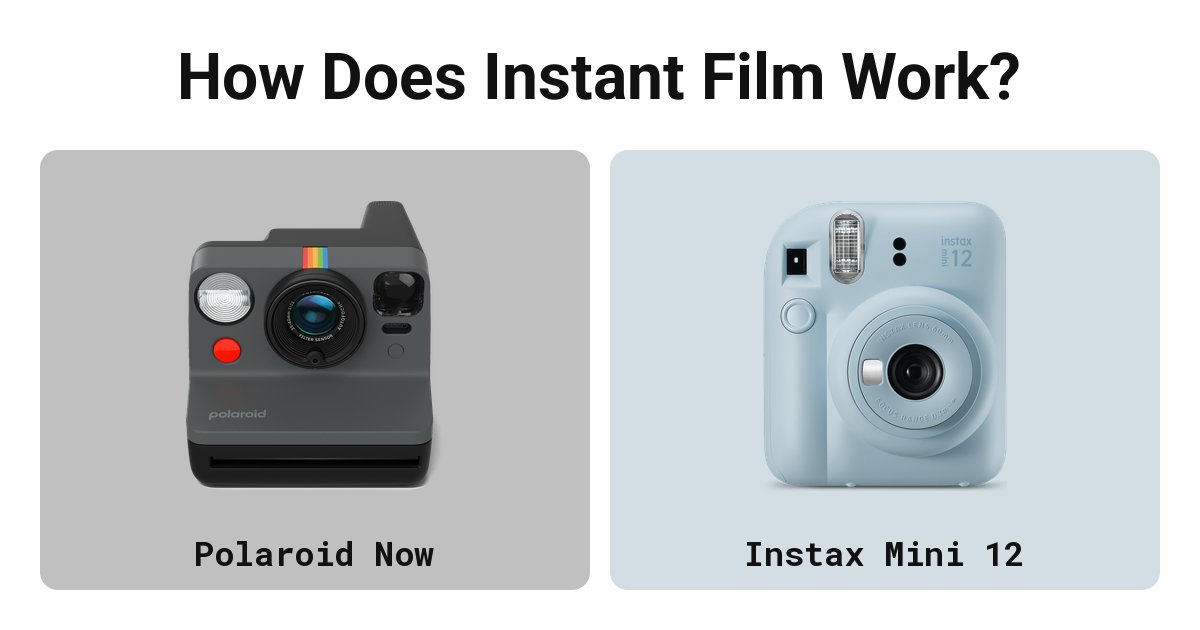
Instant film carries its own darkroom. When a sheet leaves the camera, two rollers burst a small pod of developer and spread it across the picture, and the image appears over the next few seconds or minutes.
Polaroid and Instax both work this way, though their sheets are built differently. Zink, the paper in the Polaroid Snap and many pocket printers, is not instant film at all. This page explains all three.
The short answer
You press the shutter and light exposes a light-sensitive negative inside the sheet. As the sheet comes out, rollers squeeze a pod of chemistry at one edge and push it across the frame. A dark layer in that chemistry blocks light from the outside while the developer works, and the picture comes through as that layer clears.
What happens when you press the shutter
Polaroid’s support article on how its film works sets out the steps for its integral film:
- When you load a pack, the camera pushes out the darkslide, the black card that protects the film in the pack.
- When you press the shutter, the lens projects the image through the clear front cover of the sheet onto a silver halide negative.
- The camera pushes the sheet out between two rollers. The rollers break a pod of reagent at the bottom of the frame and spread it over the picture.
- The reagent develops the negative, and the colour image forms from dyes in at least three layers: cyan, yellow and magenta.
Polaroid lists what is in that reagent: a white pigment, opacifying dyes, an alkali, water and a polymer thickener.
Inside a sheet of Polaroid film
Polaroid film is integral film. Everything needed to expose, develop and finish the picture sits inside one sealed sheet.
Light comes in through a clear cover sheet on the front and lands on the silver halide negative, and the colour comes from cyan, yellow and magenta dye layers inside the sheet. The pod of reagent sits in the bottom border, which is why that border is so much thicker than the other three.
The reagent also carries an opacifier, a dark layer that shields the negative from light once the sheet is outside the camera. Wikipedia’s article on instant film describes how Edwin Land’s opacifier darkens as the print ejects, then clears as development finishes.
Polaroid notes one practical effect: current film is thicker than the old film, so a pack now holds 8 sheets instead of 10. A vintage camera’s counter still starts at 10.
Why Polaroid needs a film shield and Instax does not
Polaroid film is still sensitive to light for the first seconds after it leaves the camera. Polaroid’s support page says the film shield, the flap that covers the slot, is there to give the blue opacification layer time to spread over the whole frame. Every new and refurbished camera Polaroid sells has one fitted.
When the opacifier does not cover the frame in time, Polaroid says you get blue, flame-shaped marks along the bottom edge. It lists the causes as dirty rollers, no shield, and expired or badly stored film. Polaroid calls dirty rollers the most common source of film defects and says to check them before every pack.
Instax film handles this differently. Fujifilm says the developer in each Instax sheet is black, which turns the sheet into a “mini darkroom” as soon as it is spread. Light also hits the back of an Instax sheet, not the front. So an Instax camera needs no shield, and you can look at the print as it develops.
How Instax film differs
Fujifilm’s Instax technology page gives the main facts:
- Each sheet has 18 layers and is tens of micrometres thick.
- Every photo has its own developer pod, spread by a roller as the sheet ejects.
- The developer is black, which keeps light out while the image forms.
- The frame at the top of the sheet absorbs excess developer.
- The image appears over about 90 seconds.
- Instax uses silver halide, and the finished prints are water resistant.
Wikipedia’s instant film article explains the structural difference. There are two kinds of integral film. In Polaroid’s SX-70 design, you expose and view the picture from the same side. In Kodak’s design, you expose it from the opposite side. Fujifilm’s integral films developed “similar to Kodak’s with the back layer first”, which is why Instax takes the light through the back of the sheet.
Instax and Polaroid formats do not swap. Instax film comes in Mini, Square and Wide sizes and fits Instax-format cameras and printers, including some from other brands, but no Polaroid camera. Our Instax vs Polaroid page compares the two systems, and Instax Mini vs Square vs Wide covers the three Instax sizes. Every format’s print and picture size is on our instant film sizes page.
Peel-apart film: how it used to work
Before integral film, most instant pictures came on peel-apart film. The negative and the positive print were separate sheets that went through the rollers together. You pulled the pair out of the camera, waited for it to develop, then peeled the negative away from the print.
Polaroid and Fujifilm no longer make it. Polaroid’s support site says it does not make peel-apart film, including Type 100, Type 80 and 4x5, and it does not make roll film, 35 mm instant film, Spectra/Image film or 500 film either. Fujifilm stopped making its FP-100C peel-apart film in 2016, according to Wikipedia.
Today Polaroid makes five integral formats: Go, 600, i-Type, SX-70 and 8x10. Packs of 600 and SX-70 film carry a battery that powers the camera. i-Type packs do not, because i-Type cameras have their own battery. Our Polaroid i-Type vs 600 film page goes through which film fits which camera.
Zink is not instant film
A Zink sheet has no chemistry and no negative, and nothing develops. Wikipedia’s article on Zink describes three layers of colourless dye crystals in the paper: yellow at the top, magenta in the middle and cyan at the bottom. A print head heats the paper with pulses of different lengths and temperatures, and each pulse melts the crystals in one layer into colour. There is no ink cartridge.
That is how the Polaroid Snap works. It is a 10 MP digital camera with a built-in Zink printer that makes 2x3-inch sticky-backed prints. It launched in 2015 at $99, stores pictures on a microSD card and has no screen on the back, according to PetaPixel and Photography Blog. Polaroid’s support site says the Snap and Zink paper have their own support site, separate from its film.
Many pocket phone printers use Zink too, such as the HP Sprocket, Kodak Step and Canon Ivy 2, and the print comes out finished. To choose between Zink and real instant film, read Instax vs Zink.
Polaroid vs Instax vs Zink at a glance
| Polaroid (i-Type, 600, SX-70, Go) | Instax (Mini, Square, Wide) | Zink 2x3 | |
|---|---|---|---|
| What makes the image | Light on a silver halide negative, developed by a reagent pod | Light on a silver halide negative, developed by a black reagent pod | Heat melts dye crystals in the paper |
| Develop time | Colour 10 to 15 min, B&W 5 to 10 min | About 90 seconds | None; it prints finished |
| Light-sensitive after it ejects | Yes, for the first seconds; needs the film shield | No; the black developer keeps light out | No |
| Print size | 88 x 108 mm (Go: 54 x 67 mm) | Mini 54 x 86 mm, Square 72 x 86 mm, Wide 108 x 86 mm | 2 x 3 in |
| Cost per shot | i-Type $2.37, 600 $2.62, SX-70 $2.75, Go $1.36 | Mini $0.91, Wide $1.40, Square $1.57 | $0.48 to $0.58 |
Develop times come from polaroid.com product pages and instaxus.com film pages, checked October 14, 2026. Print sizes come from Polaroid’s support site and instaxus.com. Costs per shot come from our product records at regular Amazon and B&H prices, checked between September 10 and October 5, 2026. Our page on how long Polaroids take to develop has the time for every film.
How a disposable camera differs
A disposable camera does not make a print at all. It shoots ordinary 35 mm negative film, the same kind a regular film camera uses, and nothing happens to that film until a lab develops it. You see your pictures days later, or after about an hour at some labs, as prints or scans.
Instant film carries its own developer, so the print is in your hand within minutes, and each shot gives you one original print with no negative. Our disposable camera vs instant camera page compares the two.
A short history
- 1947: Edwin Land introduced the instant process.
- 1948: The Polaroid Model 95, the first consumer instant camera, went on sale. Polaroid roll film ran from 1948 to 1992.
- 1972: Polaroid announced the SX-70 in April. It ejected each print automatically, and prints developed fully within 10 minutes. It was made until 1981.
- 1998: Fujifilm introduced Instax on 10 November.
- 2008: Polaroid announced in February that it would end all instant film production.
- 2016 and 2017: Fujifilm added Instax Mini Monochrome in 2016 and Wide Monochrome in 2017, and stopped making FP-100C peel-apart film in 2016.
- 2017: The Impossible Project acquired Polaroid’s formats and trademarks and renamed itself Polaroid B.V.
These dates come from Wikipedia’s articles on instant film, the Polaroid SX-70 and Instax.
More on instant film
- Do you shake Polaroid pictures? No, and both Polaroid and Fujifilm say why.
- How long do Polaroids take to develop? Every film type, and what cold does.
- Does instant film expire? Shelf life and storage for Polaroid and Instax.
- How to take good Polaroid pictures Light, flash, distance and temperature.
- Polaroid picture ideas What to shoot.
- How to display Polaroid pictures Walls, frames and albums.
- Cheap instant film Cost per shot for every format.
- Polaroid frame template A printable frame.
If you have not picked a camera yet, start with our best instant camera guide.
FAQ
Do you have to buy film for a Polaroid camera?
Yes. A Polaroid camera makes nothing without film, and each pack holds 8 shots. The Go takes Go film, and the other formats depend on the camera; our i-Type vs 600 film page explains which fits which.
Do Polaroid cameras need batteries?
Current Polaroid cameras such as the Now, Flip, I-2 and Go have a built-in rechargeable battery. Vintage 600 and SX-70 cameras have no battery of their own; they run on the battery inside each film pack.
Is Instax a Polaroid?
No. Fujifilm makes Instax. The film works the same way in principle, but the formats do not fit each other’s cameras. People often call any instant print a “polaroid”, which is where the mix-up comes from.
Does a Polaroid Snap use instant film?
No. The Snap is a digital camera that prints on Zink paper with heat. There is no developer and nothing to wait for.
Why is the bottom border of a Polaroid thicker?
It holds the pod of developer. Polaroid’s support site says the rollers break the pod at the bottom of the frame and spread it upward over the picture.
Can you take a picture of a phone screen with a Polaroid?
Yes, but glare and exposure make it hit and miss. If you want to print phone photos on Polaroid film, a printer built for it, such as the Polaroid Lab in our best portable photo printer guide, is the better tool.
Related reading
- Instax vs Polaroid: Which Instant Camera Should You Buy? (2026)
- Instax vs Zink: Which Instant Print Should You Choose? (2026)
- How Long Do Polaroids Take to Develop? Every Film Type, Including Instax
- Do You Shake Polaroid Pictures? No, and Here Is Why
- Does Instant Film Expire? Polaroid and Instax Shelf Life and Storage