
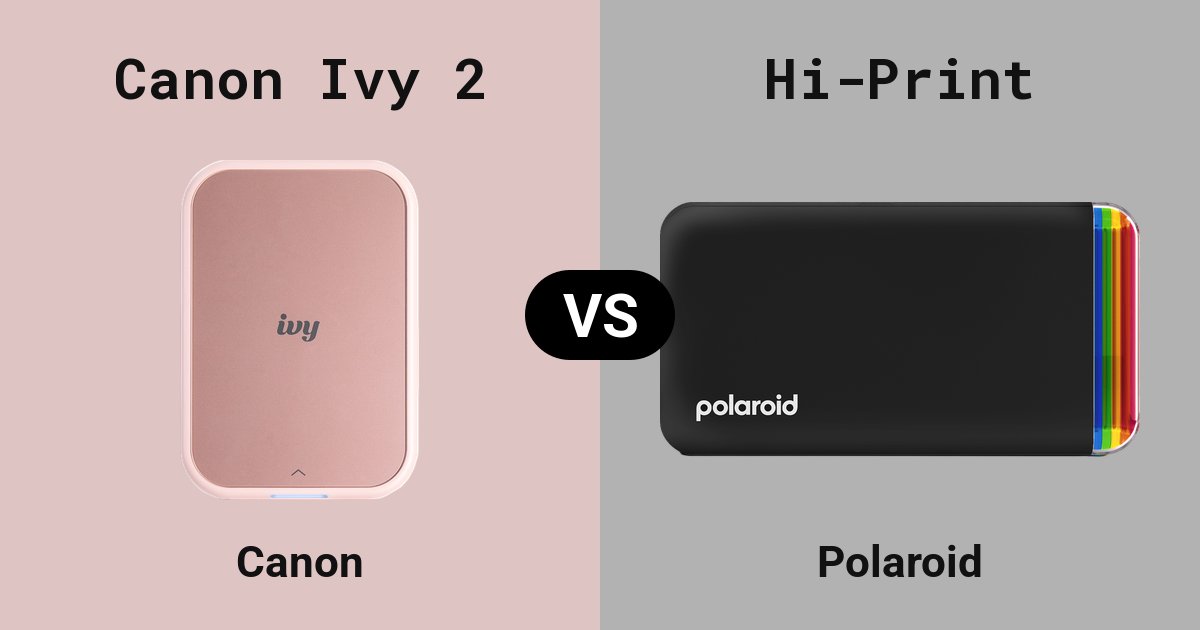
The Ivy 2 prints on ZINK paper at about 60 cents a sheet; the Hi-Print uses a dye-sub cartridge at about 85 cents for a larger, longer-lasting print. Buy the Ivy 2 unless print quality comes first.
The Canon Ivy 2 and the Polaroid Hi-Print Generation 2 look like the same product: a pocket printer that pairs with your phone over Bluetooth and turns out small sticky-backed photos. They print in different ways, though, and that decides what you pay per print and how the photos look.
What is actually different
The print technology is the real split. The Ivy 2 is a ZINK printer, short for zero ink. The colour is in the paper itself, so a pack of Canon ZINK paper is the only thing you ever buy. The Hi-Print is a dye-sublimation printer. It takes a 10-sheet Polaroid paper cartridge and prints by dye diffusion thermal transfer, feeding the sheet in and out four times per print.
You can see it in the photos. Reviewers agree the Ivy 2 makes the best-looking ZINK prints in the 2x3 class, a clear step up from the original Ivy, but that ZINK detail and dynamic range still trail dye-sub. Colours on the Ivy 2 can lean cool, deep blues suffer, and TechGearLab found some prints look overly filtered. Dye-sub prints from the Hi-Print come out dry, smudge-proof and water-resistant. Reviewing the first Hi-Print, which uses the same cartridge, The Gadgeteer said the prints were sharper and more vibrant than ZINK rivals and will not fade over time. The Hi-Print is not flawless either: some owners find its colours flatter than their phone screen.
The Hi-Print also makes a bigger print, 86 x 54 mm against 76 x 51 mm for the Ivy 2. Both have a peel-off sticker back.
The Ivy 2 wins on speed and size. Canon rates it at about 50 seconds a print. Polaroid quotes about 60 seconds for the Hi-Print, and Tech Advisor measured about 80. The four passes also make the Hi-Print warm after a print. At 119 x 84 x 20 mm, the Ivy 2 is shorter and thinner than the Hi-Print, which measures 149.8 x 79.5 x 26.9 mm and weighs 255 g.
Elsewhere they match. Each is rated for about 20 prints a charge, though Tech Advisor’s Britta O’Boyle got about 10 from the Hi-Print. Both charge over USB-C, the Ivy 2 in about 45 minutes and the Hi-Print in under an hour, with no cable in the Hi-Print’s box. Both print only from a phone over Bluetooth, not from a computer. The Ivy 2’s Canon Mini Print app is the more capable of the two: it can split one photo across four or nine sheets that you stick together into a bigger picture.
Price and paper cost
The Ivy 2 lists at $119.99 and the Hi-Print Gen 2 at $109.99, so the Hi-Print is $10 cheaper to buy. Both are often found for less, about $100 for the Ivy 2 and about $90 for the Hi-Print, and the gap stays about the same.
Paper reverses that. A 50-sheet pack of Canon ZINK paper is often found for about $30, which is about 60 cents a print. Canon’s 100-sheet pack, usually around $50, brings it down to about 50 cents. Polaroid’s 20-sheet pack of Hi-Print cartridges lists at $16.99, about 85 cents a print. The cartridges do go on sale, so the gap narrows if you catch a discount.
At those prices, every print costs about 25 cents more on the Hi-Print. The Ivy 2 makes back its higher price after about 40 prints. By 100 prints the paper alone comes to about $60 on the Ivy 2 and about $85 on the Hi-Print, and the Ivy 2 owner is about $15 ahead overall.
Which one to buy
Buy the Canon Ivy 2 if you print often, for journals, stickers, party prints or tiled collages. It costs less per sheet, it is quicker, it is thinner, and its app does more. William Harrel at PCMag called it “an excellent smartphone companion for little on-the-go pics”. Owners often rate it about 4.5 out of 5.
Buy the Polaroid Hi-Print if the print itself matters most. You get a larger photo, dye-sub colour that reviewers rate above ZINK, and a print that does not fade the way ZINK does, for about 25 cents more a sheet and a slower, warmer printer. RTINGS said the print quality is not terrible for wallet and fridge photos, “but be aware that the recurring costs are quite high.”
Where to buy
 Canon Ivy 2 Mini Photo PrinterList price $119.99Check price on Amazon
 Polaroid Hi-Print 2x3 Generation 2List price $109.99Check price on Amazon
Specs side by side
Same on both: Instant photo printer · Current · Shots per battery / prints per charge: 20.
| Spec | Canon Ivy 2 Mini Photo Printer | Polaroid Hi-Print 2x3 Generation 2 |
|---|---|---|
| Launched | 2022 | 2024 |
| Film or media | Canon ZINK 2x3 sticky-backed photo paper | Polaroid Hi-Print 2x3 cartridge |
| Print size | 76 x 51 mm | 86 x 54 mm |
| Film cost per shot | about $0.60 | about $0.85 |
| Power | Internal rechargeable lithium-ion battery, USB-C charging, roughly 45 minutes to full | Internal lithium-ion battery, 620 mAh, 7.4 V nominal, 4.588 Wh, USB-C charging in under 1 hour (no cable supplied) |
| Print resolution | 313 dpi | n/a |
| Print time | 50 s | 60 s |
| Connectivity | Bluetooth 5.0 only | Bluetooth 2.1 + EDR and Bluetooth 5.0 |
| App | Canon Mini Print app (iOS and Android) | Polaroid Hi-Print app (iOS 16.0+, Android 7.0+) |
| Dimensions | 119 x 84 x 20 mm | 149.8 x 79.5 x 26.9 mm |
| Weight | n/a | 255 g |
| Colours | 2 (Pure White, Blush Pink) | 2 (White, Black) |
| Price | List price $119.99 | List price $109.99 |
| Owner rating | About 4.5 out of 5 | About 4 out of 5 |
| Buy | Check price on Amazon | Check price on Amazon |
Specs from manufacturer pages; prices and ratings checked in October 2026.
What reviewers and owners say
Canon Ivy 2 Mini Photo Printer
Published reviews of the Canon Ivy 2 Mini Photo Printer:
- “Canon's improved Ivy 2 Mini prints good-looking photos and stickers at competitive running costs, making it an excellent smartphone companion for little on-the-go pics.” (William Harrel, PCMag, 2023-01)
- “An excellent gadget for crafters as well as anyone who wants to print, and stick, photos right from a smartphone.” (Hillary K. Grigonis, Pocket-lint, 2024-09)
- “It offers a great deal of enjoyment and proves to be budget-friendly without any extra maintenance costs, with consistent performance, speedy printing and a feature-filled app, though some prints look overly filtered.” (Genaveve Bradshaw, TechGearLab, 2023-09)
Owners rate it about 4.5 out of 5 across thousands of ratings.
Praised for: much better colour and detail than the original Ivy, very small and light, smaller than a phone, USB-C charging, full in about 45 minutes, app tiling splits one image across four or nine sheets, peel-and-stick backing for journals and planners. Criticised for: ZINK output still trails dye-sub rivals on fine detail, colours can lean cool, and deep blues suffer, about 20 prints per charge, Bluetooth only, phone only, no computer printing, lists higher than the Kodak Step for similar output.
Polaroid Hi-Print 2x3 Generation 2
Published reviews of the Polaroid Hi-Print 2x3 Generation 2:
- “The print quality isn't terrible for small pictures that you keep in a wallet or stick on a fridge door, but be aware that the recurring costs are quite high.” (RTINGS.com, 2024-10)
- “As an everyday printer for capturing and sharing moments, the Polaroid Hi-Print Generation 2 is a solid and enjoyable choice, even if the battery only lasts about 10 prints and neither paper nor a USB-C cable comes in the box.” (Britta O'Boyle, Tech Advisor, 2026-05)
- “Ranking the Hi-Print alongside the Kodak Mini 2 Retro, she calls them both solid and dependable printers, slightly below the Canon Selphy QX20 and the Instax Mini Link 3.” (Alison Winterroth, 2025)
Owners rate it about 4 out of 5 across hundreds of ratings.
Praised for: flat, crisp prints that people prefer to Instax, peel-and-stick backing suits journaling and scrapbooking, easy to load cartridges and reliable Bluetooth pairing, small and light enough to live in a bag, simple, bug-free app. Criticised for: paper cartridges are expensive and only hold 10 sheets each, some units jam on the first prints, colours can look less vibrant than the phone screen, battery only lasts a handful of prints in some hands, neither paper nor a USB-C cable is in the box.
Frequently asked questions
Is the Canon Ivy 2 better than the Polaroid Hi-Print?
It is cheaper to run and quicker, but the Hi-Print makes the better print. The Ivy 2 prints on ZINK paper at about 60 cents a sheet and takes about 50 seconds. The Hi-Print uses dye-sublimation cartridges at about 85 cents a sheet and takes about 60 seconds by Polaroid's figure. Reviewers say ZINK detail and dynamic range trail dye-sub, and The Gadgeteer found the first Hi-Print's dye-sub prints will not fade over time.
What is the difference between ZINK and dye-sublimation?
ZINK paper carries the colour in the sheet itself, so the Canon Ivy 2 needs nothing but paper. The Polaroid Hi-Print uses a paper cartridge and prints by dye diffusion thermal transfer, feeding the sheet in and out four times per print. Dye-sub prints come out dry, smudge-proof and water-resistant.
How much does a print cost on the Ivy 2 and the Hi-Print?
About 60 cents on the Canon Ivy 2, from a 50-sheet pack of Canon ZINK paper, often found for about $30. About 85 cents on the Polaroid Hi-Print, from a 20-sheet pack of cartridges at Polaroid's $16.99 list price. Canon's 100-sheet pack, usually around $50, brings the Ivy 2 down to about 50 cents.
Do both printers make sticker prints?
Yes. Canon's ZINK paper for the Ivy 2 and Polaroid's Hi-Print 2x3 paper both have a peel-off sticky back, which is why both are popular for journaling and scrapbooking.
Which prints are bigger, Ivy 2 or Hi-Print?
The Hi-Print's. It prints 86 x 54 mm, against 76 x 51 mm for the Canon Ivy 2.
Related comparisons
- Canon Ivy 2 vs Instax Mini Link 3: Which Should You Buy? (2026)
- Polaroid Hi-Print Gen 1 vs Gen 2: Which Should You Buy? (2026)
- HP Sprocket vs Kodak Step: Which Should You Buy? (2026)
- Polaroid Hi-Print vs Instax Mini Link 3: Which Should You Buy? (2026)
- Kodak Mini 2 Retro vs Polaroid Hi-Print: Which Should You Buy? (2026)