
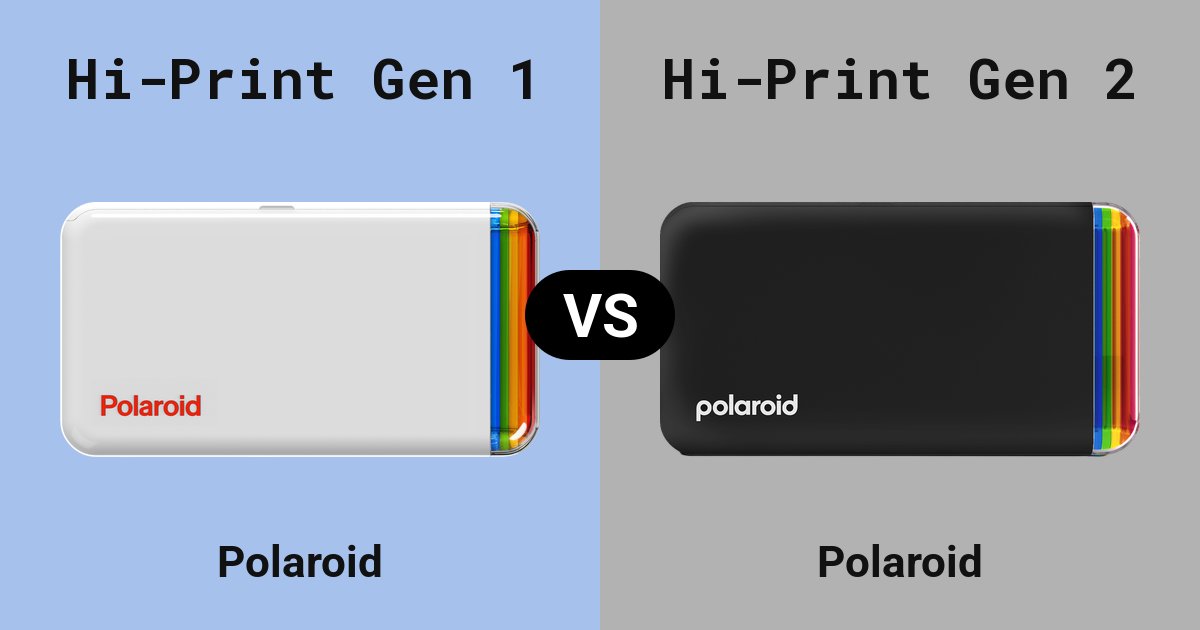
The Hi-Print Gen 2 keeps the Gen 1's print, paper, size and 20 prints a charge, and adds USB-C charging and newer Bluetooth. Buy the Gen 2: the Gen 1 is discontinued.
Polaroid launched the Hi-Print 2x3 pocket photo printer in 2020 and replaced it with the Generation 2 in 2024. The Gen 1 is now discontinued. Both print from your phone onto the same sticky-backed 2x3 paper, so the question is whether a used or leftover Gen 1 is worth buying over the current model.
What is actually different
Not much, and none of it touches the print. Both generations are dye-sublimation printers and take the Hi-Print 2x3 Paper Cartridge Polaroid sells today. Each print is made by dye diffusion thermal transfer in four passes, with the sheet fed in and out of the printer once per pass. The result is a flat print with a peel-off sticker back. Gen 2 prints come out dry, smudge-proof and water-resistant.
Polaroid’s figures for the two are close to identical. Each weighs 255 g. The Gen 1 measures 150 x 80 x 27 mm and the Gen 2 149.8 x 79.5 x 26.9 mm, the same body to within a millimetre. Both are rated at about 60 seconds a print and about 20 prints per charge, and both run the Polaroid Hi-Print app on iOS and Android.
The changes are in the plumbing. The Gen 1 charges over micro-USB in about an hour. The Gen 2 charges over USB-C in under an hour, though there is no cable in the box. The Gen 1 is listed as Bluetooth only; the Gen 2 supports Bluetooth 2.1 + EDR and Bluetooth 5.0, and Amazon buyers mention reliable pairing. The Gen 2 casing uses 30% recycled material.
The weak points carried over. Reviewers measured the Gen 1 at one minute twenty seconds a print, and Britta O’Boyle at Tech Advisor measured the Gen 2 at about 80 seconds, so neither hits Polaroid’s 60. Those four passes also leave both printers warm after a print. O’Boyle also found the Gen 2’s battery lasted about 10 prints, half the rated 20.
Reviewers like the output on both. Matthew Richards at Digital Camera World said the first Hi-Print gives “accurate yet vibrant colour” that closely matches Canon’s dye-sub printers. The Gadgeteer found its prints sharper and more vibrant than ZINK rivals and said they will not fade over time. For the Gen 2, Britta O’Boyle called it “a solid and enjoyable choice” as an everyday printer. RTINGS was cooler, warning that the recurring costs are quite high.
Paper and cost per print
The paper is the same on both. Polaroid sells one Hi-Print 2x3 Paper Cartridge, 10 sheets each, and lists it as compatible with all generations of the Hi-Print 2x3. A pack of two cartridges, 20 sheets, has a regular price of $16.99 on Polaroid’s US store, which is 85 cents a print on either printer. Amazon had the same pack at $12.10 on October 5, 2026, a sale at 29% off, so it pays to watch for discounts.
At the regular price, 100 prints cost $84.95 in paper. That is close to what the printer itself costs, and it repeats every hundred prints. Reviewers of both generations name cost per print as the main downside.
The printers themselves are where the prices split. At the October 5, 2026 price check the Gen 2 was $88.39 at Amazon, 20% off its $109.99 list price. The check found no standalone new Gen 1 for sale, only a third-party bundle of the printer with 40 sheets at $139.99. The Gen 1’s list price was $99.99 when it was current.
Which one to buy
Buy the Gen 2. It prints the same picture on the same paper at the same 85 cents a sheet, it charges over a USB-C cable you probably already own, and it is the model Polaroid still makes. At $88.39 new it also costs less than the Gen 1 bundle listing.
A Gen 1 makes sense only second hand and cheap. The paper, print size and speed carry over, so all you give up is USB-C and the newer Bluetooth. If you find one for well under the Gen 2’s street price, it will print just as well.
If you already own a Gen 1, keep it. The cartridges Polaroid sells now work in yours, so there is no paper reason to upgrade. And if speed or cost per print is what bothers you, the Gen 2 fixes neither.
Where to buy
 Polaroid Hi-Print 2x3 Pocket Photo PrinterDiscontinuedList $99.99Check price on Amazon
 Polaroid Hi-Print 2x3 Generation 2$88.39 (list $109.99)Check price on Amazon
Specs side by side
Same on both: Instant photo printer · Polaroid Hi-Print 2x3 cartridge film · 86 x 54 mm print · $0.85 a shot · Shots per battery / prints per charge: 20 · Print time: 60 s · Weight: 255 g.
| Spec | Polaroid Hi-Print 2x3 Pocket Photo Printer | Polaroid Hi-Print 2x3 Generation 2 |
|---|---|---|
| Status | Discontinued | Current |
| Launched | 2020 | 2024 |
| Power | Internal rechargeable lithium-ion battery, micro-USB charging, about 1 hour to full | Internal lithium-ion battery, 620 mAh, 7.4 V nominal, 4.588 Wh, USB-C charging in under 1 hour (no cable supplied) |
| Print resolution | 291 dpi | n/a |
| Connectivity | Bluetooth only | Bluetooth 2.1 + EDR and Bluetooth 5.0 |
| App | Polaroid Hi-Print app (iOS and Android) | Polaroid Hi-Print app (iOS 16.0+, Android 7.0+) |
| Dimensions | 150 x 80 x 27 mm | 149.8 x 79.5 x 26.9 mm |
| Colours | 1 (White) | 2 (White, Black) |
| Street price | n/a | $88.39 (checked October 5, 2026) |
| Amazon rating | 4.6 (489 ratings) | 4.1 (590 ratings) |
| Buy | Check price on Amazon | Check price on Amazon |
Specs from manufacturer pages; prices and ratings checked October 5, 2026.
What reviewers and buyers say
Polaroid Hi-Print 2x3 Pocket Photo Printer
Published reviews of the Polaroid Hi-Print 2x3 Pocket Photo Printer:
- “For small-format photo prints, the Polaroid does a good job of creating high-quality output in a simple and fairly speedy fashion, with accurate yet vibrant colour that closely matches the competing Canon dye-sub printers.” (Matthew Richards, Digital Camera World, 2022-07)
- “The printed photos are sharper, more vibrant and will not fade over time compared with other Zink printers, and the only real downside is that the price per print is significantly higher.” (The Gadgeteer, 2020-10)
- “She was pleased with the sharpness of the prints and liked the peelable sticker backing, but at one minute twenty seconds a print, a printer that got hot, bulky cartridge waste and a dollar a photo, the Instax stayed her favourite.” (bobo design studio, 2022-01)
- “The Hi-Print produces some of the best instant prints from a smartphone you can find, though heavy usage will set you back a pretty penny.” (Tech Advisor)
Amazon buyers rate it 4.6 out of 5 across 489 ratings.
Praised for: prints are sharper and more vibrant than any Zink rival of its era, dye-sub output does not fade the way Zink does, peel-and-stick backing, app is simple and looks good, prints are flat, unlike puffy Instax film. Criticised for: one minute twenty seconds a print, measured by more than one reviewer, the printer gets hot after a single print, cartridge packaging leaves a lot of plastic waste, close to $1 a print, film was only ever easy to find online.
Polaroid Hi-Print 2x3 Generation 2
Published reviews of the Polaroid Hi-Print 2x3 Generation 2:
- “The print quality isn't terrible for small pictures that you keep in a wallet or stick on a fridge door, but be aware that the recurring costs are quite high.” (RTINGS.com, 2024-10)
- “As an everyday printer for capturing and sharing moments, the Polaroid Hi-Print Generation 2 is a solid and enjoyable choice, even if the battery only lasts about 10 prints and neither paper nor a USB-C cable comes in the box.” (Britta O'Boyle, Tech Advisor, 2026-05)
- “Ranking the Hi-Print alongside the Kodak Mini 2 Retro, she calls them both solid and dependable printers, slightly below the Canon Selphy QX20 and the Instax Mini Link 3.” (Alison Winterroth, 2025)
Amazon buyers rate it 4.1 out of 5 across 590 ratings.
Praised for: flat, crisp prints that people prefer to Instax, peel-and-stick backing suits journaling and scrapbooking, easy to load cartridges and reliable Bluetooth pairing, small and light enough to live in a bag, simple, bug-free app. Criticised for: paper cartridges are expensive and only hold 10 sheets each, some units jam on the first prints, colours can look less vibrant than the phone screen, battery only lasts a handful of prints in some hands, neither paper nor a USB-C cable is in the box.
Frequently asked questions
What is the difference between the Polaroid Hi-Print Gen 1 and Gen 2?
Mostly the charging port and the Bluetooth. The Gen 2, launched in 2024, charges over USB-C in under an hour and supports Bluetooth 2.1 + EDR and Bluetooth 5.0. The Gen 1, launched in 2020, charges over micro-USB in about an hour. Both weigh 255 g, both print in about 60 seconds by Polaroid's figure, both manage about 20 prints a charge and both take the same Hi-Print 2x3 paper cartridge.
Do the Hi-Print Gen 1 and Gen 2 use the same paper?
Yes. Polaroid sells one Hi-Print 2x3 Paper Cartridge and lists it as compatible with all generations of the Hi-Print 2x3. Each cartridge holds 10 sticky-backed sheets, and a pack of two cartridges, 20 sheets, has a regular price of $16.99.
How much does a Polaroid Hi-Print print cost?
85 cents a print on either generation, based on the $16.99 regular price for 20 sheets on Polaroid's US store, checked October 5, 2026. Amazon had the same pack on sale for $12.10 that day, so watch for discounts.
Is the Polaroid Hi-Print Gen 1 discontinued?
Yes. Polaroid replaced it with the Generation 2 in 2024. The October 5, 2026 price check found no standalone listing for a new Gen 1, only a third-party bundle with 40 sheets of paper at $139.99.
Is the Polaroid Hi-Print slow?
Polaroid quotes about 60 seconds a print. Reviewers measured longer: Tech Advisor timed the Gen 2 at about 80 seconds, and reviewers of the Gen 1 measured one minute twenty seconds. The printer feeds the sheet in and out four times per print and gets warm afterwards.
Related comparisons
- Canon Ivy 2 vs Polaroid Hi-Print: Which Should You Buy? (2026)
- Polaroid Hi-Print vs Instax Mini Link 3: Which Should You Buy? (2026)
- Kodak Mini 2 Retro vs Polaroid Hi-Print: Which Should You Buy? (2026)
- Instax Mini Link 1 vs 2 vs 3: Which Should You Buy? (2026)
- HP Sprocket vs Polaroid Hi-Print: Which Should You Buy? (2026)