
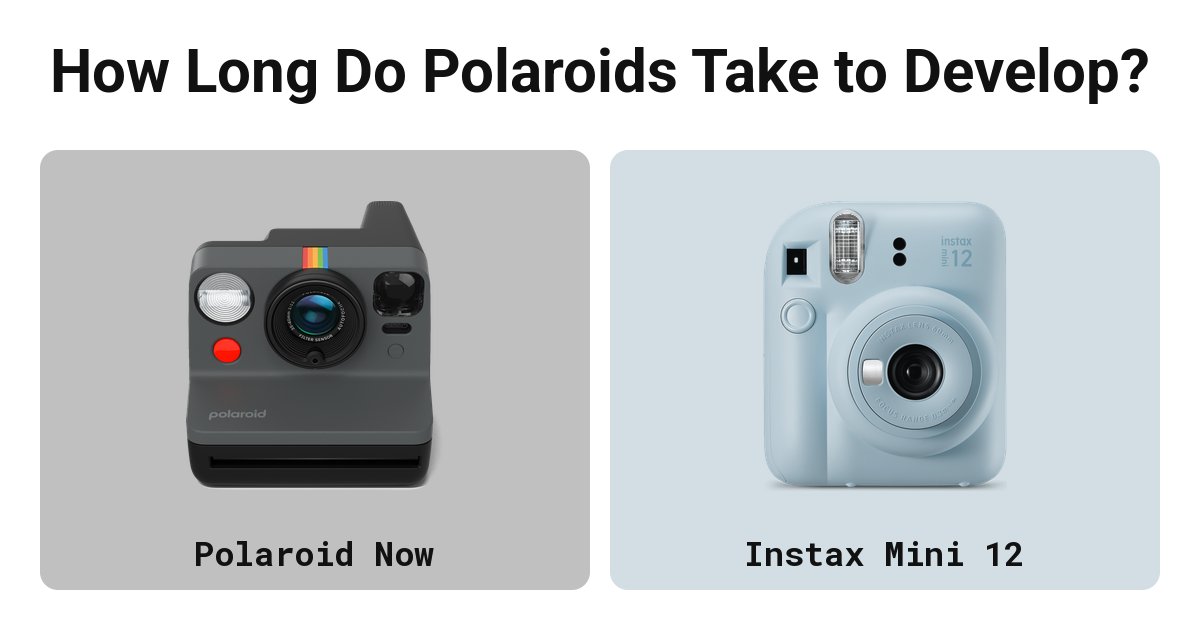
Polaroid colour film takes 10 to 15 minutes to develop, and Polaroid black and white film takes 5 to 10 minutes. Instax film takes about 90 seconds, in every size.
Those times assume normal room temperature. Cold slows both films down, and heat changes the colours. The times for every film, and what to do in the cold, are below.
Development time by film
| Film | Development time | Source |
|---|---|---|
| Polaroid Color i-Type | 10 to 15 min | polaroid.com product page |
| Polaroid B&W i-Type | 5 to 10 min | polaroid.com product page |
| Polaroid Color 600 | 10 to 15 min | polaroid.com product page |
| Polaroid B&W 600 | 5 to 10 min | polaroid.com product page |
| Polaroid Color SX-70 | 10 to 15 min | polaroid.com product page |
| Polaroid B&W SX-70 | 5 to 10 min | polaroid.com product page |
| Polaroid Go Color | 10 to 15 min | polaroid.com product page |
| Instax Mini (colour and Monochrome) | about 90 s | instaxus.com film page |
| Instax Square (colour and Monochrome) | about 90 s | instaxus.com film page |
| Instax Wide (colour and Monochrome) | about 90 s | instaxus.com film page |
All pages checked October 14, 2026. Polaroid did not list a black and white Go film on polaroid.com that day.
One small disagreement: an older Polaroid support article gives black and white as about 5 to 7 minutes. The current product pages say 5 to 10, so plan on up to 10.
Within each brand, the format makes no difference: i-Type, 600 and SX-70 colour film all take 10 to 15 minutes, and Instax Mini, Square and Wide all take about 90 seconds. Our Polaroid i-Type vs 600 film page explains how those Polaroid films differ in other ways.
Polaroid film used to be faster. The original SX-70 prints of 1972 developed fully within 10 minutes, according to Wikipedia. Polaroid’s support site says today’s film is “not back at the 5 minute development time” of the old film, and that current colour film is down to 15 minutes.
A disposable camera is slower still, because it needs a lab: that takes days, or about an hour at some labs. Instant film develops in your hand.
What happens in those minutes
A Polaroid print comes out of the camera covered by a dark blue layer called the opacifier. It protects the picture from light while the developer works. Polaroid’s film shield, the flap over the slot, covers the print for its first seconds so that layer can spread over the whole frame. Our page on how instant film works explains the layers.
Over the next few minutes the dark layer clears and the picture comes through. Black and white is done in 5 to 10 minutes. Colour takes 10 to 15.
Instax works faster and does not need hiding. Fujifilm says the developer is black, which makes each sheet a “mini darkroom”, and the image appears over about 90 seconds.
Shaking the print does not speed any of this up, and both makers say not to do it. See do you shake Polaroid pictures for why.
Temperature changes everything
Development is chemical, so temperature sets the pace. The two brands give different ranges, and they do not swap.
| Polaroid | Instax | |
|---|---|---|
| Working range | 13 to 28°C (55 to 82°F) | 5 to 40°C (41 to 104°F) |
| Too cold | Over-exposed, low contrast, colour cast | Keep the picture developing somewhere warm |
| Too hot | Yellow or red tint on colour film | Not covered on the pages we read |
| Source | support.polaroid.com | instaxus.com film pages, instax.eu |
Polaroid in the cold. Polaroid’s support site says below 13°C photos tend to come out over-exposed and low in contrast, with a colour cast. Polaroid’s own pages disagree on the colour of that cast. One support article says cyan or blue, another says green, and Polaroid’s winter film care blog says cold film gives photos a blue tint. Expect a cold blue-green look.
Polaroid in the heat. Above 28°C, Polaroid says colour photos develop with a yellow or red tint. Its hot weather advice is to cool the film in the fridge before going out, move the exposure slider toward darken, and let prints develop somewhere cool, such as in a cooler or under a cold drink, kept dry.
Instax. Every Instax film page on instaxus.com lists a working range of 5 to 40°C. Fujifilm’s European site adds that if you shoot below 5°C, you should keep the picture developing in a warm place.
Shooting in the cold: how to keep prints developing
Polaroid’s advice for winter, from its support site and its winter film care blog:
- Let the film settle to room temperature, around 20°C (68°F), before you shoot.
- Carry the camera close to your body so the film stays warm.
- After each shot, leave the print under the film shield for a few seconds.
- Then put it in an inside jacket pocket, close to your body, and keep it flat.
For Instax below 5°C, Fujifilm’s advice is the same idea: keep the print somewhere warm while it develops. A pocket works.
Is it done after 15 minutes?
The picture is done. The print is not quite. Polaroid’s support site says photos should not be compressed or sealed for the first 30 days, so they can dry out completely. Keep them out of albums and archival sleeves for a month, and leave new prints loose somewhere dry.
We found no matching drying period for Instax on Fujifilm’s pages.
Why your print is not developing
If a print stays dark, comes out blotchy or never looks right, the usual causes from Polaroid’s support pages are:
- Expired or badly stored film. Polaroid says to use its film within 12 months of the production date. Old film gives weak contrast, colour shifts and uneven development. Our page on whether instant film expires has the details.
- Dirty rollers. Polaroid calls dirty rollers the most common source of film defects and says to check them before every pack.
- No shield. Without the film shield, light hits the print before the opacifier covers it, and you get blue, flame-shaped marks along the bottom edge.
- Temperature. Outside 13 to 28°C, Polaroid says prints pick up a colour cast, and cold prints come out over-exposed and low in contrast.
Our guide to taking good Polaroid pictures covers light, flash and exposure problems.
FAQ
Do Polaroids need to develop in the dark?
They need shielding from bright light, mostly in the first seconds. Total darkness is not needed. Face down on a table or in a pocket is enough.
Can you make a Polaroid develop faster?
Not really. In the cold, keeping the print warm within Polaroid’s 13 to 28°C range helps it develop normally. Shaking does not help.
Why is my Instax taking longer than 90 seconds?
Most likely cold. Fujifilm says that below 5°C you should keep the picture developing somewhere warm.
Why did my Polaroid come out blue?
Cold film or cold air. Polaroid’s winter advice says cold film gives photos a blue tint. Let the pack reach room temperature before shooting and keep prints warm while they develop.
When can I put Polaroids in an album?
After 30 days, according to Polaroid. Until then, keep them loose so they can dry.
Related reading
- How Does Instant Film Work? Polaroid, Instax and Zink Explained
- Do You Shake Polaroid Pictures? No, and Here Is Why
- Does Instant Film Expire? Polaroid and Instax Shelf Life and Storage
- How to Take Good Polaroid Pictures (and Instax): Tips From the Makers
- Polaroid i-Type vs 600 Film: What Is the Difference? (2026)